
The battle for connected TV (CTV) and home entertainment is ultimately a battle over frictionless consumer attention. For years, major hardware developers treated the living room console as an isolated silo, a machine built strictly for core gaming. This rigid perspective ignored a fundamental rule of consumer behavior: the primary television is an integrated, multi-layered ecosystem, and whoever controls the default path to leisure wins an unfair economic advantage.
My long-standing loyalty to Fandango at Home was catalyzed by this exact corporate blind spot. When Microsoft abruptly terminated native movie and television options on the Xbox in July 2025, they broke a seamless consumer habit loop. The console does not sit in a vacuum; it occupies the physical center of the primary living room, not just a hidden game room. By forcing millions of ecosystem loyalists to open third-party applications just to rent a film on a Friday night, Microsoft willingly surrendered its non-gaming loyalty.
This created a massive distribution vacuum. In July 2026, Versant Media Group is executing an aggressive masterclass in M&A and product strategy to capture it.
The Macro Reality Check: The Collapse of Console Real Estate
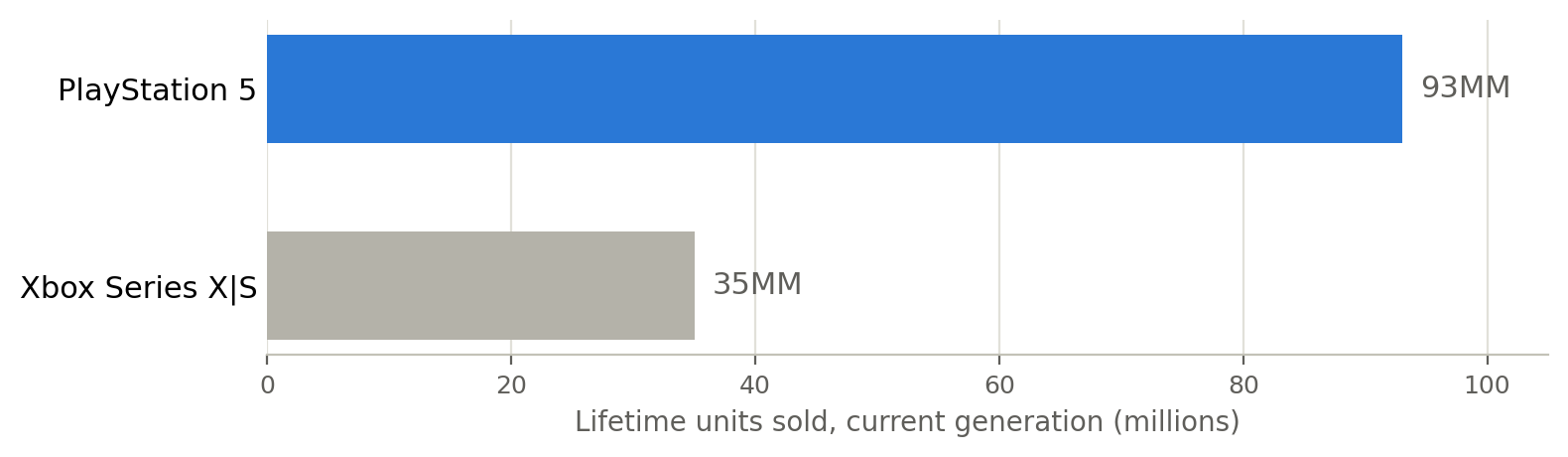
Microsoft’s retreat from living room media storefronts is not an isolated tactical shift; it reflects a much larger, systemic loss of footing in the core hardware race. Industry data compiled in July 2026 shows that Sony’s PlayStation 5 has completely dominated this console generation, surpassing 93MM lifetime units sold. In stark contrast, the Xbox Series X and S platforms have stalled at roughly 35MM units.
The hardware decline is accelerating rapidly:
- Microsoft shipped a mere 3.2MM Xbox consoles globally in all of last year.
- During the first quarter of 2026, quarterly Xbox shipments plummeted below 500,000 units for the first time on record.
- Stationary TV-connected consoles historically command a 75% share of the global console market, yet Xbox has seen its market share slide to near-single digits in major European and Asian sectors during peak seasonal windows.
By treating the console purely as a subscription box for heavy gamers, Microsoft surrendered the broader, passive media transaction fees that keep users locked into an ecosystem during their entertainment downtime.
The Strategic Inversion: Content as a Trojan Horse (The Netflix Play)
While legacy hardware providers retreat to narrow definitions of gaming, pure-play entertainment giants are executing the exact opposite playbook. Look at Netflix. Instead of manufacturing expensive, low-margin proprietary boxes, Netflix has spent years quietly using its massive streaming content footprint as a Trojan horse to conquer interactive entertainment.
By early 2026, Netflix reached over 325MM global paid subscribers and crossed 190MM monthly active users (MAUs) on its ad-supported tier. Rather than asking users to buy a new hardware unit, Netflix leveraged high-engagement video content to win the initial screen time, bundled mobile games into the baseline subscription at zero extra cost, and is now actively shifting to a cloud-first TV gaming strategy. They proved that content can successfully pull users into an interactive gaming ecosystem, bypassing traditional hardware restrictions entirely.
Versant’s July 2026 Multi-Tiered Offensive
Versant Media Group understands that the modern living room economy is driven by cross-monetization. In the span of a single month, Versant executed two massive, interconnected plays to secure a premium perimeter around the home screen:
- The Full Swing Acquisition (July 6, 2026): Versant completed a $530MM cash acquisition of Full Swing, the premier interactive sports technology and golf simulator platform heavily backed by Tiger Woods.
- The Fandango AVOD Overhaul (July 15, 2026): Versant announced a comprehensive reboot of Fandango, completely dropping the “at Home” sub-brand to transform the platform into a premium, free ad-supported streaming (AVOD) powerhouse. Led by digital platforms president Will McIntosh, the service is boosting its catalog by over 20%, injecting 3,500 hours of Versant-owned premium IP, and adding marquee live sports content like the German Bundesliga.
Deep Dive: What Tubi and Roku Did Right
The explosive growth of free streaming platforms completely validated Versant’s pivot. Incumbents like Tubi and The Roku Channel succeeded because they decoupled high-quality entertainment from the paywall, scaling eyeballs first and building sophisticated ad-tech engines second.
1. The Tubi Personalization Engine
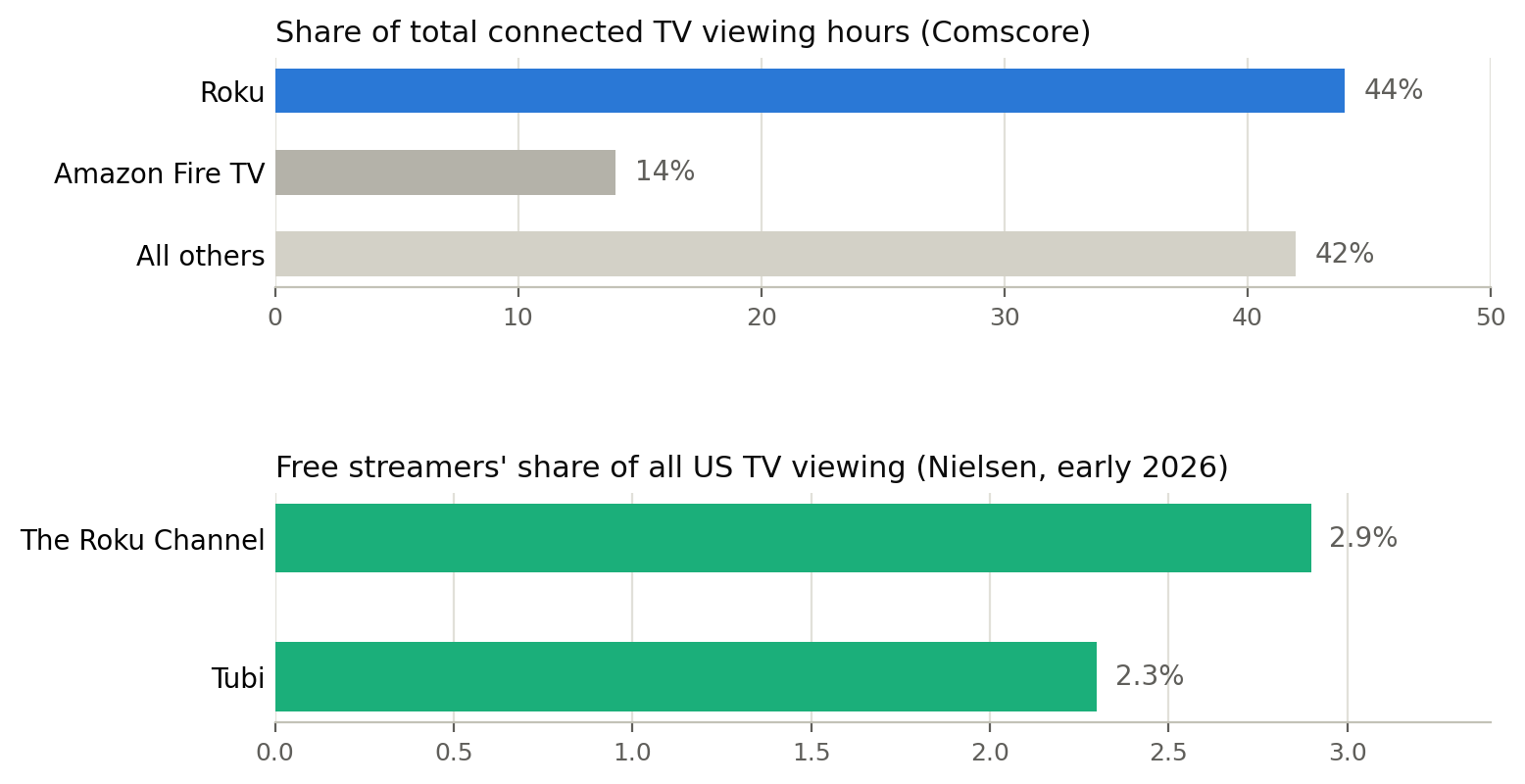
According to Nielsen’s expanded streaming measurement metrics from early 2026, Fox-owned Tubi captures 2.3% of all total US TV viewing and a commanding 6.2% share of all ad-supported streaming viewing.
- Scale: Tubi scaled past 100MM monthly active users by mid-2025.
- Ad Load Efficiency: Tubi runs a tight 4 to 6 minutes of ads per hour, spaced precisely every 12 to 15 minutes, limiting ad pods to a maximum of 3 spots to prevent ad fatigue.
- Audience Quality: Between 65% and 77% of Tubi’s audience are cord-cutters or cord-nevers, making them entirely unreachable via linear television networks.
2. The Roku Channel and Operating System Gatekeeper Status
Roku announced a historic milestone on April 16, 2026, officially surpassing 100MM active streaming households worldwide.
- Ecosystem Capture: Roku controls a dominant 55% market share of streaming devices in the United States, positioning its operating system as the default first screen consumers see.
- Engagement Dominance: Comscore data confirms Roku drives 44% of total hours spent viewing connected TV content, tripling the engagement of its closest competitor, Amazon Fire TV (at 14%).
- Monetization Yield: In 2025, Roku generated $2.4B in pure advertising revenue, an 13% year-over-year increase, while its free platform, The Roku Channel, expanded to hold a 2.9% share of total US TV viewing by February 2026.
Legacy transactional platforms missed this wave because they treated digital movie lockers as static, non-interactive utilities. The revamped Fandango aims to counter this by cross-leveraging its built-in audience of 50MM monthly unique transactional visitors, moving them seamlessly from premium theatrical rentals into a curated, lower ad-load streaming environment during their passive viewing hours.
The Strategic 2×2 Framework: Console vs. Living Room Ecosystem
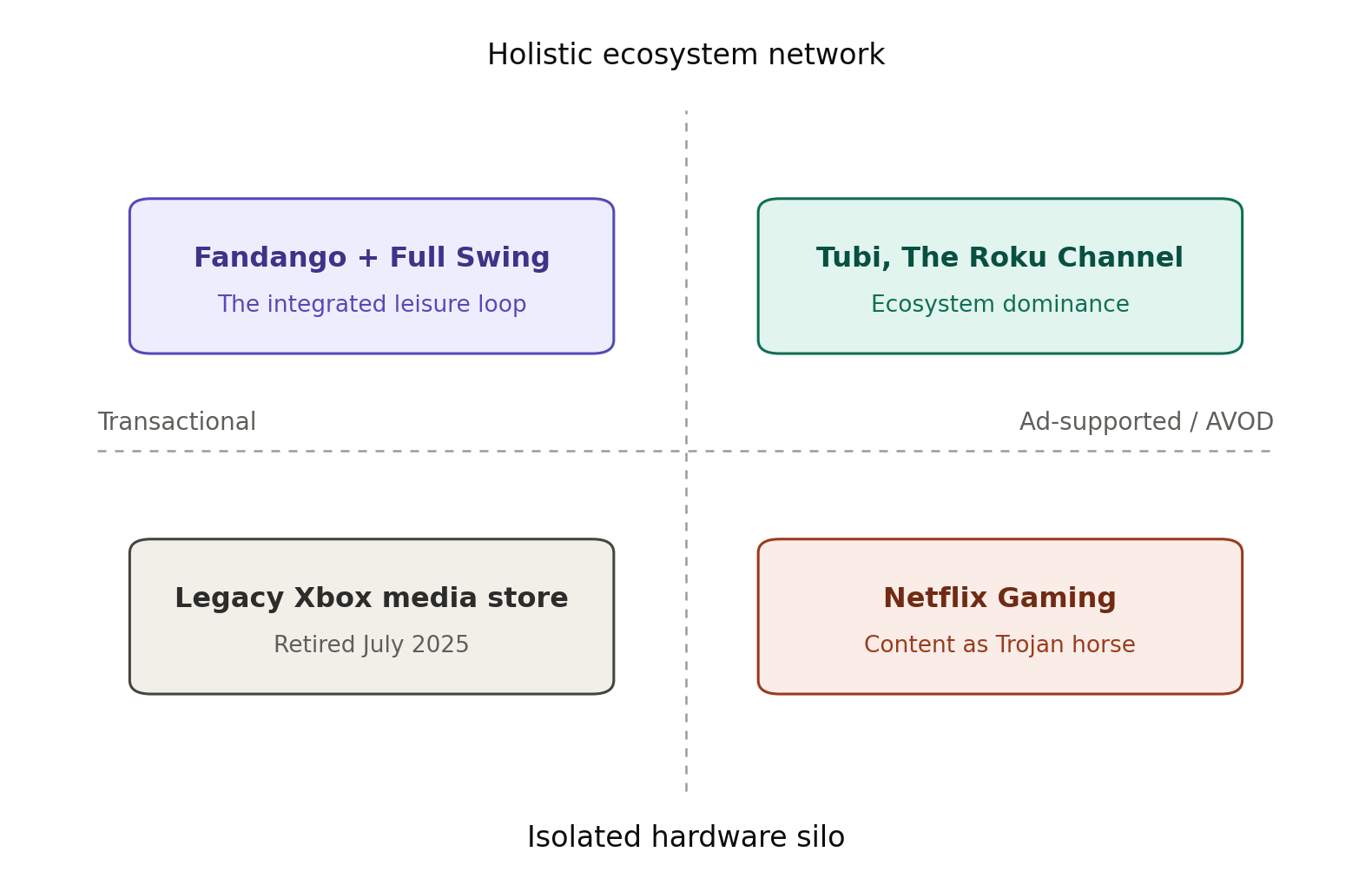
To evaluate how these models compete for consumer mindshare, we can map the ecosystem across two core variables: Monetization Playbook (Transactional vs. Ad-Supported) and Consumer Touchpoint (Isolated Hardware Silo vs. Holistic Ecosystem Network).
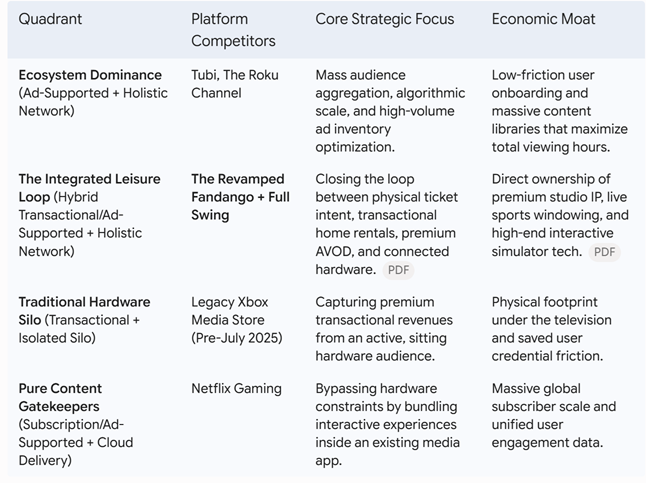
The Ultimate Question: Do You Own the Console or the Living Room?
The data proves that isolated hardware silos are dead. The video streaming segment currently holds a dominant 66.7% market share of the total $59.1B global Connected Living Room economy, with over 43% of US households utilizing a connected streaming device as their primary television gateway.
You do not win the living room by building a box meant exclusively for heavy gamers. You win it by owning the consumer’s wallet and mindshare across their entire leisure lifecycle.
Risks vs. Rewards for Versant
The Rewards
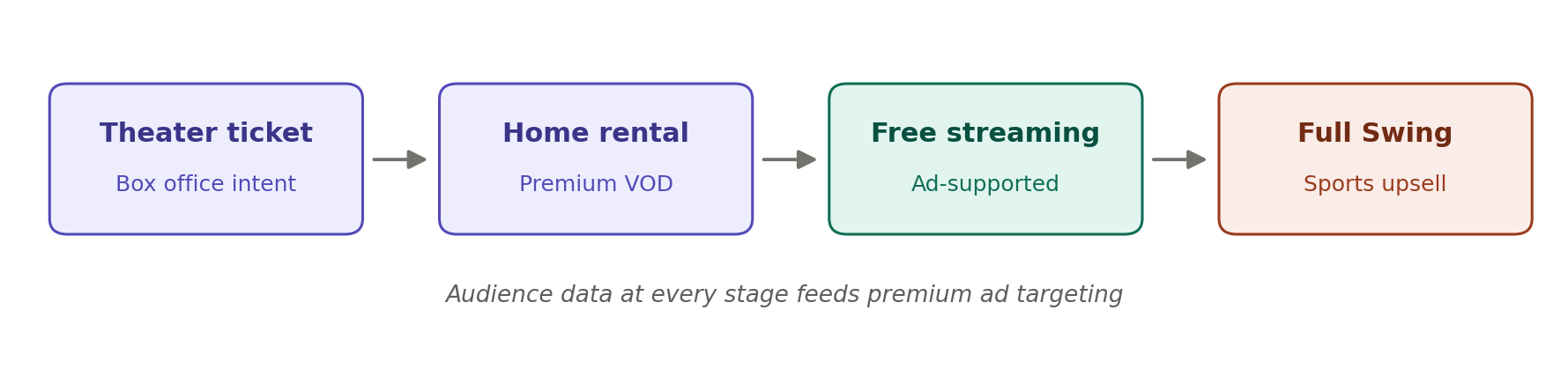
- Full-Funnel Content Windowing: Versant can now monetize a consumer across the entire film lifecycle: from purchasing a theatrical ticket on Fandango, to renting the premium video-on-demand release, to streaming it for free via AVOD months later.
- First-Party IP Arbitrage: Deploying 3,500 hours of internally owned content insulates Versant from the soaring licensing costs that pure aggregators face, significantly boosting net margins on ad yields.
- Demographic Cross-Pollination: Tying Fandango’s broad transactional audience to Full Swing’s premium, high-income sports simulation user base allows Versant to command premium CPMs from advertisers looking for highly verified, cross-platform consumer profiles.
The Risks
- Brand and User Confusion: Removing the explicit “at Home” branding risks alienating legacy transactional users who rely on the platform as a permanent digital locker for thousands of dollars of purchased films.
- Ad-Tech Infrastructure Friction: To compete with Roku’s sophisticated data-targeting architecture or Tubi’s personalization engine, Versant must execute flawless programmatic ad delivery without degrading the user experience.
By linking transactional movie intent, premium ad-supported video, and interactive sports technology under digital platforms president Will McIntosh, Versant is successfully engineering a self-sustaining ecosystem right in the heart of the home, precisely where Microsoft chose to step away.
Get the next one by email
Occasional notes on growth, brand and performance. No spam, one click to leave.