There are a lot of ways to think about growth. It’s not a series of neat, linear A/B tests. Most companies are building experimentation frameworks for an environment that no longer exists: the nostalgic era of clean attribution, stable cookies, and visible customer journeys. Behind the scenes, modern signal decay is quiet-quitting your testing stack. If you are running a 2016 optimization playbook today, you are not scaling a durable growth engine. You are just accumulating test debt.
To build an operating model that actually survives a zero-signal reality, we have to stop treating every hypothesis with the same flat-line processing. As outlined in our testing and experimentation framework, we design from the outside in, starting with human utility and cultural tension, then aligning our testing infrastructure with the gravity of the bet we are making.
Catch up on the foundational piece here: framework for testing and experimentation
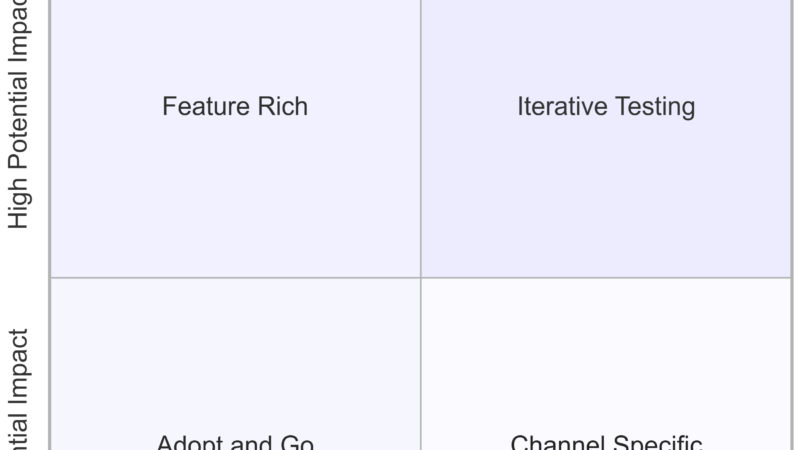
Segmenting the Playbook: The Four Operational Lanes
A mature framework does not route a copy change through the same pipeline as a structural pricing overhaul. You must segment your experiments into distinct strategic lanes before a single line of code is written.
- Feature-Rich Bets: Strategic product shifts, core business model changes, or pricing updates. These require absolute statistical rigor, long-term cohort holdouts, and backtesting. Low velocity, high gravity.
- Iterative Testing: Micro-conversions, localized UI tweaks, and isolated landing page variables. These rely on standard frequentist or Bayesian modeling on high-volume entry points. Medium-to-high velocity.
- Channel-Specific Loops: Optimizing inside walled gardens (like Meta’s server-side API or Google’s automated campaigns). This is about rapid feedback and platform-reported conversion lift.
- Adopt and Go: No-brainer user experiences already validated by human intuition and industry standards. No statistical validation required. Just ship it and monitor the health metrics.
The Infrastructure: Real-World G2 Insights for Every Layer
An experimentation framework is only as durable as the plumbing beneath it. You cannot execute this level of segmentation using yesterday’s client-side visual editors. The tooling must match the operational lane.
To help you evaluate the right fit for your stack, we have synthesized the raw, verified peer feedback from G2 across the leading platforms in each tier.
1. Warehouse-Native Engines (Statsig, GrowthBook)
The most significant shift in performance infrastructure is the move toward warehouse-native architectures. Instead of copying sensitive customer data to a third-party server to compute test results, these platforms sit directly on top of your existing data stack (Snowflake, BigQuery, or Redshift).
Statsig (G2 Rating: 4.7/5)
Highly praised for bringing institutional-grade testing infrastructure to the masses. Users love the out-of-the-box variance reduction (CUPED), which dramatically cuts down the time and sample size needed for a clean signal. The platform’s automated sequential testing allows “safe peeking” without inflating false positives.
Reviewers flag a steep learning curve for non-technical team members. The UI can feel opinionated and dense, occasionally resembling a “black box” where advanced calculations are opaque unless you dive deep into their technical documentation.
GrowthBook (G2 Rating: 4.6/5)
Celebrated as the ultimate open-source alternative. Data teams love the absolute flexibility, and it allows them to customize their statistical engine (Bayesian or Frequentist) and write custom SQL queries directly over their data warehouse.
Because it is developer-centric, it lacks the highly polished, drag-and-drop marketing features found in legacy suites. Non-technical users often find it challenging to navigate without dedicated engineering support.
2. Developer-First Feature Management (LaunchDarkly, Split)
If your engineering team is hesitant to ship because a bad release might break the core product, your testing velocity drops to zero. Developer-first platforms treat experimentation not as a marketing exercise, but as a core tenant of safe software delivery.
LaunchDarkly (G2 Rating: 4.5/5)
The undisputed heavyweight of enterprise feature flagging. Engineering teams praise its bulletproof reliability at massive scale, letting teams release code to production hidden behind “gates.” The progressive rollout mechanics (1% to 10% to 100%) make deployment stress-free.
G2 reviewers frequently point to the accumulation of “flag debt” as a massive operational headache. Managing hundreds of active flags requires strict team governance, and some users note that their native experimentation/analytics tools still feel secondary to their core flag-management product.
Split (G2 Rating: 4.4/5)
Lauded for its unique approach of tying engineering release safety directly to product health metrics. When you toggle a flag, Split monitors system latency alongside business conversion rates, alerting you if a deploy is stable but killing performance.
Users note that the user interface can feel slightly disjointed and clunky compared to modern product analytics tools, requiring a fair amount of platform-specific training to master.
3. Enterprise Marketing Suites (Optimizely, VWO)
For marketing-led optimization focused on high-volume landing pages and rapid front-end iteration, traditional testing suites still play a vital role.
Optimizely (G2 Rating: 4.4/5)
The gold standard for enterprise marketing experimentation. Users highly value its mature statistical engine and its robust, user-friendly visual editor that allows non-technical marketers to launch landing page tests independently.
Price is the elephant in the room. Optimizely is consistently flagged as an incredibly expensive solution, making it difficult to justify for early-stage or mid-market organizations. Additionally, legacy client-side integrations can introduce page-performance drag (“flicker”) if not carefully optimized.
The Ground Rules for Execution
If you want to turn your testing program from an exercise in statistical vanity into a predictable growth engine, you have to protect the integrity of the system:
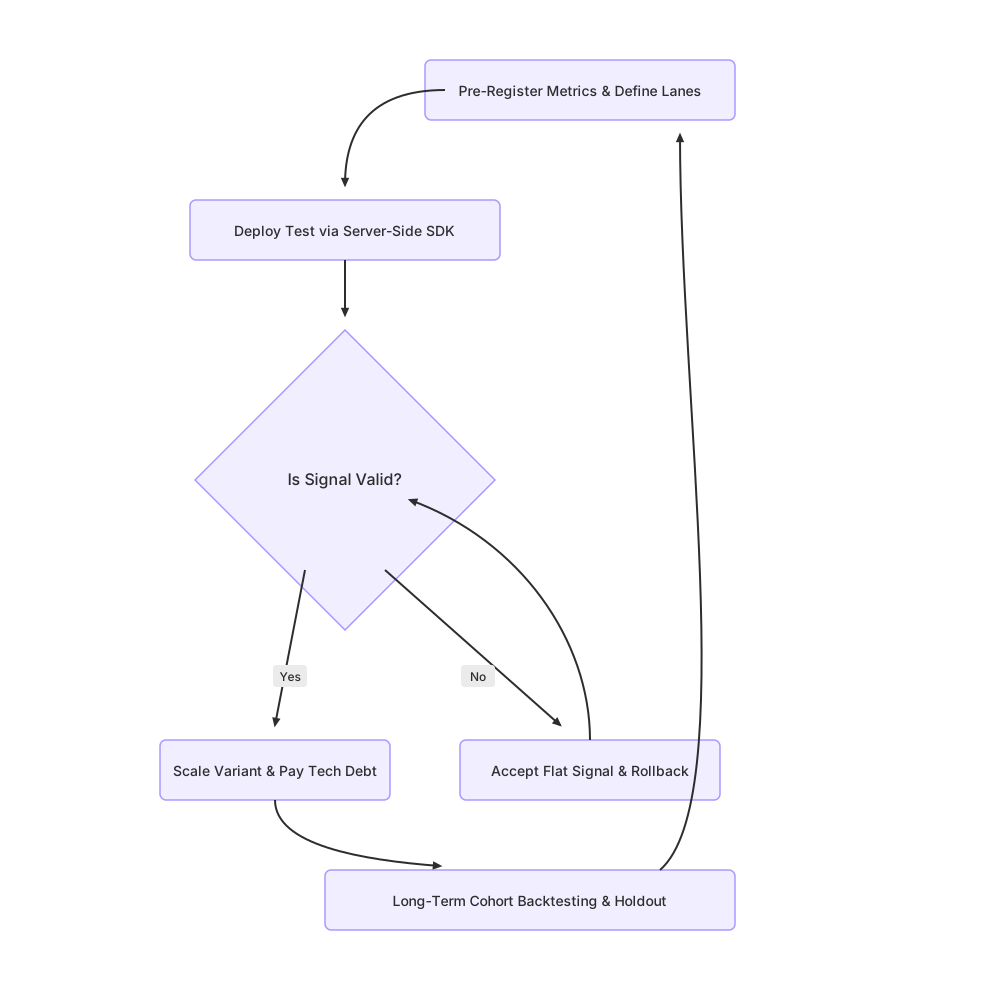
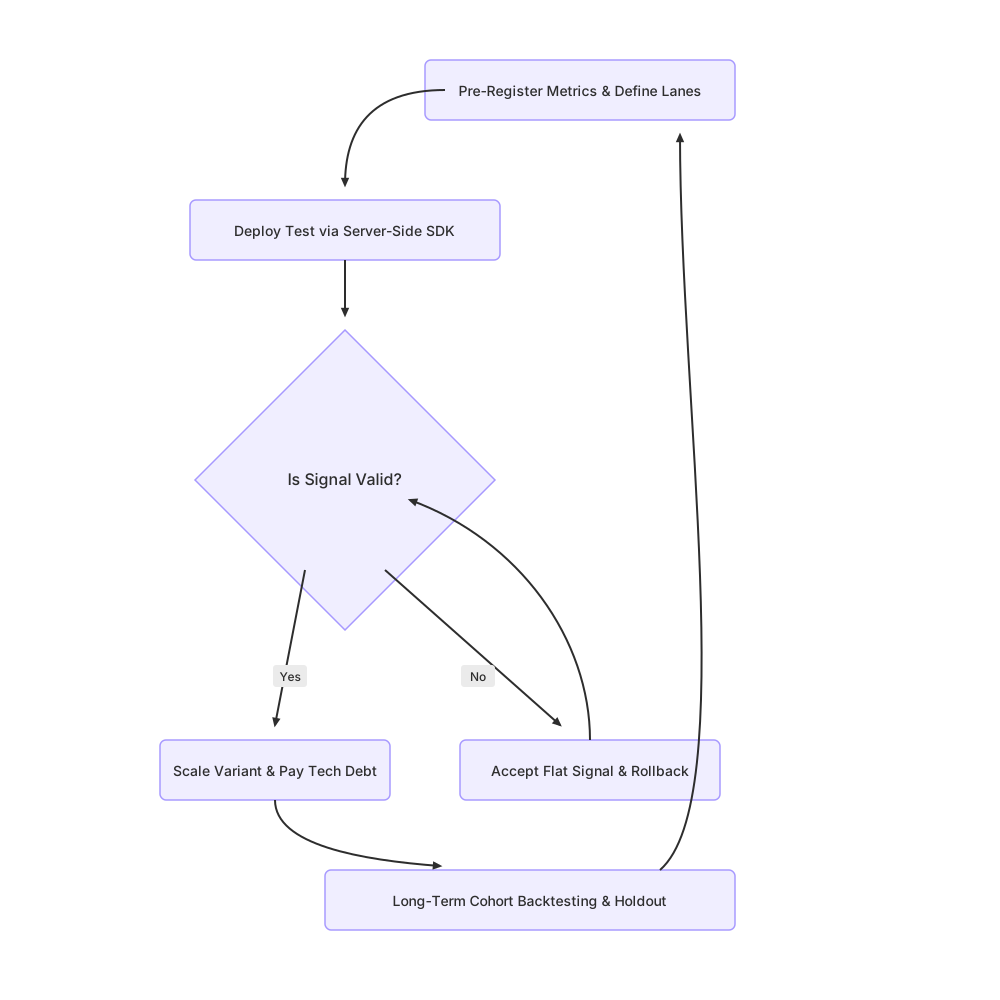
- Default to Server-Side: Bypass client-side JavaScript injection wherever possible. When Safari caps client-side storage windows to mere days, your multi-week conversion tests are leaking control and variant users into each other. Assign and resolve unique user IDs at the server level to protect your cohorts.
- Pre-Register Success: Define your primary metrics, target sample sizes, and action vectors before a test goes live. If a result is neutral, do not search for micro-segments just to declare a win. Accept the flat signal and move on.
- Pay the Tech Debt: Feature flags are incredibly powerful, but they leave scars in your codebase. Your framework must mandate a “cleanup” ticket in the very next engineering sprint once a test concludes and a variant is fully rolled out.
When you stop treating testing as a search for quick wins and start treating it as a systematic process to reduce business risk, the noise clears. That is how you build a durable engine that actually scales.
Get the next one by email
Occasional notes on growth, brand and performance. No spam, one click to leave.