
Why landing pages, onboarding, and checkout are brand decisions, not just conversion decisions
A growth leader’s analysis of DTC, e-commerce, and subscription brands: what’s working, what isn’t, and where the opportunities hide.
Digital experience isn’t only a conversion problem; it’s a brand decision. I took a look at thirteen DTC and subscription businesses, did teardowns on the differences, and laid out the experiments growth teams can run to close the gap. I’d love to hear from you: did I miss anything? Would you challenge my thesis?
How to use this piece. Part 1 is the argument: why digital experience is brand equity, not just funnel efficiency. Part 2 is the data, benchmark matrices you can scan in 60 seconds. Part 3 is the brand-by-brand teardown, each with what’s working, a watch-out, and the transferable lesson. Part 4 pulls out the cross-cutting patterns. Part 5 is a short watchlist of other brands worth studying. Part 6 is a diagnostic you can run against your own company this week.
Part 1, The argument: every click is a brand moment
When organizations talk about digital growth, the conversation tends to orbit a familiar set of metrics: customer acquisition cost, conversion rate, media efficiency, funnel optimization. Those metrics matter. But they quietly narrow the definition of what a website actually is.
A website is not merely a transaction platform. For direct-to-consumer, subscription, and digital-first companies, the website is the brand, the most visible expression of a company’s competence, taste, and trustworthiness. Every ad, social post, email, influencer partnership, and referral sets an expectation. The website is the moment that expectation is either validated or broken.
Most marketers think of a click as the beginning of a funnel. Customers don’t. Customers experience a click as the continuation of a conversation. An ad tells a story; a landing page either continues that story or interrupts it. Click an ad promising effortless convenience, land on a page that demands effort to decode, and the dissonance registers as doubt, usually before the visitor can articulate why. Brand damage rarely arrives as one catastrophic failure. It accumulates through thousands of small disappointments.
Three ideas do most of the work here:
Trust is a conversion variable. A confusing interface, a slow page, or an inconsistent message doesn’t just hurt usability, it signals that the company behind it might be equally disorganized. Customers rarely separate the website from the company. The site becomes a proxy for how every future interaction is expected to go. This matters most when the purchase carries personal stakes, legal decisions, a redesigned home, what your family eats.
Personalization is really about respect. Its deeper purpose isn’t lift; it’s demonstrating understanding. A guided onboarding flow says we want to understand you before we sell to you. The opposite, dumping a catalog and forcing the customer to do the sorting, transfers the cognitive burden onto them. Over time, people gravitate toward brands that reduce complexity rather than manufacture more of it.
Friction is a leading indicator of brand health. Nearly every company measures acquisition efficiency. Almost none measure frustration. Yet a customer who pushes through a painful checkout may still convert, and begin the relationship with diminished enthusiasm, which quietly erodes retention, referrals, reviews, and lifetime value. A surprising amount of loyalty is decided before the first purchase completes.
The strategic cost of ignoring this is that the symptoms appear late and disguised: softening brand affinity, weaker referrals, rising CAC. The instinct is to spend more on ads. But many of these problems originate not in insufficient awareness, in unmet expectations. Customers arrive optimistic and leave uncertain, and the gap between promise and experience compounds against you. Done well, the same mechanism compounds for you: every aligned, fast, well-guided interaction reinforces the promise and makes the next one more likely. The output isn’t just higher conversion. It’s stronger brand equity.
Part 2, The benchmark matrices
Two notes before reading. First, letter grades and complexity ratings are directional assessments of the funnel and on-site experience, not financial ratings. Second, the five “expansion” brands (Warby Parker, Chewy, Casper, Stitch Fix, Peloton) include current performance figures drawn from FY2024-FY2025 public filings and earnings disclosures; the original five are assessed qualitatively. See the data note at the end.
2.1, DTC Funnel Benchmark Matrix (expanded)

Note on Casper: the limiting factor isn’t the funnel, it’s unit economics in a commoditized category. More on this in Part 3.
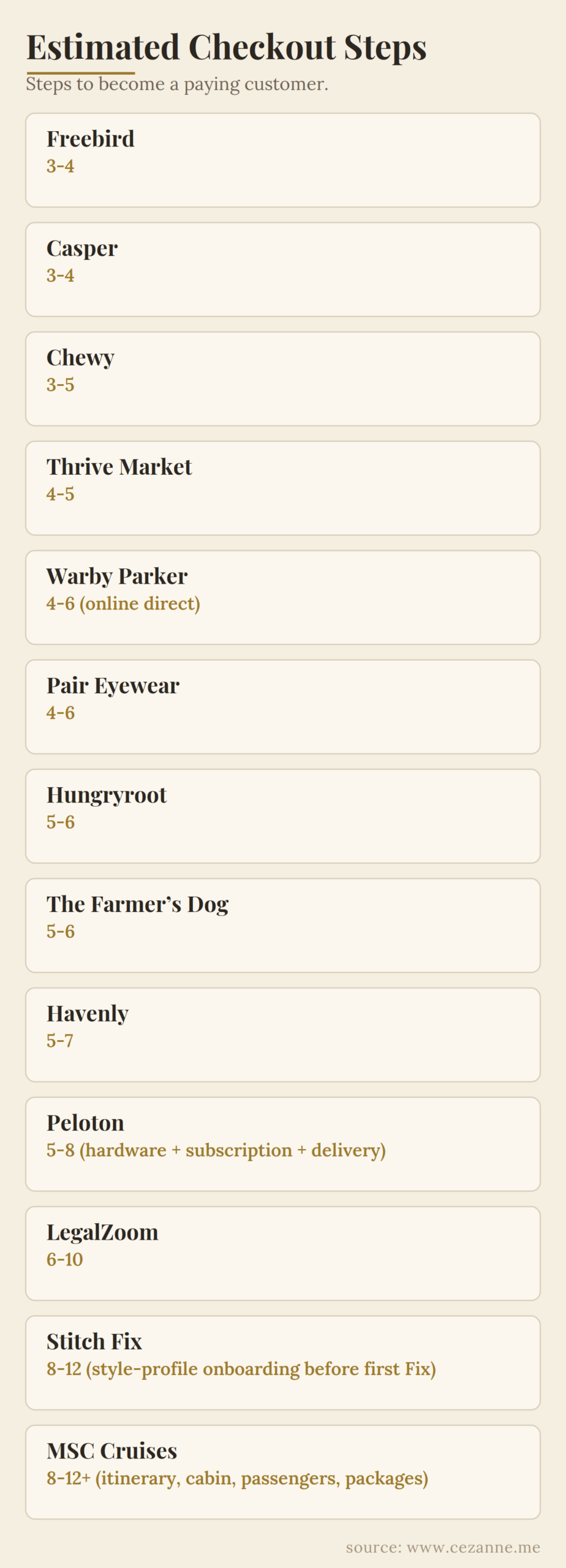
2.2, Estimated checkout steps (steps to become a paying customer)
A useful, blunt benchmark: how many steps does it take to convert? The point is not that fewer is always better.
Estimated Checkout Steps
The shortest funnel is not necessarily the highest-converting. Hungryroot’s flow is far longer than Freebird’s, yet each step increases commitment and perceived value rather than draining it. Stitch Fix and LegalZoom sit at the long end for opposite reasons, Stitch Fix because the model genuinely requires deep input to work; LegalZoom because legal complexity and upsells stack up. The question is never “how short,” it’s “is each step earning its place?”
2.3, Trajectory & lesson matrix (the watch-out layer)
This is the lens for opportunities and watch-outs. “Trajectory” reflects recent direction of travel, not a verdict.

Trajectory & Lesson Matrix
Part 3, Brand-by-brand analysis
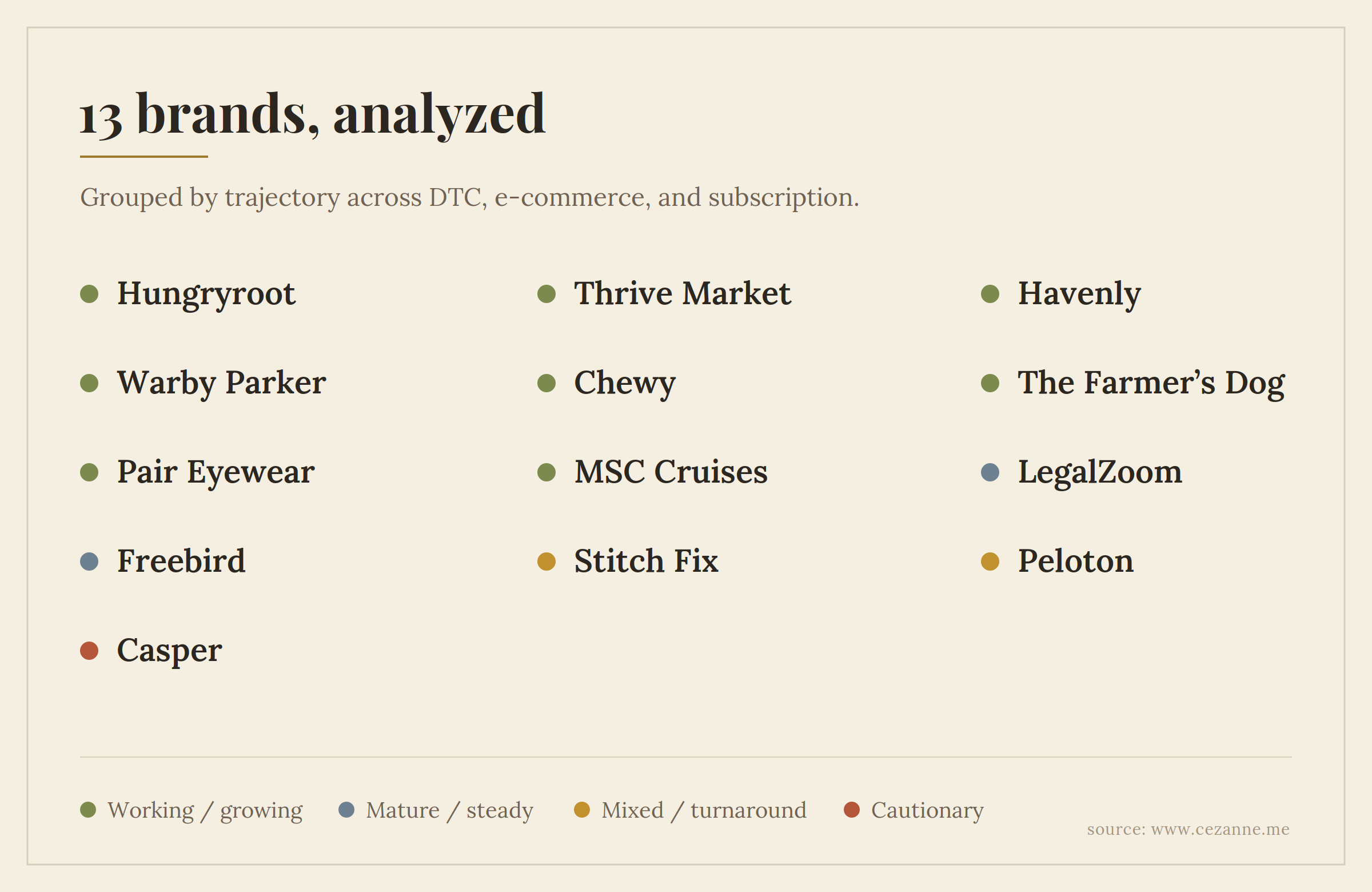
13 brands, analyzed
The original five
Hungryroot, onboarding as the product. What’s working: Hungryroot doesn’t open with a catalog; it opens by learning about you. The quiz isn’t a gate, it’s the value proposition rendered as an experience, and each step deepens commitment so the eventual cart feels personalized rather than imposed. Watch-out: a multi-stage quiz is only as strong as its weakest transition. Every additional screen is a place to lose someone. The opportunity isn’t shortening the flow, it’s reducing inter-stage abandonment while preserving the sense of being understood. Lesson: length is fine when each step adds perceived value. Audit your onboarding step by step and ask which screens take from the customer versus give.
Thrive Market, selling a membership before the experience. What’s working: a genuinely strong offer (values-led sourcing, member pricing) and a clear identity. Watch-out: the model asks customers to commit to a paid membership before they’ve fully experienced the platform, a trust ask placed early in the relationship. If the value of membership isn’t made vivid and immediate, the paywall reads as a barrier, not a benefit. Lesson: when you ask for commitment before proof, the burden is on you to make the value unmistakable at the exact moment of the ask.
LegalZoom, trust is the conversion variable. What’s working: LegalZoom isn’t selling documents; it’s selling confidence during legally and financially consequential moments. That framing is the right one for the category. Watch-out: the funnel is long (6-10 steps) and stacked with upsells and forms. In a high-anxiety purchase, each unexpected upsell or repetitive form erodes the very confidence the brand is supposed to supply. Lesson: in high-stakes categories, friction and aggressive upsells don’t just cost conversion, they undercut the core promise. Protect the emotional throughline.
Havenly, guided discovery as authority. What’s working: helping customers navigate intimate, high-uncertainty decisions (designing a home) signals genuine expertise. Guided discovery is the brand argument. Watch-out: the value isn’t always communicated before the quiz, so some visitors bounce before they understand what they’d get. The opportunity is upstream of the quiz, not inside it. Lesson: guided experiences need a compelling “why this is worth your time” before the first question, or you lose people at the threshold.
Freebird, fast, clean, and a little generic. What’s working: a low-friction, low-complexity, fast funnel, exactly what a focused footwear/apparel purchase should be. Watch-out: the flip side of simple is undifferentiated. Every visitor sees roughly the same experience, with little intent-based segmentation. Lesson: operational cleanliness is necessary but not sufficient. Once the funnel is fast, the next gain comes from making it feel tailored, segment by intent, source, or returning-visitor status.
The five worth adding
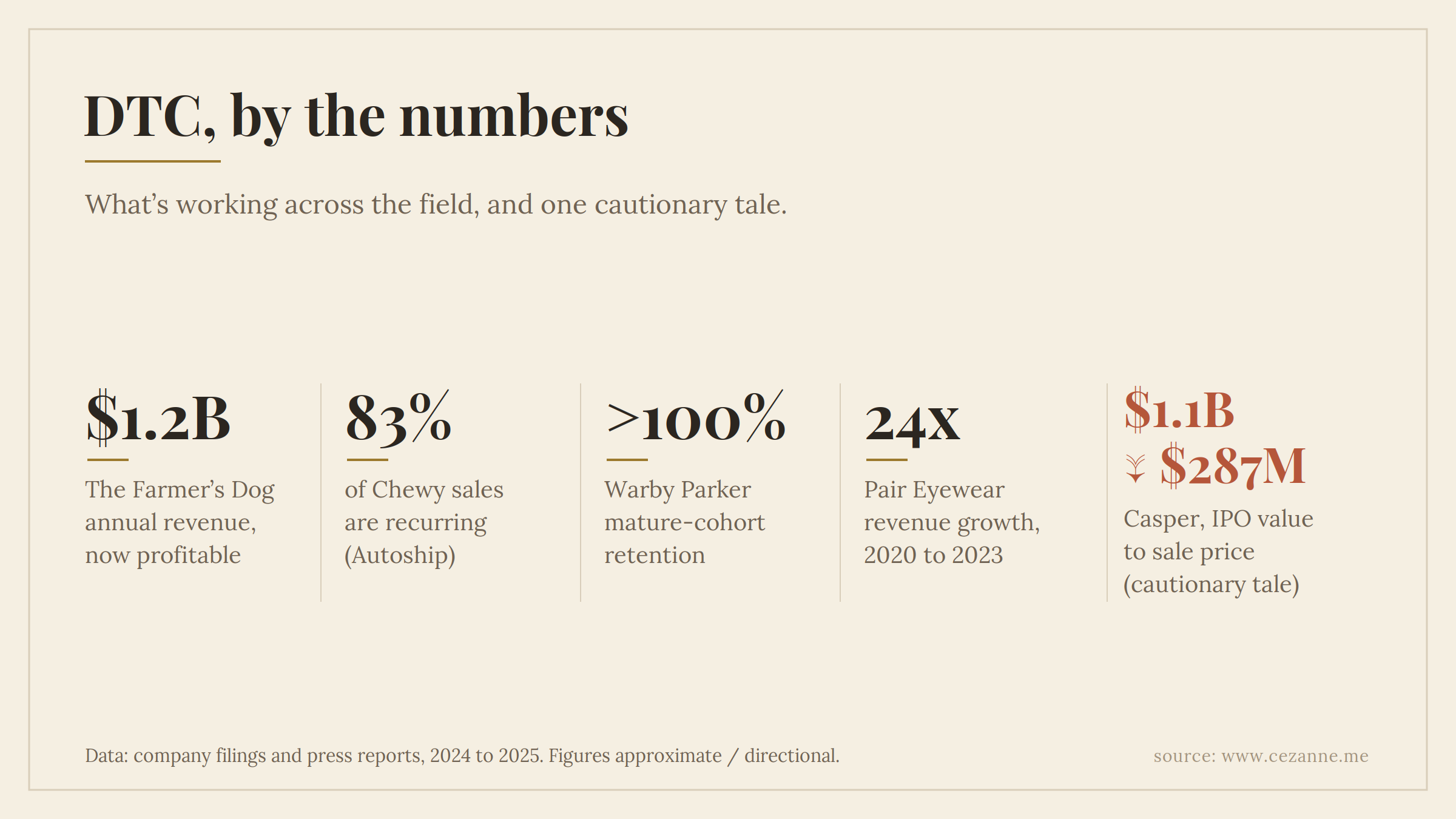
Warby Parker, risk reversal + omnichannel as the playbook. (Working) Snapshot: FY2025 net revenue ~$872M (+13% YoY), 323 stores at year-end (on a path management frames toward 900+), ~2.66M active customers, and a return to GAAP profitability in 2025. What’s working: the original move, Home Try-On (five frames, free), removed the single biggest objection to buying glasses online by reversing the risk. That’s now reinforced by Virtual Try-On, an AI “Advisor,” eye exams in stores, and AI-eyewear partnerships with Google and Samsung. Crucially, mature customer cohorts show retention above 100% (existing customers spend more over time), which is the cleanest possible signal that the experience compounds. Watch-out: the growth bet is physical retail at scale. Site-selection mistakes or overbuilding markets would pressure margins, execution risk, not strategy risk. Lesson: the highest-leverage funnel intervention is often risk reversal, not persuasion. Find the one objection blocking the purchase and engineer it away. Then let online and offline reinforce each other instead of competing.
Chewy, convenience as a moat. (Working) Snapshot: FY2025 net sales ~$12.6B (~7% growth), 21.3M active customers, net sales per active customer ~$591, and Autoship now ~83% of net sales (up from 79% a year earlier and ~66% at IPO). What’s working: Chewy turned a recurring, non-discretionary need into a subscription customers want, Autoship is convenience embedded into behavior, not a contract to escape. Layer on famously human customer service (handwritten cards, sympathy notes when a pet dies) and a paid membership (Chewy+), and you get a retention flywheel: more Autoship → better forecasting → lower unit costs → margin expansion. Watch-out: the category is wonderfully sticky but structurally low-margin; growth has to come from share, attach, and higher-margin services (e.g., vet clinics) rather than price. Lesson: the strongest subscriptions feel like a gift to the customer, not a trap. If your recurring revenue depends on customers forgetting to cancel, you’ve built fragility. If it depends on genuine convenience, you’ve built a moat.
Casper, the cautionary tale of a commoditized category. (Cautionary) Snapshot: the original DTC “mattress-in-a-box” darling. IPO’d in early 2020 around a ~$1.1B valuation, then unwound, taken private in 2021-22 at roughly $287M (less than it had raised), and ultimately acquired in 2024 by Carpenter Co., a foam manufacturer. What’s working / what didn’t: Casper’s brand-building and category creation were genuinely excellent, for a while it was the reference point for the whole DTC sleep economy. The problem was underneath the funnel. Mattresses are infrequent, big-ticket, and increasingly commoditized; dozens of near-identical competitors flooded in; and growth leaned heavily on paid acquisition and discounting. No amount of landing-page optimization fixes a model where it costs too much to acquire a customer who buys once every several years. Watch-out (for everyone): a beautiful experience cannot rescue broken unit economics. If repurchase is rare, the product is undifferentiated, and acquisition is paid, the math eventually wins. Lesson: diagnose which problem you have. Experience fixes conversion problems. They do not fix structural economics. Be honest about which one is actually killing you.
Stitch Fix, when personalization hits a ceiling. (Mixed / turnaround) Snapshot: FY2025 net revenue ~$1.27B (down ~5% YoY); active clients ~2.31M (down ~8% YoY) but revenue per client rising to ~$549; returned to adjusted revenue growth in the back half of the year while exiting the UK and leaning hard into AI styling. What’s working: Stitch Fix has the deepest personalization model in this entire set, a long style quiz feeding human-plus-algorithm styling. When it fits a customer, it fits beautifully. Watch-out: personalization, by itself, did not solve the harder problems, the long onboarding is a real conversion gate, and the model has struggled with client growth and retention. The current pivot is telling: quality over quantity, fewer, higher-value clients rather than chasing volume. Lesson: personalization is a powerful differentiator, but it is not a substitute for a durable retention and demand engine. And the more input you require up front, the more ruthlessly you must prove the payoff before the customer commits, or the abandonment shows up in onboarding.
Peloton, demand sustainability and the subscription backbone. (Mixed / turnaround) Snapshot: FY2025 revenue ~$2.4B (down ~9% YoY); connected-fitness subscribers ~2.7M and still gently declining; but the company returned to GAAP profitability via deep cost discipline, with subscription now ~70%+ of revenue. New bets include Peloton IQ (AI coaching) and rental/refurbished programs that lower the entry barrier. What’s working: the recurring subscription is the financial backbone, and engagement is the retention lever, members who use two or more workout types churn dramatically less. The company has proven it can be profitable at its current scale. Watch-out: the core challenge isn’t the funnel, it’s demand. Pandemic-era demand normalized, the hardware is largely a one-time purchase, and the subscriber base keeps shrinking. Cost cuts can manufacture profitability once; they can’t manufacture growth. Lesson: separate engagement (which you can engineer) from demand (which you mostly can’t). A great experience deepens the customers you have; it doesn’t conjure a market that has moved on. Lowering the entry barrier (app-first, rental) is the right response, meet the demand that exists rather than pricing it out.
Three deep-dive teardowns (with testable takeaways)
These three get the fuller treatment: a longer teardown plus explicit, testable hypotheses you can put into an experiment backlog.
The Farmer’s Dog, fixed consumption, so retention is the whole game. (Working)
Snapshot: a fresh, human-grade dog-food subscription founded in 2014, made-to-order from vet-designed recipes and portioned to each dog’s profile (breed, age, weight, activity), cooked in USDA-inspected kitchens and shipped frozen. By 2024 it reached roughly $1.2B in annualized net revenue (up ~50% YoY) and, after years of losses, flipped to profitability at a reported $10M+ per month, one of the most profitable VC-backed DTC brands, now rivaling public incumbent Freshpet.
What’s working: the onboarding is the pitch. Like Hungryroot, the site opens not with a catalog but with questions about your dog, and each answer makes the eventual plan feel built-for-you rather than sold-to-you. The emotional frame (your dog is family, feed it like family) justifies a premium price and powers brand-led acquisition (including Super Bowl spots). The subscription is genuinely convenient: recurring, pre-portioned, no decisions after setup. And they reached real profitability at scale, proving the premium-fresh model can work where many DTC darlings burned out.
The watch-out: the product has almost no natural expansion revenue. A dog eats a fixed amount; you can’t grow the basket the way Chewy cross-sells toys, meds, and vet care. Revenue-per-customer is essentially flat over the relationship, so lifetime value is dictated almost entirely by two variables: how cheaply you acquire and how long you retain. Acquisition is expensive (premium price, paid-heavy), and retention faces a quiet ceiling, once novelty fades, price-sensitive owners drift to cheaper fresh or hybrid feeding. There is no basket-growth lever to mask churn.
The lesson: when consumption is fixed, you cannot grow your way out of a retention problem. For products with no expansion path, LTV is purely a churn-and-CAC equation, so the entire growth engine rests on acquisition efficiency and early-life retention, not on average order value. Emotional positioning can win the premium, but it must be re-earned every billing cycle, because the customer’s spend never rises to reward the relationship; only their loyalty does.
Testable takeaways:
- Onboarding personalization → test the profile step with vs without a dog name/photo prompt. Metric: quiz-completion rate and quiz→first-order conversion.
- Early-life retention → test a structured first-30-day “transition” email/SMS sequence (how to switch foods, what to expect) against control. Metric: 90-day retention.
- Creative quality, not just CAC → run “family/emotional” vs “health/rational” acquisition creative. Metric: blended CAC and 6-month retention by creative cohort (cheap acquisition that churns is worse than pricier acquisition that stays).
Pair Eyewear, engineer the repeat purchase, and the unit economics flip. (Working)
Snapshot: founded in 2017, Pair sells a base frame with prescription lenses (~$60) plus patented magnetic “Top Frames” (from ~$25) that snap on to change the look in seconds. New collections drop about three times a month, including licensed designs (Marvel, Harry Potter, NBA, NHL, MLB, and more). Revenue grew roughly 24x from 2020 to 2023; the company has raised ~$150M (a $75M Series C in 2023), started kids-first, expanded to adults, and now sells across the US (including 100+ America’s Best locations) plus the UK and Australia. TikTok reportedly drives over a quarter of sales.
What’s working: Pair quietly rewired the worst feature of the eyewear category, you buy once and you’re stuck for years. By splitting the product into a durable base and cheap, swappable, collectible toppers, it converted a rare, high-consideration purchase into a frequent, low-friction, near-impulse one. That changes the math entirely: acquisition cost is amortized across many small repeat purchases instead of a single sale, so effective CAC falls and LTV climbs without lowering price. The monthly drops and licensed IP manufacture reasons to come back, and a visual, swappable product is tailor-made for social proof, #WearPair virality is acquisition that never shows up as ad spend.
The watch-out: the customization that drives the model can also stall it. With 1,000+ Top Frames, a first-time visitor faces real choice paralysis, and choice paralysis kills conversion. The model also depends on sustained engagement: if customers buy a base and one topper and stop, Pair is just an inexpensive glasses brand with thin margins. And the licensed-IP novelty engine carries dependency and renewal risk.
The lesson: in a high-CAC category, the highest-leverage move is usually not lowering acquisition cost, it’s raising purchase frequency so the same CAC is spread across more transactions. Casper had the opposite problem: a great brand selling an infrequent, commoditized purchase, and no amount of funnel polish fixed it. Pair is the mirror image and the playbook: if your category buys rarely, design a reason to buy often.
Testable takeaways:
- Guided start vs the full grid → test a short style quiz / curated capsule against the 1,000-frame catalog for first-time visitors. Metric: PDP→cart conversion and time-to-first-purchase.
- Front-load the repeat behavior → test a “base + 3 Top Frames” bundle vs base-only at first purchase. Metric: 6-month repeat-purchase rate and LTV.
- Subscription deepens frequency → test an opt-in Top-Frame auto-“drop” against one-off purchasing. Metric: orders per customer per year and margin per customer.
MSC Cruises, in complex purchases, the lever is decision support, not speed. (Working / expanding)
Snapshot: the world’s third-largest cruise line, part of the privately held MSC Group. It operates ~23 ships across 250+ destinations and is pushing hard into North America: the LNG-powered MSC World America (~7,000 guests) launched in 2025 sailing from Miami, joining year-round US homeports in Orlando, Brooklyn, and Galveston, with a large newbuild pipeline behind it. Differentiators include Ocean Cay, a private Bahamas island marine reserve, and the MSC Yacht Club, a premium “ship-within-a-ship.” It’s positioned as the value challenger to Royal Caribbean and Carnival.
What’s working: real product and asset differentiation (Ocean Cay, Yacht Club, new mega-ships) gives the brand genuine things to sell, and the value angle is sharp against US incumbents. The “Open Booking” program is the standout digital move: it lets a guest reserve a future cruise without locking in a ship, date, or itinerary, capturing intent at the emotional peak while deferring the dozens of hard configuration decisions that usually cause abandonment.
The watch-out: cruise booking is one of the most complex funnels in all of consumer commerce, itineraries, sail dates, cabin categories, deck positions, multi-passenger details, then a wall of upsells (drink packages, dining, excursions, Yacht Club). Every added decision is a place to lose someone, and dense, media-heavy legacy cruise sites compound the load with speed and clarity problems. On top of that, MSC Cruises carries a brand-familiarity gap in the US: it’s a major European line many American buyers don’t yet know, so the site must build trust for an unfamiliar, expensive commitment at the same time it asks for a complex configuration. That’s two hard jobs at once.
The lesson: for high-consideration, high-ticket, high-complexity purchases, the conversion lever is not speed or fewer steps, it’s decision support. Guided configuration, smart defaults, and progressive disclosure do the heavy lifting, because the customer’s barrier isn’t impatience, it’s uncertainty. Capture intent early (Open Booking is exactly right), then resolve specifics gradually rather than demanding them all up front.
Testable takeaways:
- Guidance beats filtering → test a “help me choose” wizard (who’s traveling, budget, vibe, flexible dates) against the standard itinerary grid/filters. Metric: search→cabin-select→deposit conversion.
- Deferring commitment reduces abandonment → test prominent Open Booking placement for undecided visitors against forcing full configuration. Metric: deposit-capture rate and eventual booked conversion.
- Close the brand-familiarity gap → test a “new to MSC Cruise / what’s included / European-line, American-comfort” trust module on key landing pages. Metric: new-to-MSC Cruise booking rate.
- Upsell timing → test surfacing Yacht Club at the consideration stage vs only at checkout. Metric: Yacht Club attach rate and overall booking conversion.
Part 4, Cross-cutting patterns
Reading across all thirteen, a few patterns recur, these are the meta-lessons for your own roadmap.
- The best onboarding adds value with each step; the worst extracts it. Hungryroot, Warby Parker, and Chewy all ask for input, but every step returns something (a better recommendation, a removed risk, a more convenient reorder). Length is not the enemy. Extractive steps are.
- Risk reversal beats persuasion. Warby Parker’s Home Try-On and Chewy’s frictionless service both work by removing the reason not to buy. Identify the single largest objection in your category and engineer it out, rather than writing more persuasive copy around it.
- The strongest subscriptions are wanted, not trapped. Chewy’s Autoship is a moat because it’s genuinely convenient. Any recurring model that depends on customers forgetting to cancel is borrowing against future trust.
- Experience cannot rescue broken economics. Casper is the clearest warning: infrequent purchase + commodity product + paid acquisition is a math problem, not a UX problem. Before you invest in conversion, confirm conversion is actually your constraint.
- Personalization is necessary but not sufficient. Stitch Fix has the deepest personalization in the set and still had to pivot to quality-over-quantity. Personalization differentiates; it doesn’t replace a retention engine.
- Engineer engagement; don’t assume demand. Peloton can deepen the members it has but can’t will a normalized market back to peak. Know which lever you’re actually pulling.
- Trust scales with stakes. LegalZoom, Havenly, and Hungryroot all ask customers to trust them with consequential or personal decisions. The higher the stakes, the more every slow page, surprise upsell, or generic moment costs you.
Part 5, Others worth watching (short list)
Brands that each teach a distinct lesson, if you want to extend the study:
- Ritual (vitamins, subscription), transparency-led brand with a strong onboarding quiz; a clean comp to Hungryroot for “personalization as respect.”
- HelloFresh (meal kits), the scale leader in subscription meal kits, and a live case study in churn economics: easy to acquire, hard to retain.
- Allbirds (footwear), premium-positioning erosion and a sharp retail contraction (it cut store count materially), a useful mirror-image to Warby Parker’s expansion.
- Glossier (beauty), community-as-brand done well, with the perennial DTC tension between brand love and conversion mechanics.
- Function of Beauty / Prose (personalized hair care), quiz-driven mass-customization; another data point on guided discovery and onboarding length.
- Away (luggage), content-and-brand-led DTC; a category (like mattresses) with infrequent repurchase, worth comparing to Casper.
Part 6, A diagnostic for your own company
Run this against your top-spending landing page and your checkout this week.
- The continuation test. Put your highest-spend ad next to its landing page. Does the page continue the ad’s promise, or silently change the subject? Mismatched message = doubt, even when nothing is technically broken.
- The step audit. List every step from click to purchase. Mark each one value-adding or value-extracting. You’re not trying to minimize steps, you’re trying to eliminate the extractive ones.
- The objection inventory. Name the single biggest reason a qualified visitor doesn’t buy in your category. Are you persuading around it, or have you engineered it away (the Warby Parker move)?
- The friction-vs-economics fork. Is conversion actually your constraint, or is it repurchase rate / margin / CAC (the Casper trap)? Invest in experience only if experience is the bottleneck.
- The subscription honesty check. If you have recurring revenue: does it survive a one-click cancel? If retention depends on friction-to-cancel, you’re accruing brand debt.
- The pre-commitment proof test. Wherever you ask for commitment before the customer has experienced value (Thrive’s membership, Stitch Fix’s quiz, Havenly’s questionnaire), is the payoff made vivid at the moment of the ask?
- The frustration metric. You measure CAC and CVR. Do you measure frustration, rage clicks, repeated form errors, time-on-task in checkout, abandonment by step? Frustration is the leading indicator brand reports miss.
- Purchase frequency is an economic lever, not just a metric. Pair Eyewear engineered a rare purchase into a frequent one and flipped its unit economics; The Farmer’s Dog, with fixed consumption, has no such lever and lives or dies on retention. Before optimizing the funnel, ask whether you can change how often people buy, and if you can’t, treat retention as the entire game.
- In complex purchases, sell decision support, not speed. MSC Cruises shows that when the customer’s barrier is uncertainty rather than impatience, guided configuration, smart defaults, and progressive disclosure convert better than a shorter path. Match the lever to the shape of the purchase.
The throughline: advertising creates expectations, the website validates them, onboarding demonstrates understanding, personalization communicates respect, performance signals competence, and checkout establishes trust. The real opportunity isn’t simply more conversion, it’s ensuring every digital interaction reinforces the promise your brand makes to the market.
Data & method note
Letter grades, complexity ratings, checkout-step counts, and “potential conversion recovery” ranges are directional assessments of funnel and on-site experience, not financial ratings, and are meant as discussion starters. Performance figures for Warby Parker, Chewy, Casper, Stitch Fix, and Peloton are drawn from FY2024-FY2025 public filings and earnings disclosures and reflect the most recent reporting available as of early 2026. The Farmer’s Dog and Pair Eyewear are private; their figures come from press reporting, investor disclosures, and PitchBook-cited estimates and should be treated as approximate. MSC Cruises is part of the privately held MSC Group; its operational figures are from company and trade-press sources, and its funnel grades are directional, since cruise lines do not publish conversion data. The original five brands (Hungryroot, Thrive Market, LegalZoom, Havenly, Freebird) are assessed qualitatively. Company trajectories change; verify the latest figures before circulating externally.
About this analysis. This piece combines two kinds of information. First, hands-on and crawl-based assessment of each brand’s landing pages, onboarding, and checkout, which I used to assign directional grades and estimate step counts. Second, publicly reported performance figures (filings, earnings disclosures, and press, mostly FY2024–2025), which are approximate for private companies and were not independently audited. Because flows change frequently and vary by traffic source, device, geography, and test variant, the specifics here are point-in-time estimates. The grades and counts are meant to support relative comparison between brands and to surface testable hypotheses, not to serve as exact, reproducible metrics. Treat the conclusions as directionally accurate rather than precise, and validate against your own data before acting.
Get the next one by email
Occasional notes on growth, brand and performance. No spam, one click to leave.