You can buy reach. You cannot buy belief. And for a challenger, the difference decides everything.
In a crowded, mature category, the temptation for a challenger brand is always the same: get famous fast. Buy the biggest stage, hire the recognizable faces, sponsor the global property, and let awareness do the work. It is a satisfying plan because it is visible, it is measurable in impressions, and it feels like progress.
It is also, on its own, a trap. Because the challenger’s hardest problem in a mature market is almost never awareness. It is trust. And trust is the one thing brand spend cannot buy.
Let me make this concrete, because the cruise industry is running the experiment in public right now.
The boldest brand play in the category
MSC Cruises, the world’s third-largest cruise line and a fast-growing challenger in the U.S., made the most aggressive brand moves the category has seen. It bought its first-ever Super Bowl spot, pairing Drew Barrymore and Orlando Bloom to dramatize a charming “European style, American comfort” idea, tied to a spectacular new flagship, MSC World America, purpose-built for the American market. It layered on a multiyear global Formula 1 partnership, with title sponsorship of marquee Grands Prix and ships brought portside at the races. By any measure of reach, this is a textbook awareness and prestige campaign, executed at a high creative level. The work itself is good.
Now lets hold that against what the customer actually says.
What the data says happens next
Pull the public sentiment and a consistent picture emerges. On one major review platform, the brand sits at roughly two stars, with only about a quarter of reviewers willing to recommend it and the large majority saying they will not sail again. The recurring themes are not about awareness. They are about the experience: inconsistent food, service friction, crowding, drink-package frustration, and, most damaging of all, customer-service and refund experiences that leave people feeling, in their words, like a number rather than a guest. The loyalty status-match program that is meant to poach rivals’ frequent cruisers gets described as misleading and discretionary.
Two details matter most. First, even on the brand-new flagship, the literal centerpiece of the campaign, reviews split hard between “beautiful ship, wonderful crew” and “everything was abysmal.” The marquee asset is not converting skeptics into believers. Second, and more revealing, the balanced reviewers who actually sail often conclude the product is better than its online reputation. That means the brand is losing two different battles at once: it is under-delivering for some guests, and it is failing to control its own narrative for the rest. Both are trust problems. Neither is an awareness problem.
Why the sequence is backwards
Here is the diagnosis, and it is a sequencing error more than a creative one. Every buyer weighs four things: price, value, trust, and superiority. Two of those, price and superiority, are rented advantages that competitors copy quickly. A discount is matched by lunchtime; a spectacular ship is matched at the next shipyard. The two that compound into a real moat are value, meaning clarity about what you actually deliver, and trust, meaning the belief you can only earn by keeping your promise in the lived experience.
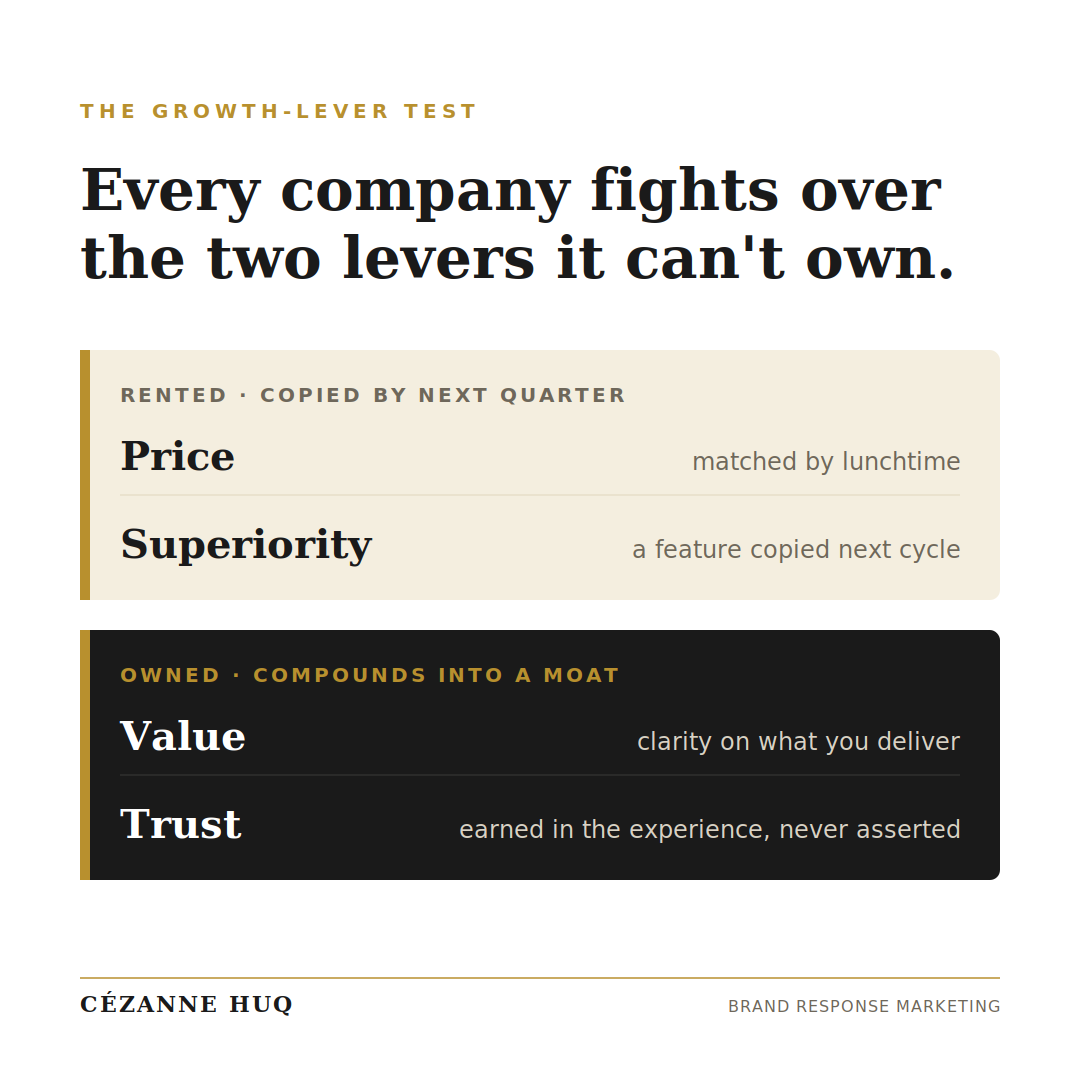
MSC poured its boldest investment into the two rented levers: awareness, which is brand spend, and superiority, which is a stunning new ship. The two that compound, value and trust, are precisely where the sentiment says it is weakest. For a challenger in a high-consideration, prepaid, days-long-commitment category, that order of operations is reversed.
And reversing it does something worse than waste money. A Super Bowl spot aimed at a trust gap does not close the gap. It accelerates trial into an experience that is not yet ready to convert that trial into loyalty, which manufactures exactly the negative word of mouth that suppresses the repeat rate. You can amplify a leaky funnel, but amplification is not improvement. In any business with recurring revenue, the growth ceiling is governed by retention, not reach. Pouring awareness into a low-trust experience spends against a ceiling that the experience itself has set. The fame finds the gap and broadcasts it.