Paying 86x revenue for anything is just obscene, yet that’s roughly what NVIDIA is doing with its nearly $13B acquisition of Hugging Face, which reportedly generates around $150MM in annualized revenue. Clearly Jensen isn’t buying the immediate P&L. He’s buying something else, and I think the best way to understand what that is may be to look at NVIDIA’s evolution almost like a person growing up.
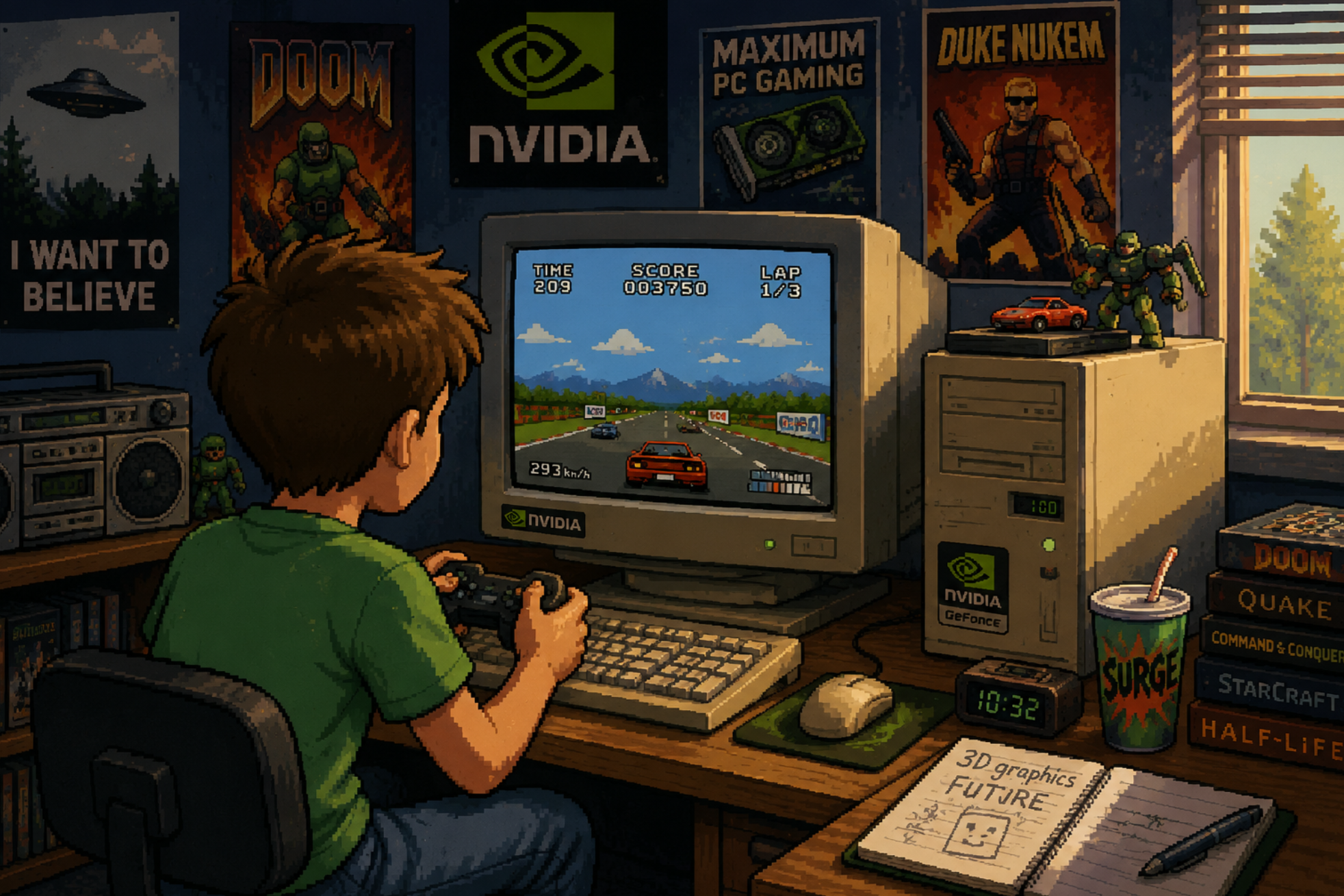
NVIDIA started out as the kid obsessed with video games, then hit adolescence and realized the thing it had gotten really good at, GPUs and parallel computing, had applications well beyond gaming. Data centers opened up a much bigger world, AI turned NVIDIA into critical infrastructure, and networking plus software allowed it to capture more and more of the system around the chip. Hugging Face feels like the next stage of growing up because it potentially moves NVIDIA from owning more of the infrastructure to owning more of the ecosystem where decisions about that infrastructure actually get made.
Gaming Wasn’t the Side Quest
It’s tempting to look back at NVIDIA’s gaming roots as some quaint first chapter before the “real” company showed up, but I think that misses the point. Gaming was the training ground. Games required huge amounts of mathematical computation to happen at the same time, and NVIDIA got absurdly good at solving that problem. CUDA then gave developers a way to use GPUs for things that had nothing to do with making a game look better.
Researchers figured that out, machine learning figured it out, data centers figured it out and then generative AI showed up. Suddenly the capability NVIDIA had spent decades building became one of the most valuable resources on the planet. The revenue transition is wild: NVIDIA generated roughly $27B in FY2023, with Data Center accounting for about $15B, or 56%. Three years later, revenue was nearly $216B and Data Center alone was almost $194B. In the latest quarter, Data Center was more than 92% of revenue.
That’s not really a gaming company that diversified well. That’s a completely different business emerging out of the capabilities of the original one, which is why the adolescence analogy actually works. You spend your childhood doing something because you enjoy it, then at some point figure out what you’re actually good at and start asking what the hell you can do with it. NVIDIA figured it out, and once it did, the company stopped thinking only about the chip.
Then It Started Buying More of the System
Being the best GPU company wasn’t enough because an AI data center isn’t just a room full of GPUs. Thousands of incredibly powerful processors have to communicate with one another very quickly, which made networking increasingly important and helps explain NVIDIA’s roughly $6.9B acquisition of Mellanox in 2020. At the time it looked somewhat adjacent to the core GPU business. In retrospect, it was one of the moves that allowed NVIDIA to stop thinking purely about chip performance and start thinking about system performance.
That progression now includes GPU, CPU, memory, NVLink, Ethernet, InfiniBand, servers, software and increasingly the architecture of the entire data center. Jensen calls these facilities “AI factories,” and I think that language matters because it also explains the economics NVIDIA is chasing. A Hopper-based gigawatt-scale AI factory represented roughly $18B of NVIDIA revenue opportunity, Blackwell increased that to around $25B and Vera Rubin potentially gets close to $40B.
The electricity didn’t suddenly become more valuable. NVIDIA simply figured out how to capture more wallet share from everything being built around the compute. That’s a growth story I understand really well because sometimes the biggest opportunity isn’t finding another customer. It’s expanding what you can economically provide to the customer you already have and capturing more of the system around the thing that originally got you in the door.
So Why the Hell Spend $13B on Hugging Face?
This is where the deal gets really interesting. Hugging Face has more than 18MM developers, researchers and creators, more than 3MM models, around 500,000 datasets and roughly 1MM applications. More than 200,000 companies reportedly use the ecosystem, while estimates put the global active software developer population somewhere around 48MM.
Hugging Face’s 18MM figure isn’t perfectly apples-to-apples because it includes researchers and creators, but the penetration is still pretty extraordinary. The more important point is that NVIDIA already has millions of developers in its own ecosystem. CUDA may be one of the strongest developer moats ever built, and NVIDIA has NIM, NeMo, TensorRT, DGX Cloud, AI Enterprise, developer programs, startup programs and relationships across academia and basically every important corner of AI.
If the objective was simply to add more developers, I’m not convinced spending $13B was the best way to do it. NVIDIA could have thrown billions at free compute, subsidized startups, flooded universities with hardware, expanded developer relations, funded open-source projects, made NIM essentially free or built a model repository and inference marketplace of its own. Hell, NVIDIA could probably recreate most of the functionality Hugging Face provides.
What it can’t simply recreate is the network around it. Models are on Hugging Face because developers are there, developers are there because the models are there, tooling companies integrate because both are there and enterprises increasingly participate because their people already use it. Each side reinforces the other, which is why this stops looking like a software product and starts looking like a network. Networks are incredibly difficult to manufacture, even if you have NVIDIA-sized piles of money.