A recruiter called me about a longevity brand a few weeks ago. I won’t name it. I did the homework, took the meetings seriously, and fell into a rabbit hole I still haven’t climbed out of. Then, this past week, the rabbit hole got strange: Bryan Johnson, the man spending $2MM a year to not die, announced he has an incurable autoimmune disease.
The part that stopped me was that nobody churned. Not him, not his followers. He says the diagnosis proves his protocols work, that without them it would have been caught later and been worse, and now he’s crowdsourcing a cure. A disconfirming event hit the most famous believer in longevity and the belief got stronger. Any operator who has watched a subscriber base flee over a shipping delay should sit with that for a minute.
The rabbit hole, and a phrase I keep coming back to
Here’s a phrase I’ve picked up along the way: invisible-benefit. It spans verticals, and it turns out I’ve been working on it most of my career. Who knew meal kits that save time you don’t notice, or air purification you can’t taste, were invisible benefits? I spent years engineering growth for products whose core value the customer never directly feels, and longevity is the extreme case of the same problem: a payoff that arrives in decades, or never provably at all, sold on a monthly subscription.
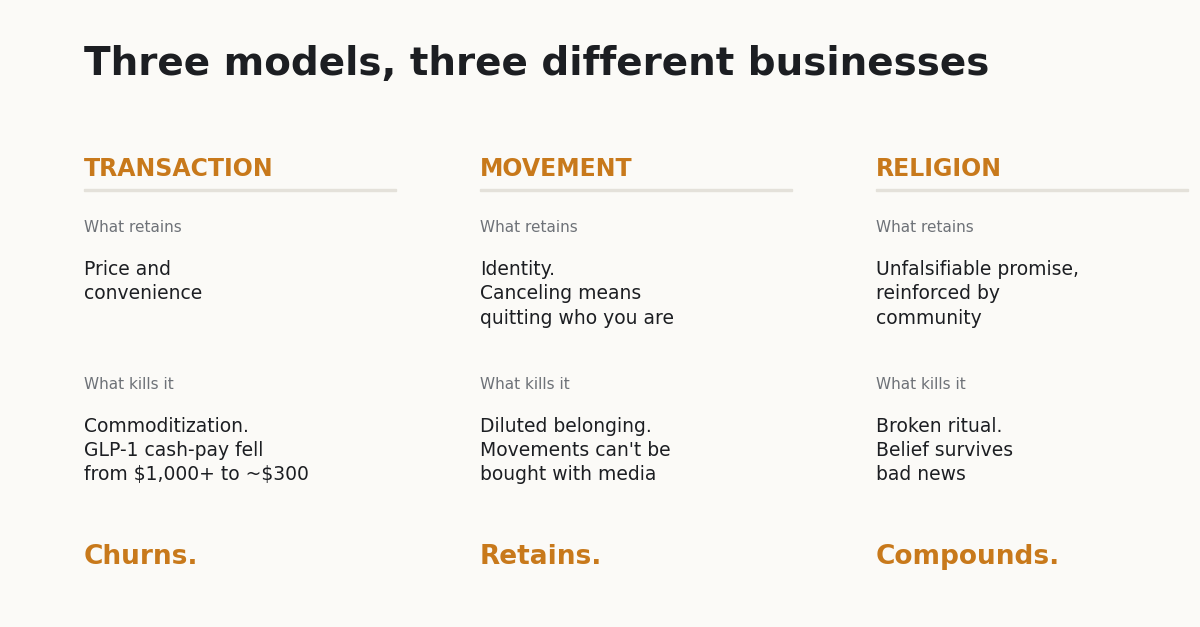
So the question I keep circling back to is how longevity gets you to believe. It’s a long play. What drives faith in the product? Desperation and need are part of it. So are clinical studies, claims, and customer testimonials. But none of those explain why a category can hold a customer for years against a benefit they cannot verify. The answer depends on what the customer is actually buying, and I keep landing on three possibilities: a transaction, a movement, or a religion. Those aren’t the same business, and they don’t run on the same growth math.
Three models, three different businesses
If it’s a transaction, the model is funnel economics. Optimize CPA, compress payback, scale spend. That’s where the GLP-1 platforms live, and the last eighteen months show how it ends. Cash-pay prices fell from over $1,000 a month to around $300. Oral options are entering at $149. Medicare coverage lands mid-year at a $50 copay. When the product commoditizes, transaction businesses compete on price until margin is gone. Acquisition efficiency stops being a moat the moment everyone can afford the funnel.
If it’s a movement, the model is identity economics. The customer isn’t buying a product, they’re joining a self-definition. Churn drops because leaving means quitting who you are, not canceling a subscription. CAC behaves differently too, because movements acquire through belonging, so the community does the marketing. The catch is that movements can’t be bought with media spend. They’re built through language, ritual, and proof, and most growth teams have never built one.
If it’s a religion, look at the retention benchmark, because religions are the most successful subscription businesses in history. An invisible benefit, deferred indefinitely, unfalsifiable by design, held for a lifetime and inherited by your kids. Nobody churns from faith at month three because the ad overpromised. The promise was calibrated to be unfalsifiable, and the community reinforces it weekly. I’m not being glib. That’s a retention architecture, and it’s worth studying seriously.
The Johnson episode is that third architecture working exactly as built. In a transaction business, an incurable diagnosis hitting your most visible customer is a product recall: refunds, churn, lawsuits. In his frame, it became content, community activation, and proof of commitment. There’s a second lesson buried in the same story, though, and it’s the sobering one. The most measured human alive, with a large personal medical team and years of bloodwork, carried a slow silent disease his data didn’t surface for years. Measurement without interpretation isn’t protection. Hold that thought, because it comes back when we get to who’s doing this well.
The GLP-1 numbers nobody wants to own
The GLP-1 data shows what happens when invisible-benefit products run visible-benefit growth math. Two out of three patients without diabetes stop within a year. One in five stop by month three.
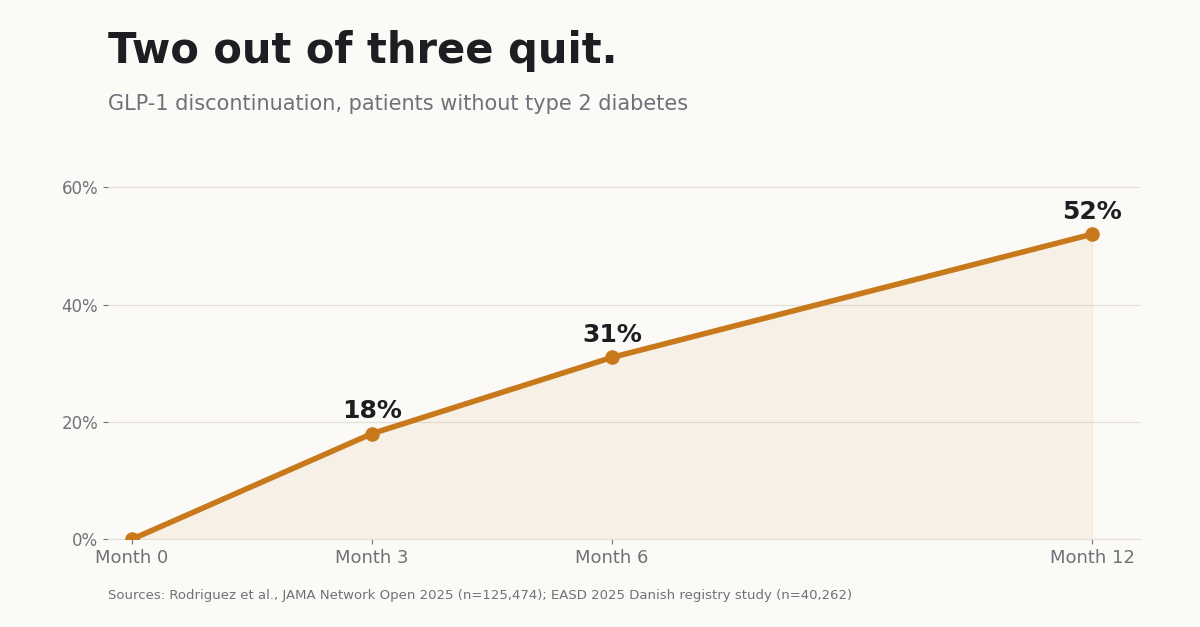
Everyone calls this a retention problem. It’s an acquisition problem, and the numbers prove it. Say your wrapped offering clears $100 in monthly contribution margin per patient, and LTV = monthly margin x months retained.
Patient A: acquired on the biggest promise at $150 CAC. Quits at month 3, right on the curve. LTV $300. Net $150.
Patient B: acquired on an honest promise at $250 CAC. Higher, because honest language filters. Retained 12 months. LTV $1,200. Net $950.
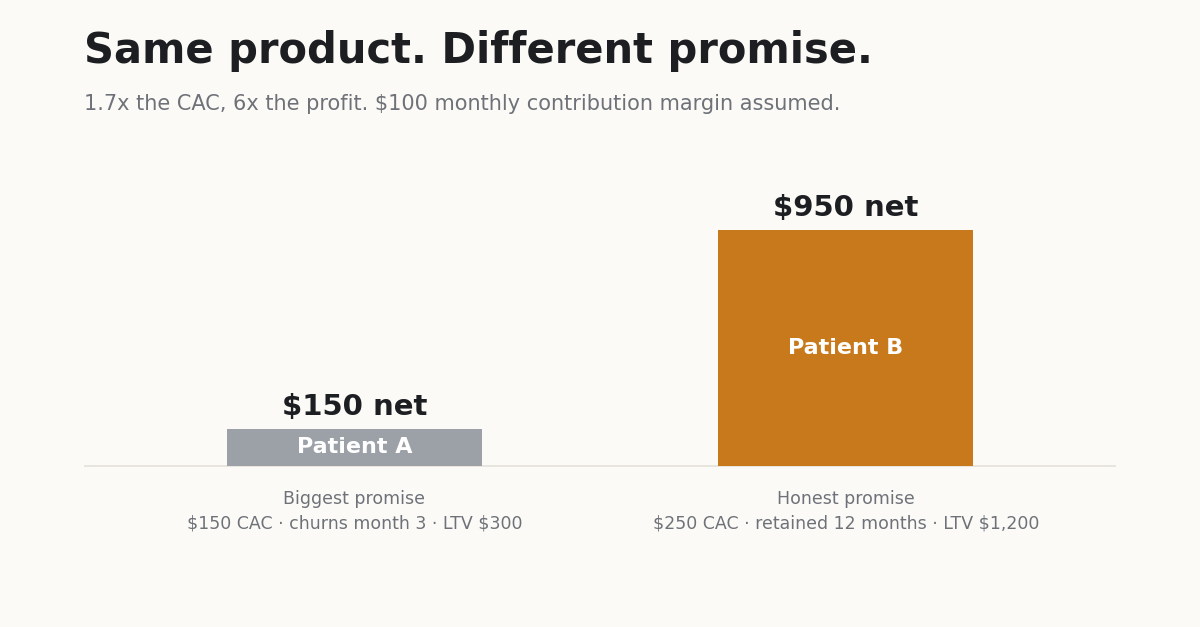
You paid 1.7x the CAC for 6x the profit, and every optimization that lowered Patient A’s CPA made the business worse. Then run the check every operator should run: CAC payback = CAC / monthly margin. If payback lands at month 4 and 18% of your cohort quits by month 3, one in five acquisitions is a guaranteed loss the day you book it. The dashboard calls it efficient. The P&L knows better.
And the churn isn’t about money. The research names three discontinuation drivers: side effects, cost, and perceived lack of benefit. But 30 to 50% of fully insured patients quit within a year too. Cost doesn’t explain that. Perceived lack of benefit does, and that perception was set by the ad, before the first dose shipped. Which brings this back to faith: the patient stopped believing, and the belief was never engineered to survive contact with month three.
How you actually message an invisible benefit
Four approaches work, and the winners stack at least two.
Sell the scoreboard. Convert a decades-long payoff into a 90-day feedback loop by making measurement the product. Biological age scores, biomarker panels with a built-in retest, daily readiness scores. The customer feels the product every morning even though the benefit is decades out.
Interpreters, not endorsers. The category is rotating away from celebrity influencers toward clinicians, scientist-founders, and educators. An endorser lends attention. An interpreter lends permission to believe a long-horizon claim. Only the second one retains.
Sell the felt proxy. When you can’t show the outcome, sell the near-term payoff as the down payment. Energy today as the felt proxy for decades later. This is the riskiest lever, because it drifts back toward overpromising if the proxy isn’t real. That’s the GLP-1 failure mode wearing a lab coat.
Ritual cadence. Weekly scores, quarterly retests, protocol check-ins. Each touchpoint re-justifies the subscription. Frequency of felt interaction substitutes for visibility of benefit.
Notice what all four have in common. They’re language and system decisions made at acquisition, not save-a-cancellation tactics bolted on later. Breakthrough language in this category resonates, it doesn’t disqualify. It converts rather than bounces and retains rather than churns. It’s not just the what, it’s the how, and the how is a repeatable system that starts with the first word a prospect reads.
Who’s running the play well
Function Health is the cleanest example I’ve found because it stacks three of the four levers in one subscription. They made measurements of the product: over 100 biomarkers with a follow-up test built into the membership, so every retest is a renewal event dressed as a health milestone. They put an interpreter at the center instead of an endorser, a physician co-founder translating the data rather than a celebrity smiling next to it. And the retest cadence gives the customer a felt experience of a benefit that won’t otherwise show up for decades. Scoreboard, interpreter, ritual.
Now recall the Johnson lesson from earlier, because it’s the open question hanging over the entire testing category. The scoreboard only works if someone reads it right, and the most measured human alive carried a silent disease his data didn’t catch. Raw biomarkers without interpretation don’t just fail to protect the customer; they actively churn them: patients who get a panel back with eight out-of-range markers and no translation don’t feel empowered; they feel anxious, and anxious customers leave. The interpretation layer isn’t a feature. It’s the retention system. The testing companies that treat it that way will hold their cohorts through the pricing pressure that’s coming for them the same way it came for GLP-1.
The receipt: Molekule
I lived this at Molekule. We sold a premium purifier with expensive PECO filter subscriptions against HEPA, a technology pushing 80 years old, and the benefit was as invisible as it gets: you cannot taste clean air. The internal belief was that the hardware plus filters had durable retention value, but the harder conviction was on the net-new side, that removing the customer’s doubt about PECO versus HEPA was worth more than inflating the promise, and that a customer who crossed that doubt wanted to be part of a growing Molekule community, not just own a gadget.
So we engineered belief at acquisition. We tested claims in social until one showed both high response and high conversion, then built the system around it: a 30 day no questions asked free trial / return policy that made the promise testable at zero risk, trust and credibility symbols where the doubt lived, and real customer testimonials doing the interpreting instead of us. We ran it as a test first and only rolled it out once we were sure returns had moved marginally, not materially, because a risk reversal that spikes returns is just churn with extra shipping. Conversion rose ~20% and CAC came down with it. And we didn’t grade the win on the conversion lift. We graded it on a 90-day actual filter sign-up to LTV, because in a filter subscription business the purifier sale is the acquisition, and the filter sign-up is the retention. That metric improved and churn fell, and every one of those changes was acquisition-side work. The language and the risk reversal did the retention job before the retention team ever saw the customer.
Where this leaves the category
Access got cheap. Anyone can fill a funnel at $300 a month. The moat is who keeps the patient, and that depends on what you’re actually selling. A transaction churns, a movement retains, a religion compounds. I’m still working out which one longevity is, but I suspect the companies that answer correctly will be the ones standing in 2028. If you’re operating in this category, I’d like your read: transaction, movement, or religion?
Read the full breakdown: [The Retention Architecture of Invisible Benefits: From Transactional Utility to Sacred Belief] for the cohort financial models and 4-quadrant matrix.
Sources: Rodriguez et al., JAMA Network Open (2025), cohort of 125,474 GLP-1 patients; EASD 2025 Danish registry study of 40,000+ semaglutide patients; eClinicalMedicine (Lancet) on post-discontinuation weight maintenance; Grosicki et al. meta-analysis of one-year GLP-1 discontinuation; public coverage of Novo Nordisk and Eli Lilly cash-pay pricing (Nov 2025 to Feb 2026) and Bryan Johnson’s July 2026 disclosure.
Get the next one by email
Occasional notes on growth, brand and performance. No spam, one click to leave.