Adobe released some interesting data recently on how people are using AI to research travel and products. On the surface, the story is that AI traffic is growing very quickly and, perhaps more importantly, the people coming through these channels are increasingly behaving like high-intent consumers once they actually reach a brand site. But a few layers in, I think there is a bigger implication here than simply another conversation about AI traffic, GEO or how brands should make themselves more readable to LLMs. For most of the internet era, we have built digital marketing around the assumption that the website itself is part of the navigable pathway to purchase. AI potentially starts to change that assumption because more of the research, comparison, evaluation and narrowing of options can now happen before someone ever reaches the site.
The Adobe numbers are pretty striking. AI traffic to U.S. travel sites increased 119% YoY in July 2026 and has grown 1,822% since Adobe began tracking it in October 2024. Retail AI traffic increased 62% YoY and 1,219% over the same period. More interestingly, AI-referred retail traffic is now converting 60% better than non-AI traffic, while travel traffic coming from AI is essentially at parity, just 1% lower. A year earlier the travel conversion gap was 47%. Adobe also found that AI-referred retail visitors spend 59% more time on the site, are 33% less likely to bounce and add products to cart at a 28% higher rate. In travel, AI-referred visits are 67% longer, engagement is 21% higher and bounce rates are 42% lower. Add in the fact that 95% of respondents using AI for travel said they believe the responses are as trustworthy as traditional search, and it starts to look less like a fringe acquisition channel and more like a meaningful shift in how people are making decisions.
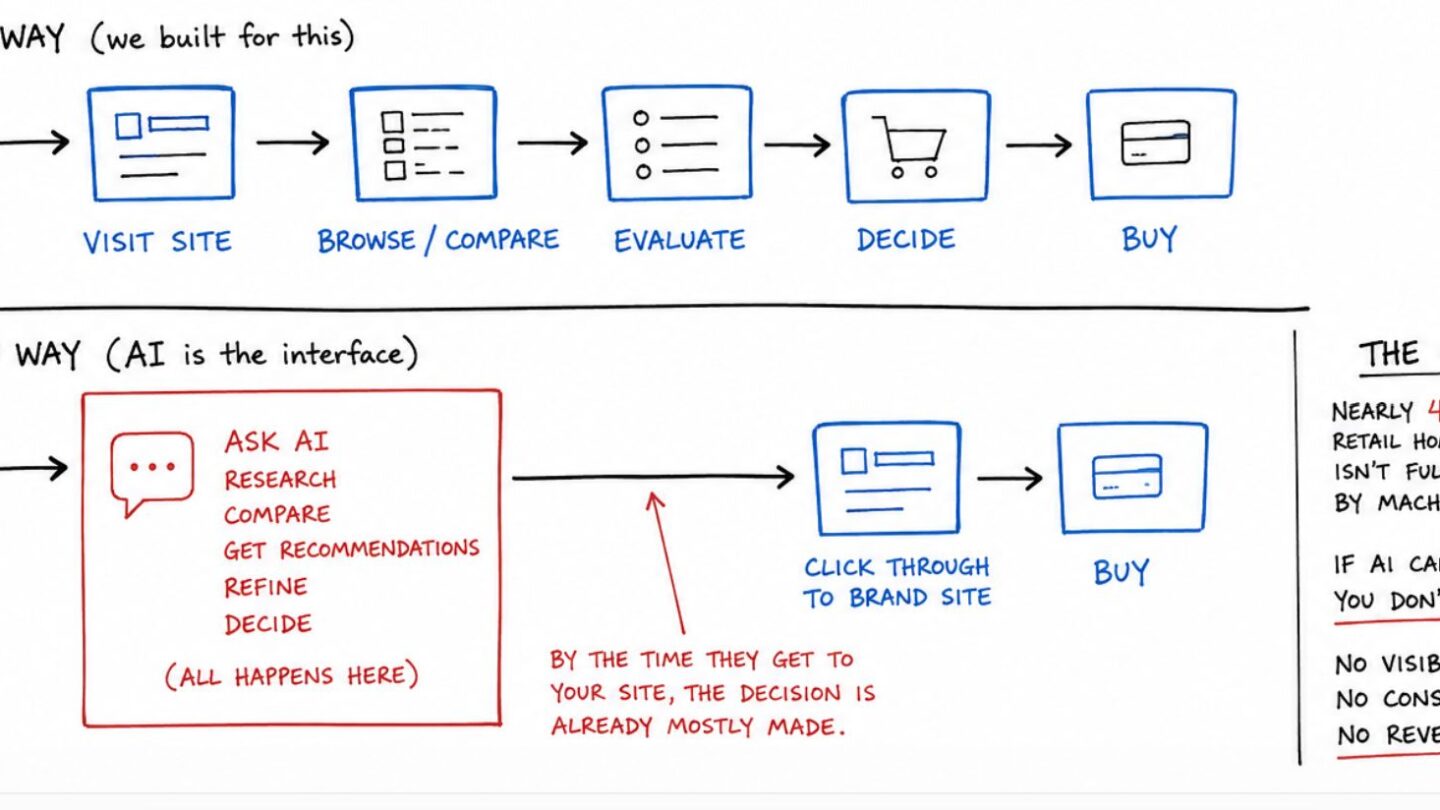
For me, the more interesting question is what this starts to do to the buyer journey itself. Historically, if someone wanted to buy a product, book a hotel or choose between a few options, they did much of the work manually. They searched, opened a bunch of tabs, visited multiple websites, browsed categories, compared products, read reviews, checked pricing, went to Reddit or YouTube, came back later through search, retargeting or email, and eventually made a decision. We then built an enormous amount of marketing infrastructure around making that path easier to navigate and more likely to convert. SEO got people into the site, information architecture helped them find what they were looking for, merchandising helped them discover products, reviews created validation, landing pages tried to organize information around intent, CRO reduced friction, and attribution attempted to reconstruct everything that happened along the way.
AI changes the mechanics because the consumer no longer needs to personally navigate every one of those steps. Someone can describe what they actually want, explain the constraints, ask for alternatives, compare products, understand the tradeoffs, check pricing, ask what people like or dislike, refine the criteria and keep going until they have narrowed things down considerably. Instead of searching for “best running shoes” and manually piecing together the answer across ten different sources, I can say that I run 20 miles a week, mostly on pavement, have wide feet, care more about cushioning than speed and don’t want to spend more than $160. Then I can ask why one option is better than another, what people complain about, which one is better for longer runs, what I give up with the cheaper option and how each compares with the shoe I already own. The consumer is still making the decision, but increasingly AI is doing the cross-referencing and synthesis that previously required the consumer to move through the web themselves.
That is where I think the role of the website starts to get interesting. Historically, we worked incredibly hard to get someone to the site because the site itself was expected to help shape the decision. Increasingly, that decision may be substantially formed before the visit even happens. Adobe’s engagement data seems to support that possibility. If AI-referred visitors are spending more time on the site, bouncing less, adding to cart more often and converting at higher rates, one plausible explanation is that they are simply arriving with more context and much further along in the decision. They aren’t necessarily starting the journey when they land on the website. They may be finishing it.
I don’t think that means websites become less important. In many cases, they may become more important, but for a different reason. The site still has to validate the recommendation, provide confidence, make pricing and availability clear, answer any remaining questions and ultimately facilitate the transaction. But if the consumer arrives already knowing what they want, why it fits their needs, what the alternatives are and roughly what they should expect to pay, the role of the site starts to shift from helping someone navigate toward a decision to helping them validate and complete one. That is a materially different experience and, over time, probably a materially different design problem.
There is also another layer that I think marketers need to pay much more attention to, which is that the website increasingly has two audiences rather than one. We have spent decades optimizing digital experiences for humans, but now there is an intermediary reading the site on the consumer’s behalf and deciding what information is relevant enough to surface. That intermediary needs to understand what the product is, who it is for, how much it costs, how it compares with alternatives, where it is available, what customers think about it and why someone should choose it. If that information is difficult for a machine to parse, the problem occurs before the consumer ever reaches the website.
Adobe’s visibility data makes that pretty clear. The average U.S. retail homepage has an AI visibility score of just 61%, meaning nearly 40% of the content is not fully readable by machines. Apparel scored 76%, electronics 70%, cosmetics 68%, sporting goods 67%, furniture and home 64%, general merchandise 63%, and grocery just 59%. Travel has similar gaps, with hotel homepages at 71%, cruise lines at 70%, car rental at 64% and airlines at just 42%. So while brands may be spending enormous amounts of time optimizing how people move through the experience, a meaningful amount of the underlying information AI needs to understand the business is not even readable.
This is why I don’t think the conversation can stop at GEO or AEO. Those are important, but treating this purely as the next version of SEO misses the larger structural change. Search historically helped people find the pathway. AI can increasingly participate in the pathway itself. That has implications for content because information has to work for both humans and machines, for merchandising because product comparisons may increasingly happen somewhere you don’t control, for brand because the AI is synthesizing what you say about yourself alongside reviews, Reddit, publishers, creators and marketplaces, and for measurement because the referral click we see at the end may tell us almost nothing about the research and decision process that happened before it.
It also creates a different CRO problem. A consumer who comes in through traditional search may still need discovery, education and comparison. An AI-referred visitor may already know the specific product they want and why. Treating those two users exactly the same seems unlikely to remain optimal. Over time, I would expect the site experience, landing logic, product information and even measurement frameworks to become more adaptive to where the decision was actually made rather than assuming every visitor is starting from roughly the same place.
I don’t think websites disappear, and I don’t think consumers stop navigating them entirely. But I do think we should question an assumption that has been embedded in digital marketing for decades, which is that people will personally move through the information architecture we have so carefully created in order to make a decision. Increasingly, some of that work will happen elsewhere and some of it will be handled by AI.
If AI increasingly navigates the information instead of the consumer navigating the website, marketers may need to rethink what a website is actually supposed to do. That feels like a much bigger question than how to rank in ChatGPT.
Source: Adobe: https://business.adobe.com/blog/us-consumers-are-embracing-llms-to-make-travel-plans
Get the next one by email
Occasional notes on growth, brand and performance. No spam, one click to leave.