In 2013, when Publicis and Omnicom first attempted their mega-merger, I sat down with AdExchanger and called it the “end of the agency era.” My argument then was that these moves were “last ditch efforts” driven by exhausted R&D and a desire for financial efficiencies rather than better work.
Twelve years later, Omnicom has officially closed its $13 billion acquisition of IPG. The press release is stuffed with 2025 buzzwords, claiming the merger will “harness the significant opportunities of generative artificial intelligence” to create “sales leadership”.
Don’t let the tech jargon fool you. This isn’t an innovation play. It is an infrastructure consolidation designed to solve a math problem, not a marketing one.
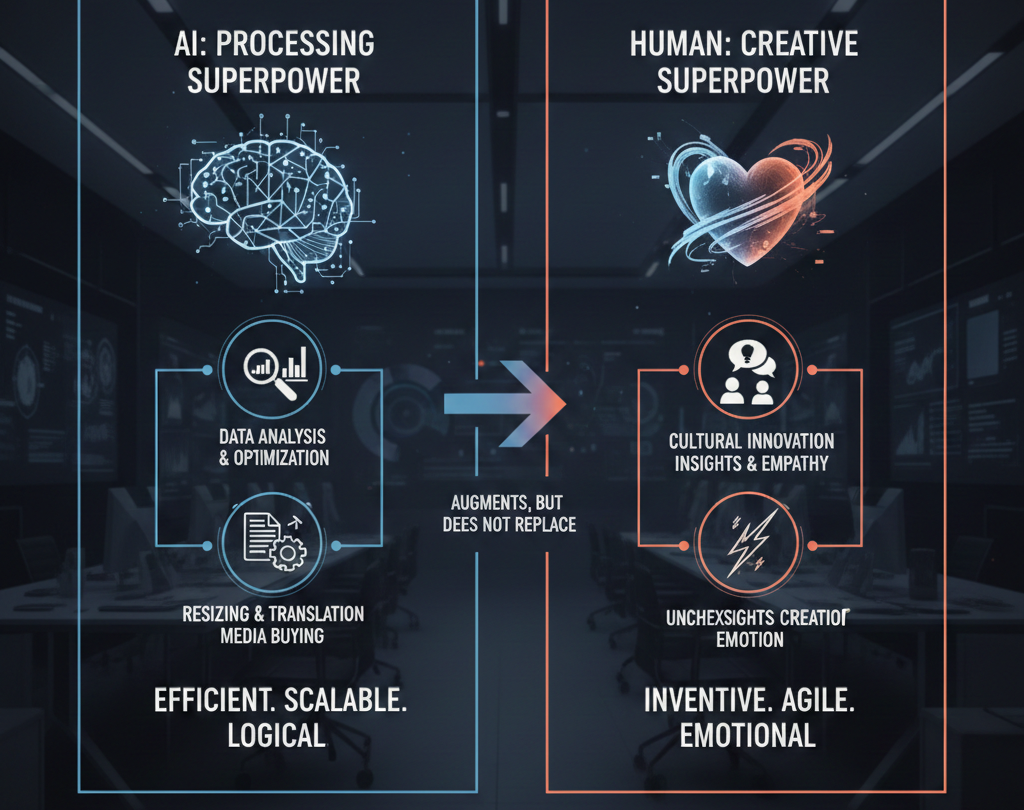
AI Is a Processing Superpower, Not a Creation Superpower
The core justification for this merger is that “scale” is required to feed the AI beast. Omnicom claims the combined entity will accelerate “ideation and creation”.
I disagree. We need to distinguish between processing and creation.
AI is a processing superpower. It can resize assets, translate copy, optimize media spend, and analyze patterns faster than any army of junior associates. But it does not possess the creation superpower required to move culture.
To resonate with a niche community, whether it’s F1 fans or Android users, you need team members who “speak the language” and can sniff out inauthenticity in a second. You need the human intuition to turn a typo (like Nicki Minaj calling Shopify “Spotify”) into a brand win, rather than a PR crisis.
AI can process the recap, but it cannot create the moment. By betting the farm on AI, Omnicom is doubling down on the commoditized middle, the processing layer, while the true value of an agency (creative invention) remains a uniquely human, un-scalable trait.
The Data Fallacy: Renting the Fuel
To train a proprietary model that offers a true competitive moat, you need proprietary data. Publicis understood this years ago when they acquired Epsilon and Axciom, effectively buying the fuel for their engine. Omnicom and IPG, by contrast, generally do not own the underlying consumer data in the same way. They are service providers processing client data.
Without a proprietary data lake like Axciom, the “scale” Omnicom just bought is simply a larger volume of rented data. They are building a bigger refinery, but they still don’t own the oil.
Culling the Herd for Margin Preservation
If the AI isn’t for creative invention, and they don’t own the data to build a unique brain, what is the $13 billion actually for? It is for margin preservation.
The goal is to use AI to strip out the “inefficiencies” of human capital: the mid-level managers, the media planners, the production staff. By consolidating IPG’s roster into Omnicom’s AI infrastructure, they can drastically reduce headcount to protect margins in an era where clients are squeezing fees.
The Verdict
The Omnicom-IPG merger is a brilliant financial maneuver for a company realizing that its traditional service model is too expensive. By replacing human processing with AI processing, they will undoubtedly save money.
But let’s not call it the future of marketing. The brands winning today are moving away from “long-tail campaigns” toward a “shipping mentality” driven by culture-obsessed humans. Omnicom has built a massive machine to process the past efficiently. But they are no closer to creating the future.
Get the next one by email
Occasional notes on growth, brand and performance. No spam, one click to leave.