The Illusion of Platform Automation
The contemporary performance marketing landscape has entered an era of total platform financialization. Paid media practitioners are continuously told that account fragmentation is the enemy of efficiency. The prescription from major ad networks is uniform: consolidate budgets, remove audience guardrails, and rely entirely on creative asset variations to execute targeting segmentations.
While this advice maximizes data liquidity and reduces platform-level friction, it introduces a severe systemic vulnerability: it aligns ad spend with algorithmic convenience rather than corporate unit economics. For growth executives managing complex product lines, varying contribution margins, and volatile lifetime values (LTV), blind account consolidation represents a profound strategic risk.
To manage ad platforms predictably over multiple quarters, enterprise brands must shift from reactive tactical adjustments to a durable, repeatable governance model. To strip away the noise of platform trends, we can map this operational challenge into a classic, elegant business favorite: a clean, data-driven four-quadrant framework.
This article introduces the Strategic Autonomy vs. Liquidity Matrix (The SALM Model)—a structured tool designed to determine exactly when to leverage algorithmic automation and when to enforce rigid structural boundaries.
The Fundamental Flaw of Algorithmic Bias
To understand why total consolidation fails a complex business, one must analyze the objective function of machine learning models. Meta’s algorithm is fundamentally built to maximize conversion volume based on the data parameters it is given. It is completely blind to a company’s back-end financial constraints, variable manufacturing margins, or supply chain obligations.
If a brand places a high-margin, high-LTV product (Product A) into the same consolidated campaign asset pool as a low-margin, single-purchase item (Product B), the algorithm will rapidly analyze user behavior and identify that Product B converts with less friction. Consequently, the automated budget optimization mechanics will direct the vast majority of capital toward Product B to deliver a lower platform-level Cost Per Acquisition (CPA).
On paper, the advertising account appears highly optimized. In reality, the business engine is starving its most valuable long-term asset line while scaling an inefficient, low-margin product. Total consolidation leaves the brand entirely vulnerable to the platform’s path of least resistance.
The SALM Matrix: An Executive Framework
The choice between account consolidation and structural segmentation should never be an emotional debate or a reaction to a single week of poor performance. Instead, it must be driven by an objective analysis of two critical corporate dimensions: Economic Variance and Operational Constraints.
By plotting these variables on a classic 2×2 grid, we can visually isolate the exact structural strategy required for your business.
<!-- THE SALM MATRIX WEB COMPONENT -->
<div class="w-full max-w-5xl mx-auto bg-[#12131C] text-slate-200 p-8 rounded-xl font-sans border border-[#2E3142]">

  <!-- Header / Labels -->
  <div class="flex justify-between items-center mb-6 border-b border-[#2E3142] pb-4">
    <div>
      <h3 class="text-xl font-bold text-white tracking-wide">THE SALM MATRIX</h3>
      <p class="text-xs text-slate-400">Strategic Autonomy vs. Liquidity Model</p>
    </div>
    <div class="text-right">
      <span class="text-xs font-mono uppercase bg-[#2E3142] px-3 py-1 rounded text-slate-300">Executive View</span>
    </div>
  </div>


  <!-- 2x2 Grid Layout -->
  <div class="grid grid-cols-1 md:grid-cols-2 gap-6">

    <!-- Quadrant 2: Strategic Segmentation -->
    <div class="border-l-4 border-[#F59E0B] bg-[#1A1C29] p-6 rounded-r-lg shadow-md">
      <div class="flex items-center justify-between mb-3">
        <span class="text-xs font-bold tracking-wider uppercase text-[#F59E0B]">🔴 High Intent / High Variance</span>
        <span class="text-xs font-mono text-slate-500">[ Q2 ]</span>
      </div>
      <h4 class="text-lg font-bold text-white mb-1">STRATEGIC SEGMENTATION</h4>
      <p class="text-xs text-slate-400 italic mb-4">(Strategic Isolation)</p>
      <ul class="space-y-2 text-sm text-slate-300">
        <li><strong class="text-slate-400">■ Focus:</strong> High Economic Variance</li>
        <li><strong class="text-slate-400">■ Action:</strong> Isolate High-LTV Business Lines</li>
        <li><strong class="text-slate-400">■ Risk:</strong> Algorithmic bias starves premium assets</li>
      </ul>
    </div>


    <!-- Quadrant 4: The Hybrid Model -->
    <div class="border-l-4 border-[#10B981] bg-[#1A1C29] p-6 rounded-r-lg shadow-md ring-1 ring-[#10B981]/20">
      <div class="flex items-center justify-between mb-3">
        <span class="text-xs font-bold tracking-wider uppercase text-[#10B981]">🟢 THE SCALE ENGINE</span>
        <span class="text-xs font-mono text-slate-500">[ Q4 ]</span>
      </div>
      <h4 class="text-lg font-bold text-white mb-1 text-[#10B981]">THE HYBRID MODEL</h4>
      <p class="text-xs text-slate-400 italic mb-4">(The Balanced Engine)</p>
      <ul class="space-y-2 text-sm text-slate-300">
        <li><strong class="text-slate-400">■ Focus:</strong> High Variance + High Constraints</li>
        <li><strong class="text-slate-400">■ Action:</strong> Deploy a Core + Satellite Structure</li>
        <li><strong class="text-slate-400">■ Risk:</strong> Requires strict manual bid caps</li>
      </ul>
    </div>


    <!-- Quadrant 1: Full Consolidation -->
    <div class="border-l-4 border-[#3B82F6] bg-[#1A1C29] p-6 rounded-r-lg shadow-md">
      <div class="flex items-center justify-between mb-3">
        <span class="text-xs font-bold tracking-wider uppercase text-[#3B82F6]">🔵 Low Intent / Uniform Economics</span>
        <span class="text-xs font-mono text-slate-500">[ Q1 ]</span>
      </div>
      <h4 class="text-lg font-bold text-white mb-1">FULL CONSOLIDATION</h4>
      <p class="text-xs text-slate-400 italic mb-4">(The Liquid Machine)</p>
      <ul class="space-y-2 text-sm text-slate-300">
        <li><strong class="text-slate-400">■ Focus:</strong> Low Economic Variance</li>
        <li><strong class="text-slate-400">■ Action:</strong> Maximize Data Liquidity (ASC / CBO)</li>
        <li><strong class="text-slate-400">■ Risk:</strong> Internal overlap if SKUs diverge</li>
      </ul>
    </div>


    <!-- Quadrant 3: Operational Segmentation -->
    <div class="border-l-4 border-[#E11D48] bg-[#1A1C29] p-6 rounded-r-lg shadow-md">
      <div class="flex items-center justify-between mb-3">
        <span class="text-xs font-bold tracking-wider uppercase text-[#E11D48]">🟡 COMPLEX OPERATIONS</span>
        <span class="text-xs font-mono text-slate-500">[ Q3 ]</span>
      </div>
      <h4 class="text-lg font-bold text-white mb-1">OPERATIONAL SEGMENTATION</h4>
      <p class="text-xs text-slate-400 italic mb-4">(Operational Railing)</p>
      <ul class="space-y-2 text-sm text-slate-300">
        <li><strong class="text-slate-400">■ Focus:</strong> High Operational Constraints</li>
        <li><strong class="text-slate-400">■ Action:</strong> Force Spend to Inventory Leaks</li>
        <li><strong class="text-slate-400">■ Risk:</strong> Can reset learning phases if reactive</li>
      </ul>
    </div>


  </div>


  <!-- Footer Axis Labels -->
  <div class="mt-6 pt-4 border-t border-[#2E3142] flex flex-col sm:flex-row justify-between text-xs text-slate-400 font-mono gap-2">
    <div>[ Y-AXIS ]: ECONOMIC VARIANCE (Margins, AOV, LTV Profiles)</div>
    <div class="sm:text-right">[ X-AXIS ]: OPERATIONAL CONSTRAINTS (Inventory, Logistics, Strategy)</div>
  </div>
</div>
Quadrant 1: Full Consolidation (The Liquid Machine)
- Criteria: Low Economic Variance, Low Operational Constraints.
- Execution: When a business features a single core offer, uniform gross margins across its SKU catalog, and stable, unconstrained inventory, full consolidation is highly effective. By lumping assets under a unified structure, the account eliminates internal auction overlap, aggregates conversion signals swiftly to exit the platform’s learning phase, and achieves a lower blended CPM.
Quadrant 2: Strategic Segmentation (Strategic Isolation)
- Criteria: High Economic Variance, Low Operational Constraints.
- Execution: When a brand sells products with vastly divergent customer lifecycles—such as an enterprise SaaS tier alongside a self-serve starter package—the accounts must be isolated. Segmenting these business units via dedicated campaign architecture ensures that high-value consumer profiles receive guaranteed capitalization, completely insulated from the algorithm’s natural bias toward lower-value, high-velocity conversions.
Quadrant 3: Operational Segmentation (Operational Railing)
- Criteria: Low Economic Variance, High Operational Constraints.
- Execution: This quadrant is defined by real-world operational logistics. Even if product margins are uniform, a brand may face severe warehouse overstocks, local distribution imbalances, or strict, time-sensitive product launch windows. Because machine learning models require historical data consistency, they cannot adapt dynamically to sudden supply chain emergencies. Explicit campaign architecture must be leveraged to force inventory liquidity.
Quadrant 4: The Hybrid Framework (The Balanced Engine)
- Criteria: High Economic Variance, High Operational Constraints.
- Execution: This is the operating reality for scaling enterprise brands. It requires a dual-layered account architecture that captures the cost efficiencies of automation while enforcing the ironclad guardrails required by corporate finance.
Reclaiming Control: The Outside-In Audience Framework
Relying entirely on creative variations to find your audiences, as platform guidelines dictate, is a dangerous gamble. Meta’s algorithm optimization model is reactive, not proactive; it shifts spend based on early, cheap engagement metrics (like video views or post likes), which frequently fail to correlate with deep business unit profitability or actual user intent.
To build a repeatable, scalable acquisition engine, you must define and segment your audiences from the outside in, using a strict hierarchy of Intent, Utility, and Affiliation.
1. Deterministic Audience Segmentation (First-Party & Behavioral Data)
This is your most critical audience segment, representing known human entities with explicit brand interactions. By utilizing your first-party database, including hashed CRM lists, server-side Conversions API (CAPI) retention cohorts, and offline transaction records, you build explicit audience boundaries.
When executing strict net-new customer acquisition, these deterministic groups must be used as absolute exclusion fences. This forces the algorithm to focus its computational power exclusively on cold market expansion, preventing it from taking the lazy path of fluffing performance metrics by retargeting warm, existing users.
2. Seed-Based Probabilistic Segmentation (Value-Based Lookalikes)
When scaling beyond your immediate warm audience, you cannot simply go “broad” and hope Meta figures out who your best buyers are. You must guide the machine by feeding it high-value audience templates.
Instead of building a generic lookalike based on all past purchasers, you segment your customer database to isolate your top 10% highest-LTV or highest-margin buyers. Use this refined, premium cohort as your seed list to generate a 1% to 2% Value-Based Lookalike (VBO). This passes a sophisticated directional signal to Meta, handing it a mathematically precise archetype of a profitable customer.
3. Broad Contextual Segmentation (Structural Persona Isolation)
This is where you leverage Meta’s open liquidity, but you do it with an intentional, cross-functional strategy—aligning creative production directly with specific human utility or distinct buyer personas. If your product serves two entirely different customer archetypes, you do not put their creative assets into the same ad set. You segment them into separate ad sets running within your Strategic Satellites, keeping the targeting completely broad (open demographics) but completely isolating the creative messages.
This forces the system to spend the allocated capital exactly against that distinct persona’s message-match landing page, giving you clean, uncompromised data on which audience hook actually drives profitable unit economics.
Architecting the Hybrid System
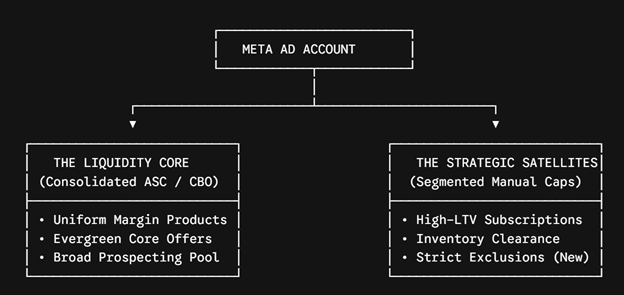
Implementing a durable hybrid system requires dividing the ad account into two distinct operational components mapped out by our quadrant and audience analysis: The Liquidity Core and The Strategic Satellites.
Layer 1: The Liquidity Core
The Liquidity Core serves as the account’s baseline engine. It utilizes maximum automation (Advantage+ Shopping or centralized CBO structures) and contains evergreen, standardized-margin products or broad prospecting lead funnels. This layer is designed to give the platform the massive, unstructured pool of data it requires to optimize its machine learning models, effectively keeping the account’s baseline costs steady.
Layer 2: The Strategic Satellites
Surrounding the core are the Strategic Satellites. These are manual, segmented campaigns deployed to protect highly specific business initiatives identified by Quadrants 2 and 3. Whether managing a premium product tier, a geographic expansion, or a strict net-new user acquisition pipeline with forced first-party data exclusions, these campaigns operate under strict bid controls.
By utilizing Cost Caps or Bid Caps rather than Highest Volume bidding, the Strategic Satellites are governed by an automated financial valve. If the ad auction becomes hyper-competitive and threatens profit margins, the cap automatically restricts delivery to protect unit economics. If inventory becomes cheap and highly profitable, the system automatically capitalizes on the opportunity.
Conclusion: Control Your Strategy, Leverage the Machine
The debate between total consolidation and infinite segmentation is built on a false dichotomy. Growth success does not belong to those who blindly trust platform automation, nor does it belong to those who fight it with micro-managed, fragmented structures.
True enterprise scaling belongs to the growth executives who rely on rigorous, repeatable operational frameworks. By looking at your growth channels through a disciplined 2×2 lens, you ensure that your media buying structure is built entirely around your business’s financial reality—allowing you to fully leverage the computational power of modern algorithms while ensuring you never lose control of your strategic destiny.
Get the next one by email
Occasional notes on growth, brand and performance. No spam, one click to leave.