
Month: November 2025

The Great Cull: Why the Omnicom-IPG Merger is a Margin Play, Not a Creative One

Omnicom Merger

In 2013, when Publicis and Omnicom first attempted their mega-merger, I sat down with AdExchanger and called it the "end of the agency era." My argument then was that these moves were "last ditch efforts" driven by exhausted R&D and a desire for financial efficiencies rather than better work.

Twelve years later, Omnicom has officially closed its $13 billion acquisition of IPG. The press release is stuffed with 2025 buzzwords, claiming the merger will "harness the significant opportunities of generative artificial intelligence" to create "sales leadership".

Don't let the tech jargon fool you. This isn't an innovation play. It is an infrastructure consolidation designed to solve a math problem, not a marketing one.

AI is a Processing Superpower, Not a Creation Superpower

The core justification for this merger is that "scale" is required to feed the AI beast. Omnicom claims the combined entity will accelerate "ideation and creation".

I disagree. We need to distinguish between processing and creation.

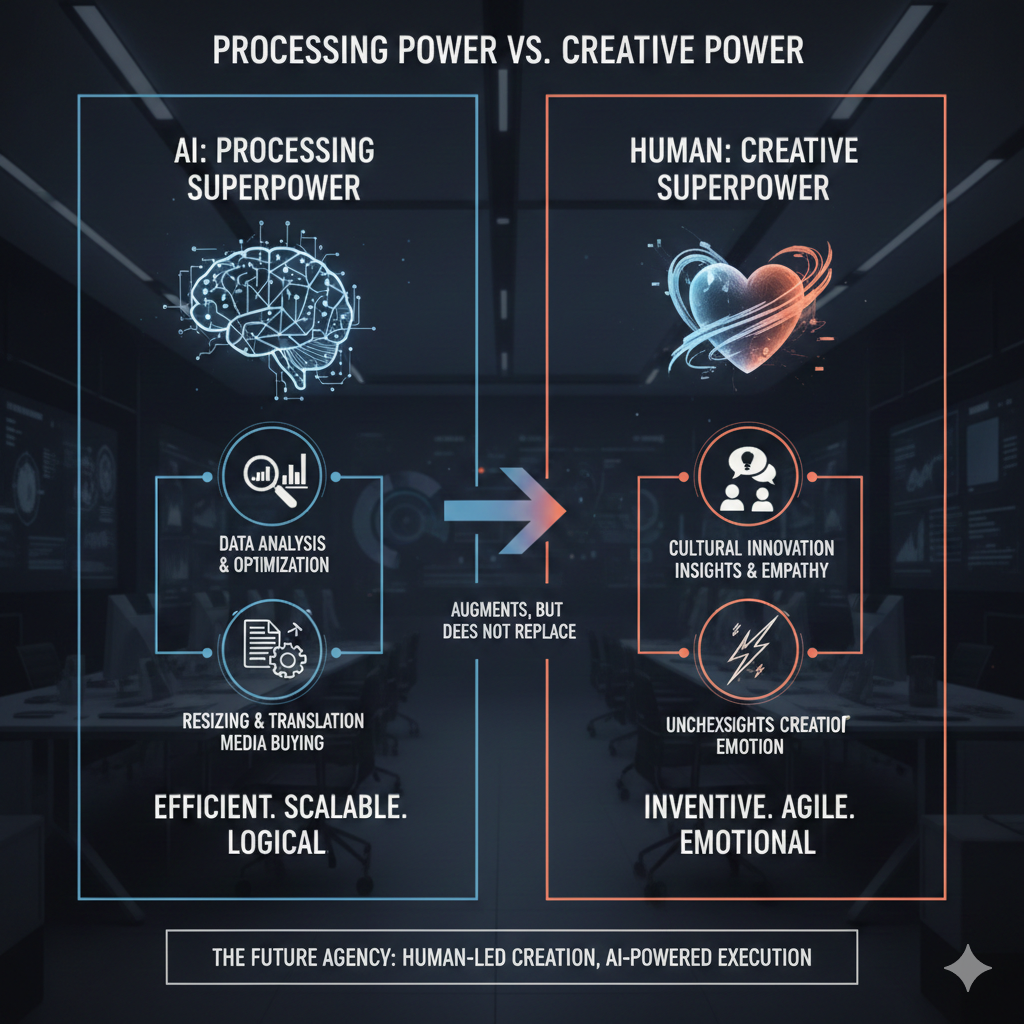
AI is a processing superpower. It can resize assets, translate copy, optimize media spend, and analyze patterns faster than any army of junior associates. But it does not possess the creation superpower required to move culture.

As noted in a recent discussion at ADWEEK House, modern marketing runs on "agility" and "insiders". To resonate with a niche community - whether it’s F1 fans or Android users - you need team members who "speak the language" and can sniff out inauthenticity in a second. You need the human intuition to turn a typo (like Nicki Minaj calling Shopify "Spotify") into a brand win, rather than a PR crisis.

AI can process the recap, but it cannot create the moment. By betting the farm on AI, Omnicom is doubling down on the commoditized middle - the processing layer - while the true value of an agency (creative invention) remains a uniquely human, un-scalable trait.

The Data Fallacy: Renting the Fuel

The second hole in the "AI innovation" narrative is the data itself. To train a proprietary model that offers a true competitive moat, you need proprietary data.

Publicis understood this years ago when they acquired Epsilon and Axciom, effectively buying the fuel for their engine. Omnicom and IPG, by contrast, generally do not own the underlying consumer data in the same way. They are service providers processing client data.

Without a proprietary data lake like Axciom, the "scale" Omnicom just bought is simply a larger volume of rented data. They are building a bigger refinery, but they still don't own the oil.

Culling the Herd for Margin Preservation

If the AI isn't for creative invention, and they don't own the data to build a unique brain, what is the $13 billion actually for?

It is for margin preservation.

In 2013, John Wren admitted the Publicis-Omnicom deal would create $500 million in "efficiencies". In 2025, AI is the ultimate efficiency engine. This merger isn't about empowering talent; it is about "culling the herd."

The goal is to use AI to strip out the "inefficiencies" of human capital - the mid-level managers, the media planners, the production staff. By consolidating IPG's roster into Omnicom's AI infrastructure, they can drastically reduce headcount to protect margins in an era where clients are squeezing fees.

This is the "right-sizing" I predicted in 2013, but on a technological steroid.

The Verdict

The Omnicom-IPG merger is a brilliant financial maneuver for a company realizing that its traditional service model is too expensive. By replacing human processing with AI processing, they will undoubtedly save money.

But let’s not call it the future of marketing. The brands winning today are moving away from "long-tail campaigns" toward a "shipping mentality" driven by culture-obsessed humans.

Omnicom has built a massive machine to process the past efficiently. But they are no closer to creating the future.
Meta’s Instagram Reels Skippable Ads: The Quiet Revolution

Meta Insta Reels skippable ads

Members Only Podcast

Please log in or subscribe to listen.

In October 2025, Adweek confirmed Meta began testing Instagram Reels skippable ads, mirroring YouTube’s in-stream ad format. Users can now skip ads after a few seconds and jump back to their video feed.

At first glance, it might look like a simple UX experiment. But beneath it lies a major shift in how attention, intent, and creative performance could be measured across social platforms.

The Test and Its Context

According to Adweek reporter Trishla Ostwal, Meta is running a limited test to understand whether this format helps users discover businesses more effectively.
Unlike YouTube, Meta is not sharing revenue with creators during the pilot phase.

The timing is deliberate.
Gartner’s 2025 CMO Spend Survey shows marketers allocating 30.6% of total budgets to paid media, a 10% year-over-year increase. Social channels are now the second-largest digital spend category. And among them, Instagram has a higher purchase intent than both Facebook and YouTube.

For Meta, the equation is simple: if users tolerate skippable ads without hurting engagement, Reels could become a more efficient revenue engine.

(Source: Adweek, “Meta Is Testing Skippable Ads on Instagram Reels, Borrowing From YouTube’s Playbook,” Oct 17, 2025)

Why It Matters

Skippable ads change the game for both performance marketers and creative teams.

Historically, non-skippable ads were priced at a premium because they guaranteed full viewership. But forced attention rarely equals real engagement. Skippable formats, on the other hand, turn the moment of attention into a user decision and a behavioral signal that can separate curiosity from disinterest.

When someone doesn’t skip, that’s intent data.
When they do, it’s still valuable just different. It tells the algorithm what not to show, and it tells you which creative failed to earn a second chance.

What Growth Marketers Should Do Now

1. Treat skips as data, not failure

Every skip is a signal. Over time, Meta’s delivery models will likely use skip behavior to refine audience targeting. Track skip rates, watch-through rates, and conversions together to uncover patterns that explain quality, not just reach.

2. Redesign creative for “voluntary attention”

The first five seconds of a Reels ad now matter more than ever. Borrow the YouTube hook architecture: open with story, motion, or emotion versus a logo. Reward attention early, and you’ll earn more of it later.

3. Build sequential storytelling

Skippable formats open the door for creative sequencing:

  • Those who skip can be retargeted with shorter, sharper hooks.
  • Those who watch can be served longer or higher-intent creative, like testimonials or offers.

It’s a subtle shift from one-shot persuasion to multi-step storytelling.

4. Expect pricing and auction evolution

Meta could eventually roll out cost-per-view (CPV) or hybrid pricing models. Prepare by modeling CPV vs CPM efficiency and by aligning ROI measurement around view-through conversions.

What to Watch For

AreaShift or RiskWhy It Matters
Measurement NoiseSkip data may complicate attribution and inflate signal-to-noise ratio.Algorithms will need time to interpret skips as quality indicators rather than negatives.
Creative StrategyMay usher in a new short-form storytelling discipline.Teams will need to master earned attention rather than relying on forced impressions.
Auction DynamicsCPMs could temporarily rise as the system learns.Early adopters should isolate budgets to prevent blended CPM distortion.
Attribution ClarityView-based engagement may dilute click-based signals.Marketers must redefine how success is measured beyond CTR.
Creator EcosystemNo revenue share yet for creators.This could limit long-term adoption unless Meta adjusts monetization models.

Staying Ahead of Platform Changes

The speed at which ad platforms evolve means marketers can’t wait for quarterly updates. Teams should build a lightweight “Ad Product Watchlist” to stay current.

Here’s a simple playbook:

  • AI Alerts: Use Feedly, Perplexity, or Google Alerts for “Meta test,” “Reels ad format,” and “auction update.”
  • Weekly Syncs: Align creative and media teams to share what’s changing and test hypotheses early.
  • Rapid Test Protocol: Treat every new ad format like a product feature — run 14-day experiments, report learnings, and scale what works.
  • Partner Engagement: Encourage Meta Partner Managers to include you in closed betas. Early learnings compound over time.

The Takeaway

Skippable Reels ads are not just a UX tweak they’re Meta’s signal that attention is moving from captive to voluntary.

The best growth marketers will recognize this for what it is:
A chance to design for curiosity, not captivity.
To read attention like a behavioral dataset, not a vanity metric.
And to build creative that doesn’t demand attention but earns it.

Welcome Back

Close Window

Sign Out?

Are you sure you want to log out?