
Category: Mergers

Publicis Didn’t Buy LiveRamp. It Bought Time.

I got to wade into the Publicis Groupe acquisition of LiveRamp this weekend and figured I’d share a perspective. My opinions are my own.

Everyone is asking whether this was a smart acquisition, but I think the more important question is whether it was actually necessary.

Because if you read between the lines, this is not really an advertising story. It’s an infrastructure story disguised as an M&A deal.

Publicis is continuing its transformation from a holding company into a platform business powered by agency services. Frankly, they may be the furthest along among the large holdcos in understanding where the market is heading. The traditional agency model was built around media buying leverage, creative services, procurement scale, and client relationships, but the next era looks very different.

AI is compressing execution rapidly. Creative production is accelerating, optimization is becoming automated, segmentation is becoming commoditized, and media buying itself is increasingly system-driven. As that happens, the differentiator shifts lower into the stack. Identity infrastructure, privacy-safe collaboration, closed-loop measurement, proprietary data orchestration, and AI-enabled intelligence systems are becoming the real battleground.

That’s what this deal is actually about.

On paper, the acquisition looks rational. Publicis is paying roughly $2.2B for a company approaching approximately $850MM in ARR, putting the transaction around a 2.6x revenue multiple depending on how you frame it. In an environment where scaled SaaS businesses historically traded much richer, that multiple stands out.

And the infrastructure itself is meaningful. LiveRamp connects more than 25,000 publisher domains and over 500 technology and data partners across 14 markets. Rebuilding that organically would likely take years, even for a company with Publicis’ scale and distribution.

But I think most people are still underestimating what Publicis is really buying here.

They are not simply buying identity resolution or adtech middleware. They are buying positioning for the agentic AI era.

That’s the part that clicked for me after reading deeper into the deal commentary. Publicis keeps using language around “data co-creation,” “agentic transformation,” and “smarter AI agents.” Digiday framed it even more bluntly with the statement, “Identity is the qualifier for AI.”

That’s an extremely important signal.

Because if AI agents become operational layers for marketing, commerce, servicing, and personalization, then competitive advantage no longer comes from simply having access to AI models. The models themselves will increasingly commoditize. The advantage comes from differentiated data, identity continuity, behavioral context, and the ability to safely orchestrate actions across fragmented ecosystems.

Arthur Sadoun basically said this directly when he noted, “There is no way you can win with agents if you don’t have the right and differentiated data.”

That statement tells you this acquisition is about far more than media. It’s about owning part of the infrastructure layer underneath AI-enabled business systems.

At the same time, I think there’s another uncomfortable reality embedded in this deal that deserves more discussion.

If LiveRamp was truly bulletproof as an independent company, why sell now?

That question matters because strategically valuable and independent long-term winner are not always the same thing.

The low multiple itself may actually tell the story. If the market genuinely believed LiveRamp was becoming the dominant independent operating system for the AI era, the valuation probably looks very different. Instead, LiveRamp sat in an awkward middle position for public markets. It wasn’t quite a hyperscaler, wasn’t enterprise SaaS at Salesforce scale, wasn’t a pure AI company, and wasn’t purely infrastructure either.

That ambiguity matters.

At the same time, the identity market itself may eventually become less valuable than people think. Not because identity disappears, but because the economics shift. The strongest businesses are increasingly building direct first-party ecosystems, proprietary behavioral feedback loops, AI-enabled decisioning systems, and authenticated relationships internally rather than relying on external stitching layers across the open web.

In other words, the future may require less brokering of fragmented identity and more ownership of proprietary intelligence systems.

That changes the long-term trajectory for intermediary platforms.

Which is why this acquisition feels simultaneously smart and defensive.

Smart because Publicis clearly understands infrastructure matters in the AI era. Defensive because they also understand the current stack is being rewritten in real time. And frankly, LiveRamp may have understood that too.

There’s a very plausible scenario where remaining independent became the riskier path. Competing in the next era likely requires enormous scale, distribution, enterprise relationships, AI investment, regulatory maturity, and integration depth. Publicis already has Epsilon, Sapient, Lotame, massive enterprise penetration, consulting layers, and media scale. Together, that creates a much stronger ecosystem than LiveRamp operating independently.

To be fair, Publicis probably had limited scaled alternatives available as well. They could have continued expanding Epsilon and Lotame. They could have leaned harder into hyperscaler partnerships or assembled a federated orchestration layer through smaller acquisitions and internal development. But those approaches are slower, more fragmented, and significantly riskier during a market transition that is accelerating monthly, not yearly.

This acquisition buys mature infrastructure, enterprise adoption, privacy frameworks, regulatory maturity, distribution, and perhaps most importantly, time.

That may actually be the entire story.

When incumbents sense platform risk approaching, they tend to buy certainty before the market fully reprices the threat. That’s why this deal feels simultaneously smart and anxious. Smart because infrastructure absolutely matters in the AI era, and anxious because everyone can feel the stack being rewritten in real time. 🔁
The Netflix and Warner Bros. Discovery Acquisition

netflix acquisition of warner bros

Members Only Podcast

Please log in or subscribe to listen.

A Strategic Break Point for the Future of Global Entertainment

Netflix’s $72B acquisition of Warner Bros. Discovery represents a defining pivot point in modern entertainment. What began as a simple streaming service has now become the world’s most powerful entertainment ecosystem. With this deal, Netflix unites global distribution scale with HBO’s prestige storytelling, Warner Bros.’ blockbuster film engine and Discovery’s unscripted production capacity. It signals a consolidation of power that fundamentally reshapes the competitive landscape.

This merger is not simply a business transaction. It is the moment streaming eclipsed Hollywood’s legacy hierarchies and the moment Netflix transitioned from a category leader into a full spectrum entertainment super platform. At the same time, the deal introduces complex challenges involving cultural integration, creative autonomy, antitrust pressure, data oversight and advertiser expectations.

Below is my full strategic breakdown of how the acquisition strengthens Netflix’s position, where it creates vulnerabilities and what it means for consumers, advertisers and the broader industry.

Why Netflix Moved

The streaming market has matured and fragmentation has reached its upper limit. Consumers are subscribing to multiple services and canceling frequently. Content budgets are climbing at unsustainable rates and only a handful of companies have the scale to balance global production costs with subscriber lifetime value.

Warner Bros. Discovery owns world class properties but struggled to maintain financial stability. Netflix is the only platform with the distribution, technology and operational rigor to extract the full value of those assets. The acquisition gives Netflix the depth, breadth and consistency it previously lacked and blocks competitors like Apple, Amazon and Disney from acquiring one of the few remaining premium content portfolios capable of reshaping market share.

What Netflix Gains

Netflix now controls the strongest combined content engine in the industry. HBO supplies prestige storytelling. Warner Bros. delivers blockbuster franchises and leading theatrical production. DC provides a globally recognized superhero universe. Discovery powers low cost unscripted content that fuels everyday engagement.

This broadens Netflix’s monetization strategy beyond subscriptions. The company can now fully participate in theatrical releases, consumer products, experiential programming, licensing and gaming. It can also use its personalization and recommendation technology to match audiences with content at a scale that traditional studios cannot replicate.

The Risks and Complexities

With a deal of this scale, risk is unavoidable. Cultural integration is one of the most immediate challenges. Netflix emphasizes experimentation, speed and data driven decision making. HBO and Warner Bros. rely heavily on creative relationships, legacy processes and long development cycles. The value of the acquisition depends on preserving HBO’s creative DNA while aligning workflows with Netflix’s operational systems.

There is also a high likelihood of antitrust scrutiny since the combined entity surpasses traditional competitive thresholds. Debt pressure adds another layer of complexity, and talent retention will be critical. HBO’s creative network is a key asset and any disruption to long standing relationships could weaken the portfolio that justified the acquisition in the first place.

What This Means for Advertisers

This acquisition significantly alters the future of video advertising. Netflix has already begun expanding its ad supported tier and now inherits HBO and Discovery inventory that advertisers already value for premium audiences, long watch times and content safety.

Netflix will be able to offer

  • unified cross platform measurement
  • deeper audience segmentation
  • premium contextual placements across HBO titles
  • high volume unscripted inventory from Discovery
  • global reach that rivals any broadcaster

This creates an advertising environment where Netflix becomes the most influential premium video partner in the world. Advertisers who once negotiated separately with cable networks, broadcast properties and streaming services will now be dealing with a consolidated powerhouse that controls a significant share of premium impressions.

There is also a shift in leverage. Netflix will have more control over pricing, packaging and access to high value ad inventory. Advertisers accustomed to negotiating across multiple networks may now face a more concentrated and therefore more powerful marketplace.

Data Collection, Privacy and Portfolio Controls

With the integration of HBO Max, Discovery and Warner Bros. properties, Netflix gains access to a significantly expanded data ecosystem. This includes cross genre viewing behavior, franchise engagement, unscripted consumption patterns and historical user behavior across formerly separate services.

This consolidation raises important questions about

  • how cross platform data will be unified
  • how Netflix will govern privacy controls
  • how user level viewing, discovery and search data will be merged
  • how identity resolution will evolve across devices and services
  • how data will be used to drive ad targeting and personalization

Netflix must maintain strict transparency, especially as global regulators are increasingly sensitive to data consolidation. There will be heightened scrutiny in Europe, India and emerging markets where cross service data stitching may raise compliance concerns.

The deal also gives Netflix unprecedented portfolio control. By managing theatrical releases, home entertainment windows, streaming availability and global distribution licensing under one coordinated strategy, Netflix can dictate the lifecycle of high value franchises in a way no other platform can.

This centralization may impact

  • availability of HBO and WB titles on third party services
  • the structure of syndication and licensing deals
  • how exclusivity windows are allocated
  • the timing and tiering of content releases

Netflix will now manage the strategic sequencing of some of the world’s most valuable IP. That control will influence competitors, distributors and even creative negotiations across Hollywood.

Historical Parallels

Consider Disney’s acquisition of Pixar, Marvel and Lucasfilm. Those deals concentrated creative leverage and reshaped the franchise model. Amazon’s acquisition of MGM expanded its Prime Video library. Comcast’s integration of NBCUniversal illustrated the complexities of combining legacy media with large corporate systems. Paramount and Skydance demonstrate the financial pressures many content companies face.

Netflix’s acquisition of Warner Bros. Discovery stands apart because it is proactive, not defensive. It is a move made from strength rather than necessity, executed by a company that already leads globally in engagement, technology and subscriber penetration.

What This Means for Consumers

Streaming will become more unified, more bundled and more expensive. The days of juggling multiple separate apps are ending. Consolidation will reduce choice but increase content density within fewer platforms. Consumers will likely pay more, but they will receive deeper libraries with stronger curation, recommendation and personalization.

Netflix’s platform will become the default destination for blockbuster entertainment, prestige storytelling, unscripted content, animation and global cinema. It will resemble a modernized cable bundle governed by personalized delivery rather than channel schedules.

The New Media Power Map

Netflix now controls the largest content library, the most advanced distribution system, the deepest personalization technology and the clearest path to sustainable profitability. It has effectively absorbed its strongest competitor and reshaped the rules of the streaming economy.

Unless Apple or Amazon responds with an equally significant acquisition, the streaming wars may be over. We are entering the era of the entertainment super platform, and Netflix now sits at the center of it.

Citations

Pew Research Center. Streaming usage by adults and demographic penetration.
Deloitte. Number of services per household and average monthly spend.
USA Today. Market share, cable retention and analysis of the Netflix and WBD merger.
Comments by Representative Darrell Issa regarding antitrust concerns.
Statements by Bank of America analyst Jessica Reif Ehrlich on the industry impact of Warner Bros. Discovery.

The Great Cull: Why the Omnicom-IPG Merger is a Margin Play, Not a Creative One

Omnicom Merger

In 2013, when Publicis and Omnicom first attempted their mega-merger, I sat down with AdExchanger and called it the "end of the agency era." My argument then was that these moves were "last ditch efforts" driven by exhausted R&D and a desire for financial efficiencies rather than better work.

Twelve years later, Omnicom has officially closed its $13 billion acquisition of IPG. The press release is stuffed with 2025 buzzwords, claiming the merger will "harness the significant opportunities of generative artificial intelligence" to create "sales leadership".

Don't let the tech jargon fool you. This isn't an innovation play. It is an infrastructure consolidation designed to solve a math problem, not a marketing one.

AI is a Processing Superpower, Not a Creation Superpower

The core justification for this merger is that "scale" is required to feed the AI beast. Omnicom claims the combined entity will accelerate "ideation and creation".

I disagree. We need to distinguish between processing and creation.

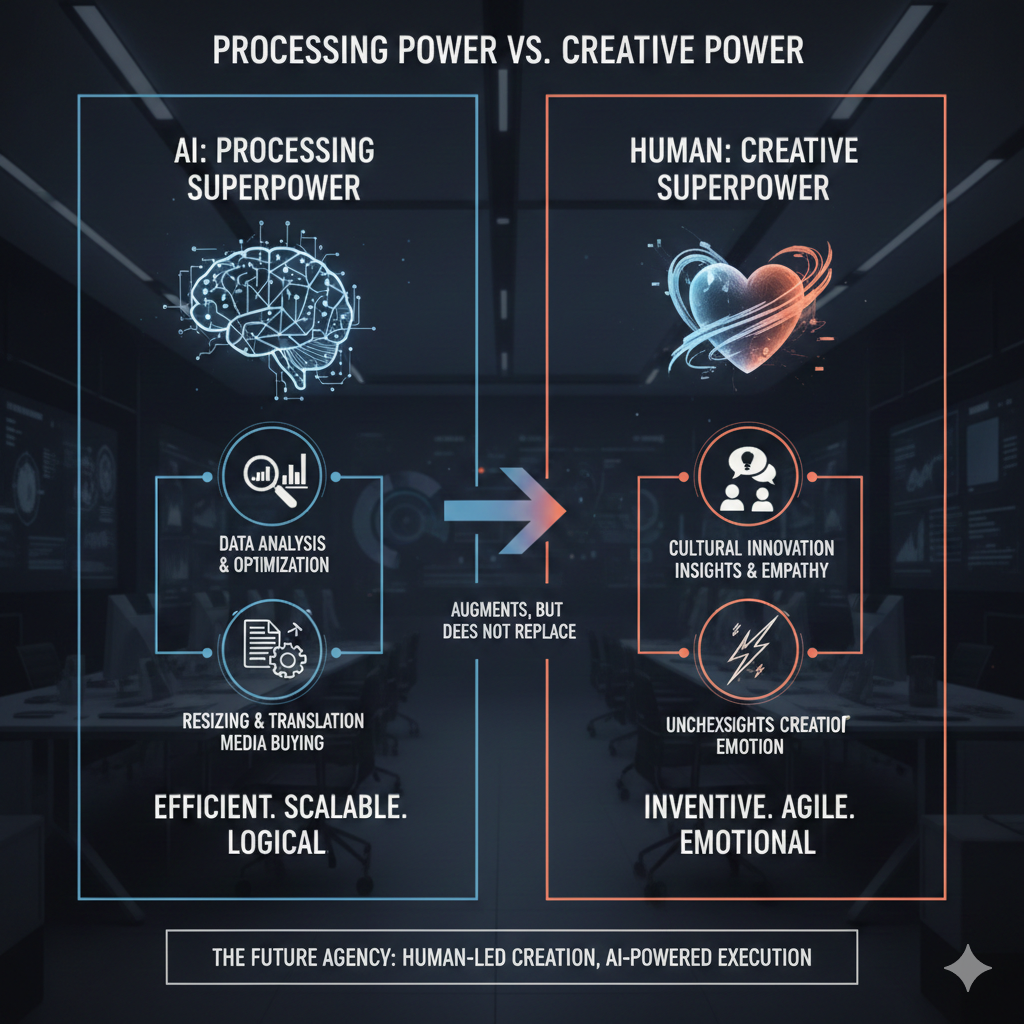
AI is a processing superpower. It can resize assets, translate copy, optimize media spend, and analyze patterns faster than any army of junior associates. But it does not possess the creation superpower required to move culture.

As noted in a recent discussion at ADWEEK House, modern marketing runs on "agility" and "insiders". To resonate with a niche community - whether it’s F1 fans or Android users - you need team members who "speak the language" and can sniff out inauthenticity in a second. You need the human intuition to turn a typo (like Nicki Minaj calling Shopify "Spotify") into a brand win, rather than a PR crisis.

AI can process the recap, but it cannot create the moment. By betting the farm on AI, Omnicom is doubling down on the commoditized middle - the processing layer - while the true value of an agency (creative invention) remains a uniquely human, un-scalable trait.

The Data Fallacy: Renting the Fuel

The second hole in the "AI innovation" narrative is the data itself. To train a proprietary model that offers a true competitive moat, you need proprietary data.

Publicis understood this years ago when they acquired Epsilon and Axciom, effectively buying the fuel for their engine. Omnicom and IPG, by contrast, generally do not own the underlying consumer data in the same way. They are service providers processing client data.

Without a proprietary data lake like Axciom, the "scale" Omnicom just bought is simply a larger volume of rented data. They are building a bigger refinery, but they still don't own the oil.

Culling the Herd for Margin Preservation

If the AI isn't for creative invention, and they don't own the data to build a unique brain, what is the $13 billion actually for?

It is for margin preservation.

In 2013, John Wren admitted the Publicis-Omnicom deal would create $500 million in "efficiencies". In 2025, AI is the ultimate efficiency engine. This merger isn't about empowering talent; it is about "culling the herd."

The goal is to use AI to strip out the "inefficiencies" of human capital - the mid-level managers, the media planners, the production staff. By consolidating IPG's roster into Omnicom's AI infrastructure, they can drastically reduce headcount to protect margins in an era where clients are squeezing fees.

This is the "right-sizing" I predicted in 2013, but on a technological steroid.

The Verdict

The Omnicom-IPG merger is a brilliant financial maneuver for a company realizing that its traditional service model is too expensive. By replacing human processing with AI processing, they will undoubtedly save money.

But let’s not call it the future of marketing. The brands winning today are moving away from "long-tail campaigns" toward a "shipping mentality" driven by culture-obsessed humans.

Omnicom has built a massive machine to process the past efficiently. But they are no closer to creating the future.

Welcome Back

Close Window

Sign Out?

Are you sure you want to log out?