

Category: Algorithms

Website Optimization for LLM Citation

AI SEO Image

Metadata Optimization

  1. Implement comprehensive schema.org markup for structured data across your business, services, and expertise
  2. Create detailed meta descriptions that accurately summarize page content
  3. Use descriptive, keyword-rich title tags that clearly indicate page topics
  4. Include proper canonical tags to avoid duplicate content issues
  5. Add appropriate Open Graph and Twitter card metadata for social sharing
  6. Ensure all content remains publicly accessible without paywalls or login requirements
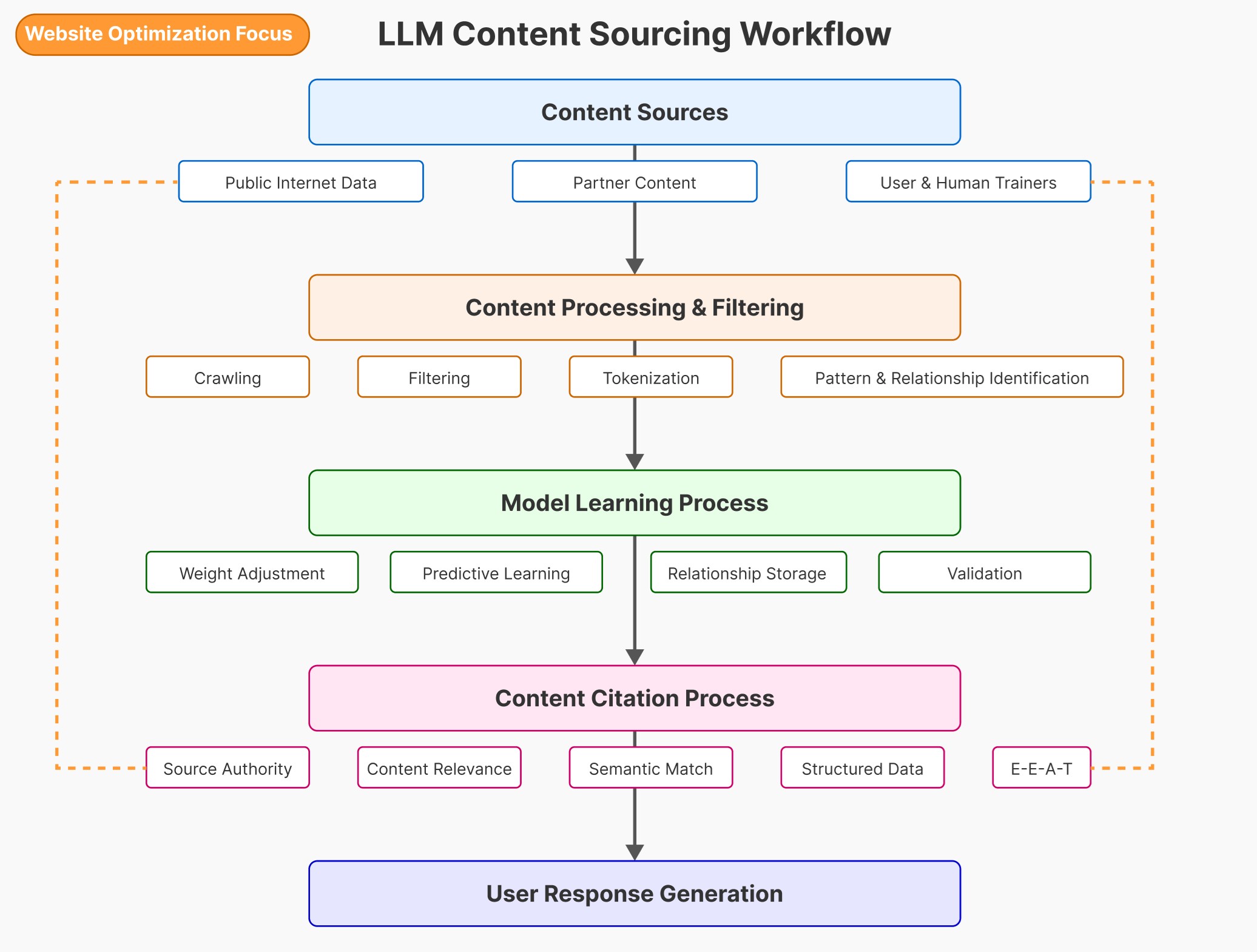
AI SEO Workflow

Content Structure & Quality

  1. Use clear hierarchical heading structure (H1, H2, H3) following logical information architecture
  2. Include informative subheadings that summarize key points in each section
  3. Structure content with semantic HTML5 elements (article, section, aside, nav)
  4. Create content that answers specific questions comprehensively
  5. Include data tables with proper markup for structured information
  6. Maintain high information-to-word ratio for efficient knowledge transfer
  7. Build progressive knowledge structure from fundamental to advanced concepts
  8. Present information in multiple formats (text, tables, lists) to reinforce learning relationships

Semantic Relationships

  1. Create topic clusters with pillar pages and supporting content
  2. Use descriptive anchor text that indicates linked page content
  3. Build internal links between related content to establish topical authority
  4. Explicitly define relationships between concepts with clear statements
  5. Include concise definitions of key domain terms
  6. Structure content to showcase predictive patterns (cause-effect, problem-solution)
  7. Use semantic HTML enrichment beyond basic elements (time, mark, details, summary)

Technical SEO & Accessibility

  1. Ensure fast loading speeds and high Core Web Vitals scores
  2. Implement proper robots.txt configuration to guide crawler behavior
  3. Use HTTPS for security (LLMs prefer secure sources)
  4. Make your site mobile-friendly and responsive
  5. Ensure accessibility compliance (WCAG) to help with content parsing
  6. Maintain a flat site architecture where important pages are few clicks from homepage
  7. Create comprehensive sitemap.xml files to ensure all content is discoverable
  8. Implement machine-readable fact structures using schema.org types like ClaimReview

Trust & Authority Signals

  1. Include clear author information with credentials and expertise
  2. Cite authoritative external sources to support claims
  3. Display trust signals like testimonials, reviews, and certifications
  4. Regularly update content to maintain freshness and accuracy
  5. Provide transparent "About Us" and contact information
  6. Implement robust citation systems showing information sources
  7. Include explicit fact verification language ("research confirms," "studies show")
  8. Clearly mark content updates with dates to signal currency
  9. Add transparency statements about content origin and verification processes

Structured Data & FAQ Implementation

  1. Implement FAQ schema markup for question-answer pairs
  2. Create comprehensive FAQ sections addressing common queries in your field
  3. Structure answers in clear, concise formats that LLMs can easily extract
  4. Use consistent vocabulary and terminology throughout your site
  5. Include both broad and specific questions to capture different search intents
  6. Create knowledge graph connections through entity linking and references

Content Filtering Prevention

  1. Avoid content that might trigger filtering (spam patterns, excessive personal information)
  2. Respect privacy boundaries while remaining informative
  3. Include elements that signal legitimate content use (attributions, permissions)
  4. Create content with ethical considerations and standards clearly indicated

By implementing this comprehensive framework, you'll significantly increase the likelihood that LLMs will recognize your content as valuable, authoritative, and worthy of citation. This approach aligns with how these systems actually learn from and evaluate web content, positioning your site as an ideal knowledge source.


Testing & learning without measuring experimentation debt is a fail

In the world of data-driven decision-making, experimentation is the backbone of many companies' scale up strategies. Whether it’s testing new product features, channels, marketing campaigns, or experimenting with operational improvements, the ability to experiment and learn quickly is seen as a competitive advantage. More crucially, establishing a plan to measure, validate and collect on the success metrics that helps reduce experimentation debt is an Achilles heel.

However, a critical, often-overlooked issue undermines the effectiveness of these efforts: experimentation debt.

This phenomenon, similar to technical debt in software development, arises when companies neglect the rigor and discipline required to validate and maintain their experimentation frameworks. In fact, studies suggest that nearly 60% of companies fail to validate or backtest their winning experiments, assuming that initial results are bulletproof. The consequences? Overconfidence in flawed conclusions, wasted resources, and eroded trust in experimentation as a tool for growth.

What Is Experimentation Debt?

Experimentation debt refers to the cumulative issues and inefficiencies that arise when experimentation processes are mismanaged, leading to suboptimal outcomes and flawed decision-making. Just like financial debt, it accrues interest over time, with its effects compounding as unchecked assumptions proliferate across the organization.

How Experimentation Debt Builds Up

  1. Failure to Backtest and Validate Results
    Companies often rush to implement "winning" experiments without replication or backtesting in different conditions. What works in one segment, geography, or time period may fail spectacularly when scaled.
  2. Flawed Experiment Design
    Poorly designed experiments—such as those with insufficient sample sizes, inadequate control groups, or confounding variables—can lead to misleading results, creating false confidence in the outcomes.
  3. Short-Term Focus
    Many experiments prioritize short-term metrics like clicks or immediate revenue, ignoring long-term impacts on retention, brand equity, or customer lifetime value.
  4. Inadequate Documentation
    Experiments are often poorly documented, leaving teams without clear learnings or a repository of what worked and why. This leads to repeated mistakes and a lack of institutional knowledge.
  5. Ignoring Negative or Neutral Results
    There’s a bias toward celebrating wins and sidelining experiments with negative or neutral outcomes. Yet, these "non-wins" often contain valuable insights that could guide future efforts.
  6. Lack of Iterative Refinement
    Winning experiments are frequently treated as "one-and-done" solutions. Without further refinement, what was once a great idea can stagnate, leaving value untapped.

The Cost of Experimentation Debt

The consequences of experimentation debt are far-reaching:

  • Wasted Resources: Time, money, and effort are often funneled into scaling initiatives that don’t hold up under broader scrutiny.
  • Eroded Trust: Stakeholders lose confidence in the experimentation framework, viewing it as unreliable or inconsistent.
  • Missed Opportunities: By failing to iterate or learn from mistakes, companies leave growth opportunities on the table.
  • Stagnation: Experimentation frameworks that don’t evolve over time lead to diminishing returns, hindering innovation and progress.

How to Avoid Experimentation Debt

While the risks of experimentation debt are significant, they can be mitigated with the right strategies and mindset:

  1. Validate and Backtest Winning Results
    Before scaling, ensure that initial results can be replicated in different conditions. Backtest experiments to verify their validity over time and across segments.
  2. Enforce Rigorous Experiment Design
    Invest in proper experiment design, with clear hypotheses, appropriate sample sizes, and robust control groups. Engage statistical experts to avoid common pitfalls like false positives.
  3. Track Long-Term Impact
    Extend the tracking period for experiments to understand their effects on long-term KPIs such as retention, lifetime value, and customer satisfaction.
  4. Document and Share Learnings
    Create a centralized repository for experiments. Document methodologies, results, and key learnings to build institutional knowledge and avoid redundant efforts.
  5. Normalize Learning from Neutral or Negative Outcomes
    Treat experiments as learning opportunities, even when the results aren’t positive. Insights from neutral or negative tests can often lead to breakthroughs in future experiments.
  6. Embrace Continuous Improvement
    Revisit and refine winning experiments as conditions evolve. Continuous iteration ensures that initial wins remain relevant and impactful over time.
  7. Monitor the Experimentation Framework
    Regularly audit the experimentation process to identify inefficiencies and gaps. Use dashboards or scorecards to track the health of the framework and hold teams accountable.

The Road to Better Experimentation

Experimentation is one of the most powerful tools in a company’s arsenal, but it’s only as good as the framework supporting it. Experimentation debt can erode trust, waste resources, and hinder growth, yet it often flies under the radar. By recognizing its impact and taking proactive steps to address it, companies can build a stronger, more resilient experimentation culture—one that drives sustainable growth and fosters innovation.

🚀 Agentic AI: Autonomous AI – The Future of Marketing 🌐

Our fast-evolving marketing landscape requires us to stay ahead by leveraging the latest innovations, and agentic AI is one of the most exciting developments to me.


But what exactly is agentic AI, and why should we care?
Agentic AI refers to systems that can autonomously take actions based on data, improving decision-making across various processes. Unlike traditional AI that assists with specific tasks, agentic AI dynamically adapts and optimizes on its own. In practice, it allows marketers to scale efforts programmatically with precision and intelligence.

💡 Why is this important? Imagine automating the constant decision-making required to manage campaigns. With agentic AI, we can move beyond manual adjustments, trusting AI to handle tasks such as creative variation, campaign trafficking, and media spend management. This not only saves time but also drastically improves the accuracy and efficiency of campaigns, driving business outcomes at scale.

📊 Business Impact:

  • Increased ROI: Agentic AI identifies the best-performing creatives and scales them, improving engagement and conversions.
  • Better Budget Allocation: AI models optimize media spend, ensuring every dollar is invested in the most impactful channels.
  • Improved Efficiency: Automated QA and trafficking eliminate errors, speeding up go-to-market strategies.

✨ My Experience: I’ve personally tested agentic AI for:

  • Campaign Trafficking & QA: We've seen a 10% improvement in campaign functionality and reporting accuracy by reducing human error.
  • Media Spend Planning & Management: AI dynamically adjusts media spend based on real-time performance data, leading to faster iterations, reduced CPA, and higher overall engagement.

✨ Future Areas I'm Exploring:

  • Creative Variation: Automatically generating and testing creative variants to find the top performers.
  • Virtual teams: Looking into using smart agents as virtual team members who can handle specific, repetitive, or even strategic tasks autonomously. Idea is that these agents can adapt, learn, and evolve based on real-time data and decision-making processes, allowing human team members to focus on higher-level, creative, and strategic work.

How are you incorporating AI in your strategy? Are you using smart agents? What successes or learnings have you experienced? As we move into 2025, marketers need to embrace agentic AI as a present-day opportunity to drive exponential growth. 🌱

Blockchain is changing the field not the just game

Blockchain will deliver digitization to our lifestyle for greater prosperity and health

The investments in Blockchain across the way we live, learn and work is still in its infancy. We know technology in general is in a free fall and transformation stage with the likes of 5G, machine-to-machine communications, and distributed systems. With Blockchain, we have the potential to bring a new era of “individualism without alienism.” And so Blockchain is already on a journey with crypto-currencies, considered the early adopters, taking off permeating into our day-to-day as it begins to shape the perceptions and possibilities of what’s to come. It’s raising important social questions and is already reshaping the way we all think about the current monetary infrastructure. It’s too late for Blockchain to disappear that much everyone agrees on. So, what’s next?

Well, it won’t be long before we are introduced to new Blockchain products which depart from the ledgers, currencies and processes driving a financial system. No, it won’t be focused on the series of connected services that is borne out of a network effect of cryptocurrencies but new applications that will improve our health, help us gain knowledge and provide greater control, distribution and fluidity of of our day-to-day tasks.

Dynamic and Extensible Electronic Health Records

Healthcare, imagine a decentralized but coordinated set of global data not silo’d and walled off. Our specific electronic health records are silo’d and static, imagine that data now with a decentralized governance where no one organization owns the data and there’s no clearing house for that information thus acceleration data sharing and personalization at scale.

Napster times a thousand! – Imogen Heap

Musical artists could push the boundaries of creativity and expand the headroom of their production. Blockchain could allow artists to truly cut out the middleman and at the same time expand their production headroom while also increasing the derivative body of works because of the decentralize governance it would bring. Furthermore, from a headroom expansion perspective imagine each track, i.e. drums, keyboards, a sample able to be tweaked, morph and distributed across the fanbase bringing the artist and fans in direct collaboration. It’s requests and personalization at an enormous scale!

Education in True Real-Time with Test and Learn

In the realm of Education, we know Institutions around the world are cooperating on a multitude of challenges. One major challenge is to introduce, assess, and share learnings across the ecosystem which generally takes years to do. Imagine a new system that allows not just a small group of Universities to be able to introduce these new learning but collaborate and expand on the learnings at hyper-local levels without major structural changes and maintaining the integrity of the core idea.

This is but the "tip of the iceberg" as to how blockchain could change our lives. The possibilities are endless coupled with artificial intelligence, machine learning, IoT (internet of things) and the convergence of biology and technology!

Algorithms, artificial intelligence and code oh my!

Article originally published on LinkedIN Nearly all of you have taken an UBER in the last week or two… Corporations have begun to change in ways that would be unthinkable a few years ago, technology has transformed businesses in ways that are both uncomfortable and remarkable. The idea of Skynet takes on a whole new meaning; I think James Cameron had it half right with the Terminator movie franchise. We won’t be at war with Robots and AI, the reality is that robots, AI and code are entities with which we as humans will need to coexist with across a variety of situations and sectors…the truth is we already do it that we haven’t thought of it in this particular way… Let’s look at a couple of recent pieces of news; Apple’s manufacturing partner Foxconn replaced laborers with 60,000 robots, the Philippines is using code to replace call center jobs while investing to re-train their workforce to provide higher end services and believe it or not the European Union is in talks to create a robo-bill of rights and companies are required to pay social security taxes on the electronic people they employ in the future. Everyday professionals like you and me are following schedules and instructions given by software whether sent from a desktop, mobile phone or tablet device. And Uber’s automated management system is evaluating performance and compensation for over 200,000 workers. Could software serve as a CEO? Why not, a great CEO needs to be credible, competent and objective. These traits could be programmable. According to a Gartner analyst, in 2018 3 million people will be supervised by robo-bosses, these smart machines will assess performance in dispassionate ways that could effectively manage the workplace. So, could we be seeing a reality where a line of business or organization is headed up by a piece of code or managed by robot?