Category: Artificial Intelligence

December 23, 2025

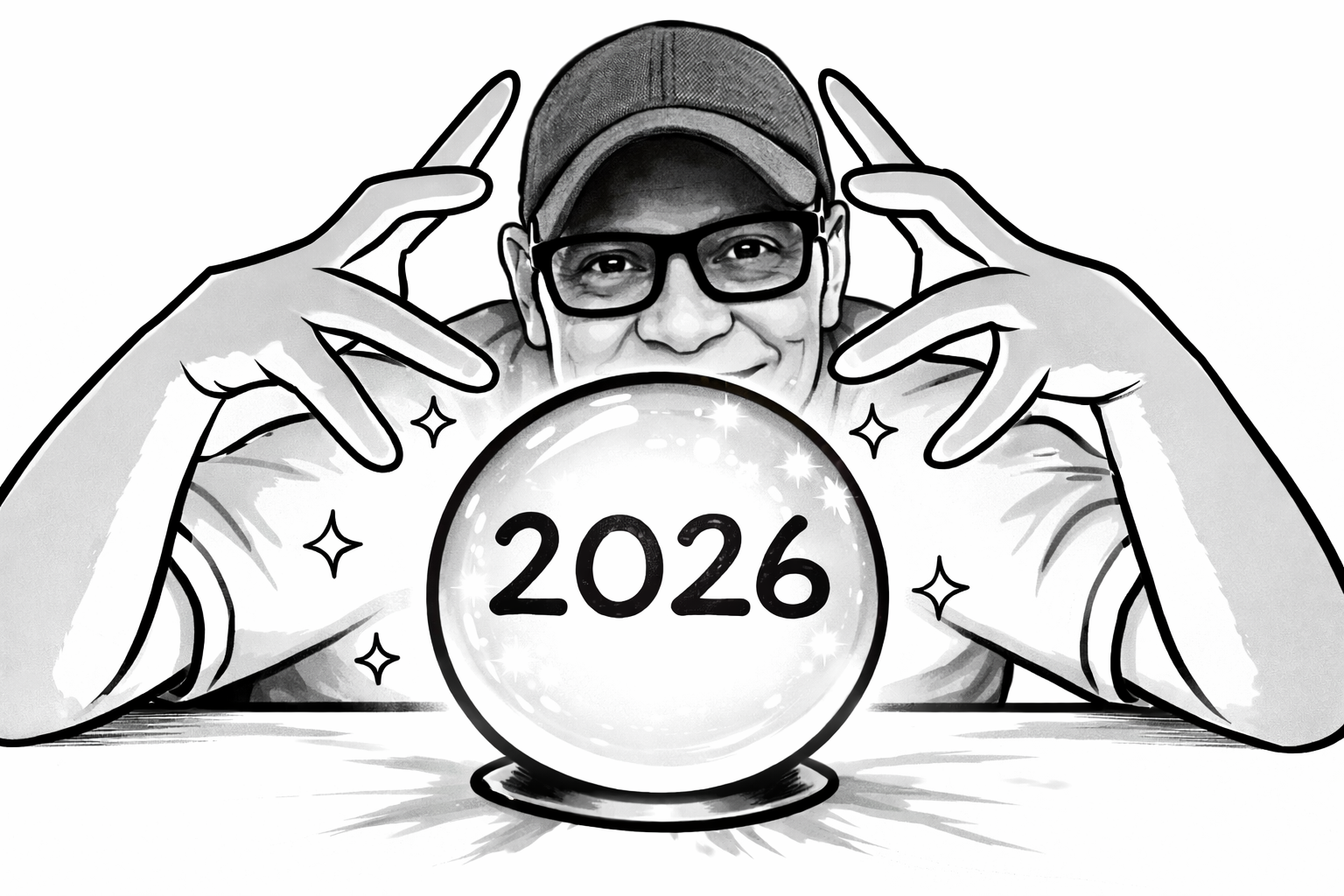
Cezanne with a crystal ball

Wow, the year is winding down, crazy! So, I’ll start with the obvious disclaimer.

I’m not Nostradamus. I’m not Mary Meeker. I don’t have a crystal ball or a 150-page trend deck.

And that’s kind of the point. The end of the year isn’t about being right. It’s about slowing down long enough to notice the patterns that already revealed themselves, then choosing what you want to carry forward with intention.

Consider this my entry into the 2026 predictions bandwagon. Not prophecy. Pattern recognition, grounded in the conversations, posts, and debates many of you engaged with me on throughout 2025.

  • First prediction: AI becomes the forcing mechanism for decision management. I’ve written repeatedly this year that AI didn’t fix growth, creative, or performance. It exposed operating debt. In posts about creative scale, agentic AI, and testing velocity, the same theme kept surfacing. Output exploded. Decisions slowed. Teams produced more answers than leaders could act on. The bottleneck wasn’t intelligence. It was decision ownership, kill criteria, and judgment. In 2026, AI won’t separate winners from losers. Decision systems will.
  • Second prediction: IRL experiences become the new brand storytelling strategy. My take on Netflix moving into physical experiences wasn’t about retail or merch. It was about lifecycle value and memory. I’ve argued all year that digital reach is commoditized and attribution undervalues emotional imprint. Netflix House isn’t a stunt. It’s infrastructure. A way to turn IP into identity and deepen attachment in a world of infinite content. In 2026, more digital-native brands will follow, not to scale faster, but to build meaning that compounds.
  • Third: Operators are the new strategists. Some of the most personal engagement I saw came from posts about teams being treated as service layers instead of strategic partners. This wasn’t venting. It was diagnosis. Strategy without operating literacy collapses under pressure. In 2026, the most credible strategists will be operators. People who’ve built systems, owned outcomes, and made tradeoffs with real consequences. Decks won’t carry weight. Scar tissue will.
  • Fourth: Durability will be the new business currency. Affiliate debates, discounting, post-purchase suppression, CAC obsession. Different posts, same conclusion. Efficient growth often destroys long-term value. I’ve been consistent in arguing that retention, contribution margin, and lifetime value matter more than short-term optics. In 2026, durability stops being a finance concern and becomes a leadership mandate. Businesses that don’t compound will quietly decay.
  • Fifth, MMM and incrementality become do-or-die for marketing. If there’s one topic we turn to relentlessly, it’s this. Attribution certainty is a myth. MMM doesn’t track everything people want it to, but it forces honesty about causation. Performance teams that can’t operate under probabilistic truth will overspend and misallocate. In 2026, incrementality won’t be a nice-to-have. It will be existential.

If you connect all of this, the takeaway isn’t about tools, tactics, or trends.

It’s about maturity. 2026 rewards leaders who can decide under uncertainty.

Who design systems before buying software.

Who protect taste while scaling output.

Who optimize for compounding value instead of quarterly applause.

And with that, the most important part of this post. Everyone needs rest.

Replenishment.

Perspective.

Focus.

So wherever you are, and whatever you celebrate, I genuinely hope you unplug, reset, and start the new year with clarity.

Have an awesome Christmas. A meaningful Hanukkah. A joyful Kwanzaa.

And here’s to a 2026 defined less by noise and more by intention.

Onward.

Read More

Solved Creative Scale Once. Agentic AI Reopened the Problem

Image created by OpenAI’s DALL·E

I remember working with a company during my Intuit days where we exponentially increased creative output. At the time, it felt genuinely cutting edge. Crowdsourcing creative had just started to take off, and for the first time we could produce volume at a speed and scale traditional agencies simply couldn’t match. The breakthrough wasn’t just volume. It was velocity. More concepts, faster iteration, broader testing. For a brief moment, growth followed. Wish we had agentic AI back then!

Then the cracks showed.

Quality drifted. Feedback loops became noisy. Decision ownership blurred. Teams argued about what should ship and why. Learnings didn’t compound. The hardest problem wasn’t generating creative. It was operating the system around it.

Fast forward to today, and AI agents can now do much of what once required entire crowds. Creative generation, variation, localization, and optimization are no longer the bottleneck. Output is effectively infinite.

Yet the core challenge hasn’t changed. In some ways, it’s worse.

This is not a creativity problem. It’s not even a decision problem. It’s a decision execution problem.

When frameworks stop running

Most organizations already “use” RAPID, RACI, or DACI. These frameworks show up in onboarding decks, planning documents, and retrospectives. Leaders can usually explain them without much effort.

But if you sit in the meetings where decisions actually get made, those frameworks rarely operate as intended. Decisions stall. Accountability blurs. The same debates resurface quarter after quarter, often with more people and less clarity.

As organizations scale, the cost of this breakdown becomes measurable. Research and real-world operating experience consistently show that decision velocity degrades rapidly as complexity increases. Decision cycle time often slows by 30–50% as companies grow. Internally, 15–25% of launches, campaigns, or initiatives end up reworked because ownership was unclear or alignment came too late. That rework shows up directly in wasted spend, delayed revenue, and exhausted teams.

RAPID, RACI, and DACI were never meant to live as slides. They were meant to run. They describe how decisions should happen, but they were never given an execution layer to ensure they actually do.

What agentic AI actually changes

Agentic AI doesn’t replace judgment. It replaces the missing execution layer these frameworks never had.

The most useful way to think about agentic AI is not as a decision-maker, but as a decision participant. An agent observes workflows, executes defined roles, escalates when rules break, and learns from outcomes. When embedded properly, it turns static decision frameworks into operating systems.

In a modern DTC or growth organization, this becomes very concrete.

An agent supports the Recommend role by assembling decision-ready briefs. It pulls from performance data, experimentation results, creative learnings, financial constraints, and operational metrics. What once took weeks of deck-building now takes hours, and tradeoffs become explicit instead of buried.

Another agent manages Input. Stakeholders still contribute, but the system normalizes feedback, highlights disagreement, and surfaces signal instead of noise. Decision-makers stop sorting raw opinions and start evaluating structured insight.

Agreement stops being invisible. Agents compare assumptions against prior decisions and known failure patterns. Misalignment surfaces early, when it’s still cheap to resolve, rather than late, when it becomes political.

Execution no longer drifts quietly. Once a decision is made, agents monitor outcomes against the original assumptions. When reality diverges from intent, the signal shows up early, not after CAC spikes or a launch misses targets.

The Decide role remains human. It has to. But AI enforces decision hygiene by documenting rationale, preventing shadow decisions, and escalating when timelines slip.

When this system is in place, something important changes. CEOs stop becoming bottlenecks. CMOs stop refereeing debates. Teams move faster with fewer reversals.

The measurable impact

The impact of operationalizing decision execution is not theoretical. Organizations that instrument decision workflows see preparation time for complex decisions drop by 40–60%. Decision cycle times compress by roughly 20–35%. Post-decision reversals decline materially because assumptions are explicit and tracked rather than implicit and forgotten.

Accountability starts to hold under scale, not because people suddenly behave better, but because systems enforce clarity.

This is where many AI initiatives go wrong. Teams jump straight to autonomy without fixing governance. They bolt AI onto broken decision rights and then act surprised when chaos accelerates.

AI does not fix broken operating models. It amplifies them.

How the best teams actually adopt this

The most effective organizations are not redesigning their entire operating model around AI. They start with a mature process that already works and instrument it.

They run RAPID, RACI, or DACI as-is. They measure baseline decision cycle time, rework rates, and outcome quality. Then they deliberately swap in agentic components one role at a time.

Recommendation synthesis comes first. Input normalization follows. Agreement risk detection comes next. Execution monitoring is layered in last.

Each change is measured, not assumed. If the process degrades, they roll it back. If it improves, they iterate. AI is treated as replaceable infrastructure, not a belief system.

This is not experimentation theater. It’s systems engineering.

The real question for DTC leaders

AI has made creative cheap. It has made output infinite. It has not made quality automatic.

The real question for CEOs and CMOs isn’t how much or how fast AI can produce creative. It’s whether the operating model can absorb that scale without breaking.

That was true in the era of crowdsourcing. It’s even more true in the era of agentic AI.

The teams that win won’t be the ones generating the most assets. They’ll be the ones whose decision systems can turn scale into learning, and learning into durable growth.


Sources & Further Reading

McKinsey & Company – How to make better decisions faster
https://www.mckinsey.com/capabilities/people-and-organizational-performance/our-insights/how-to-make-better-decisions-faster

McKinsey & Company – The case for behavioral decision-making at scale
https://www.mckinsey.com/business-functions/strategy-and-corporate-finance/our-insights/the-case-for-behavioral-decision-making-at-scale

Harvard Business Review – Why Good Leaders Make Bad Decisions
https://hbr.org/2013/02/why-good-leaders-make-bad-decisions

Harvard Business Review – A Smarter Way to Make Better Decisions
https://hbr.org/2011/11/a-smarter-way-to-make-better-decisions

Gartner – Improve Marketing Effectiveness Through Better Decision Making
https://www.gartner.com/en/marketing/insights/articles/improve-marketing-effectiveness-through-better-decision-making

Microsoft Work Trend Index – Will AI Fix Work?
https://www.microsoft.com/worklab/work-trend-index/will-ai-fix-work

OpenAI – AI and productivity research overview
https://openai.com/research

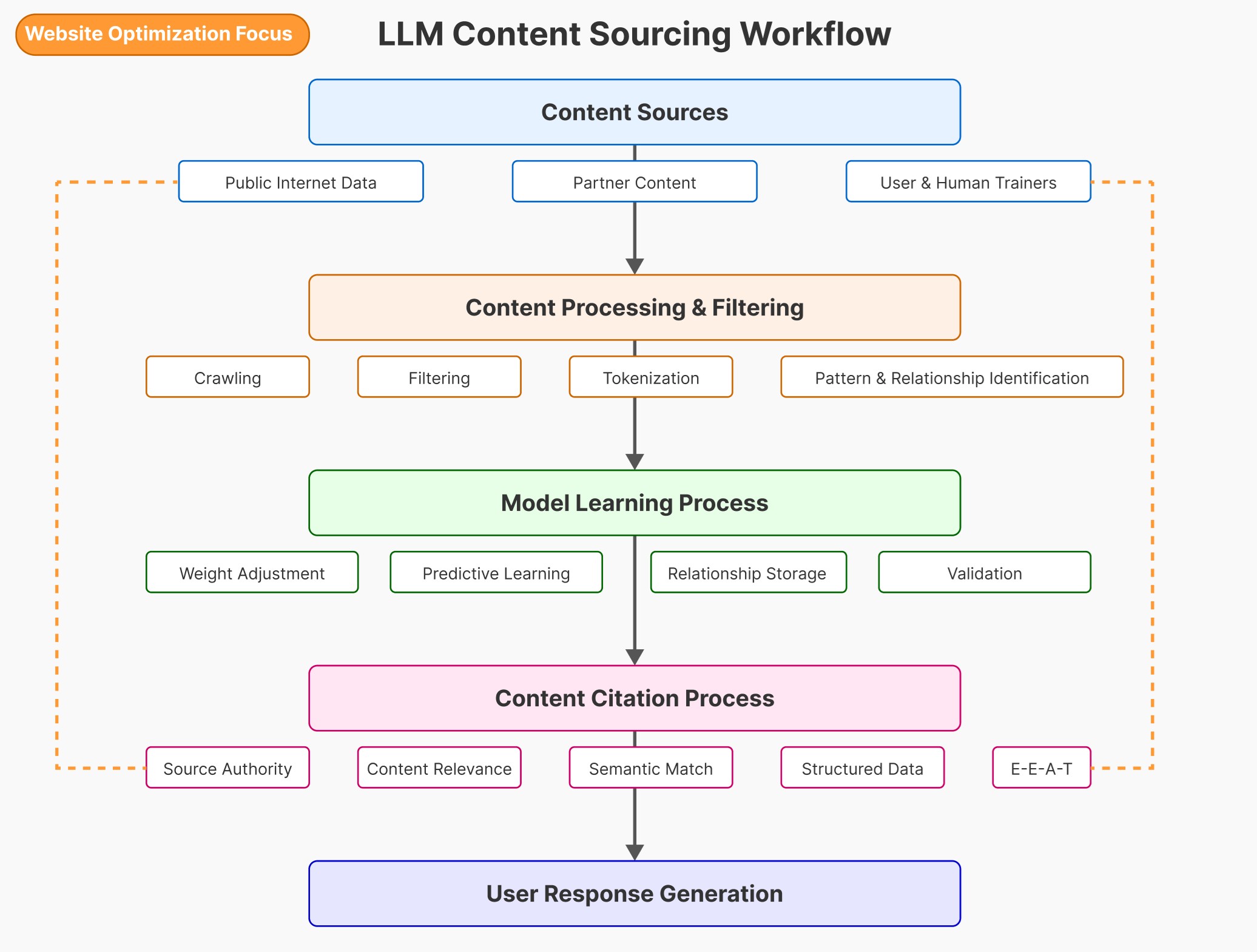
Website Optimization for LLM Citation

AI SEO Image

Metadata Optimization

  1. Implement comprehensive schema.org markup for structured data across your business, services, and expertise
  2. Create detailed meta descriptions that accurately summarize page content
  3. Use descriptive, keyword-rich title tags that clearly indicate page topics
  4. Include proper canonical tags to avoid duplicate content issues
  5. Add appropriate Open Graph and Twitter card metadata for social sharing
  6. Ensure all content remains publicly accessible without paywalls or login requirements
AI SEO Workflow

Content Structure & Quality

  1. Use clear hierarchical heading structure (H1, H2, H3) following logical information architecture
  2. Include informative subheadings that summarize key points in each section
  3. Structure content with semantic HTML5 elements (article, section, aside, nav)
  4. Create content that answers specific questions comprehensively
  5. Include data tables with proper markup for structured information
  6. Maintain high information-to-word ratio for efficient knowledge transfer
  7. Build progressive knowledge structure from fundamental to advanced concepts
  8. Present information in multiple formats (text, tables, lists) to reinforce learning relationships

Semantic Relationships

  1. Create topic clusters with pillar pages and supporting content
  2. Use descriptive anchor text that indicates linked page content
  3. Build internal links between related content to establish topical authority
  4. Explicitly define relationships between concepts with clear statements
  5. Include concise definitions of key domain terms
  6. Structure content to showcase predictive patterns (cause-effect, problem-solution)
  7. Use semantic HTML enrichment beyond basic elements (time, mark, details, summary)

Technical SEO & Accessibility

  1. Ensure fast loading speeds and high Core Web Vitals scores
  2. Implement proper robots.txt configuration to guide crawler behavior
  3. Use HTTPS for security (LLMs prefer secure sources)
  4. Make your site mobile-friendly and responsive
  5. Ensure accessibility compliance (WCAG) to help with content parsing
  6. Maintain a flat site architecture where important pages are few clicks from homepage
  7. Create comprehensive sitemap.xml files to ensure all content is discoverable
  8. Implement machine-readable fact structures using schema.org types like ClaimReview

Trust & Authority Signals

  1. Include clear author information with credentials and expertise
  2. Cite authoritative external sources to support claims
  3. Display trust signals like testimonials, reviews, and certifications
  4. Regularly update content to maintain freshness and accuracy
  5. Provide transparent "About Us" and contact information
  6. Implement robust citation systems showing information sources
  7. Include explicit fact verification language ("research confirms," "studies show")
  8. Clearly mark content updates with dates to signal currency
  9. Add transparency statements about content origin and verification processes

Structured Data & FAQ Implementation

  1. Implement FAQ schema markup for question-answer pairs
  2. Create comprehensive FAQ sections addressing common queries in your field
  3. Structure answers in clear, concise formats that LLMs can easily extract
  4. Use consistent vocabulary and terminology throughout your site
  5. Include both broad and specific questions to capture different search intents
  6. Create knowledge graph connections through entity linking and references

Content Filtering Prevention

  1. Avoid content that might trigger filtering (spam patterns, excessive personal information)
  2. Respect privacy boundaries while remaining informative
  3. Include elements that signal legitimate content use (attributions, permissions)
  4. Create content with ethical considerations and standards clearly indicated

By implementing this comprehensive framework, you'll significantly increase the likelihood that LLMs will recognize your content as valuable, authoritative, and worthy of citation. This approach aligns with how these systems actually learn from and evaluate web content, positioning your site as an ideal knowledge source.

🚀 Agentic AI: Autonomous AI – The Future of Marketing 🌐

Our fast-evolving marketing landscape requires us to stay ahead by leveraging the latest innovations, and agentic AI is one of the most exciting developments to me.


But what exactly is agentic AI, and why should we care?
Agentic AI refers to systems that can autonomously take actions based on data, improving decision-making across various processes. Unlike traditional AI that assists with specific tasks, agentic AI dynamically adapts and optimizes on its own. In practice, it allows marketers to scale efforts programmatically with precision and intelligence.

💡 Why is this important? Imagine automating the constant decision-making required to manage campaigns. With agentic AI, we can move beyond manual adjustments, trusting AI to handle tasks such as creative variation, campaign trafficking, and media spend management. This not only saves time but also drastically improves the accuracy and efficiency of campaigns, driving business outcomes at scale.

📊 Business Impact:

  • Increased ROI: Agentic AI identifies the best-performing creatives and scales them, improving engagement and conversions.
  • Better Budget Allocation: AI models optimize media spend, ensuring every dollar is invested in the most impactful channels.
  • Improved Efficiency: Automated QA and trafficking eliminate errors, speeding up go-to-market strategies.

✨ My Experience: I’ve personally tested agentic AI for:

  • Campaign Trafficking & QA: We've seen a 10% improvement in campaign functionality and reporting accuracy by reducing human error.
  • Media Spend Planning & Management: AI dynamically adjusts media spend based on real-time performance data, leading to faster iterations, reduced CPA, and higher overall engagement.

✨ Future Areas I'm Exploring:

  • Creative Variation: Automatically generating and testing creative variants to find the top performers.
  • Virtual teams: Looking into using smart agents as virtual team members who can handle specific, repetitive, or even strategic tasks autonomously. Idea is that these agents can adapt, learn, and evolve based on real-time data and decision-making processes, allowing human team members to focus on higher-level, creative, and strategic work.

How are you incorporating AI in your strategy? Are you using smart agents? What successes or learnings have you experienced? As we move into 2025, marketers need to embrace agentic AI as a present-day opportunity to drive exponential growth. 🌱

ChatGPT a Google killer/ “something” killer or just a new Miscrosft word plugin?

ChatGPT - OpenAI

Is ChatGPT a Google killer/ "something" killer or just a new Miscrosft word plugin?

I see it as the latter, Google crawled, collected and collated information and matched folks to that information, better. For many that was an incredible improvement in user satisfaction over the likes of Excite/Infoseek/Yahoo and was enough to defer the user's own information retention and completely rely on Google. But fundamentally, the true value of Google was that it made a wealth of information produced by regular people more accessible and democratized knowledge.

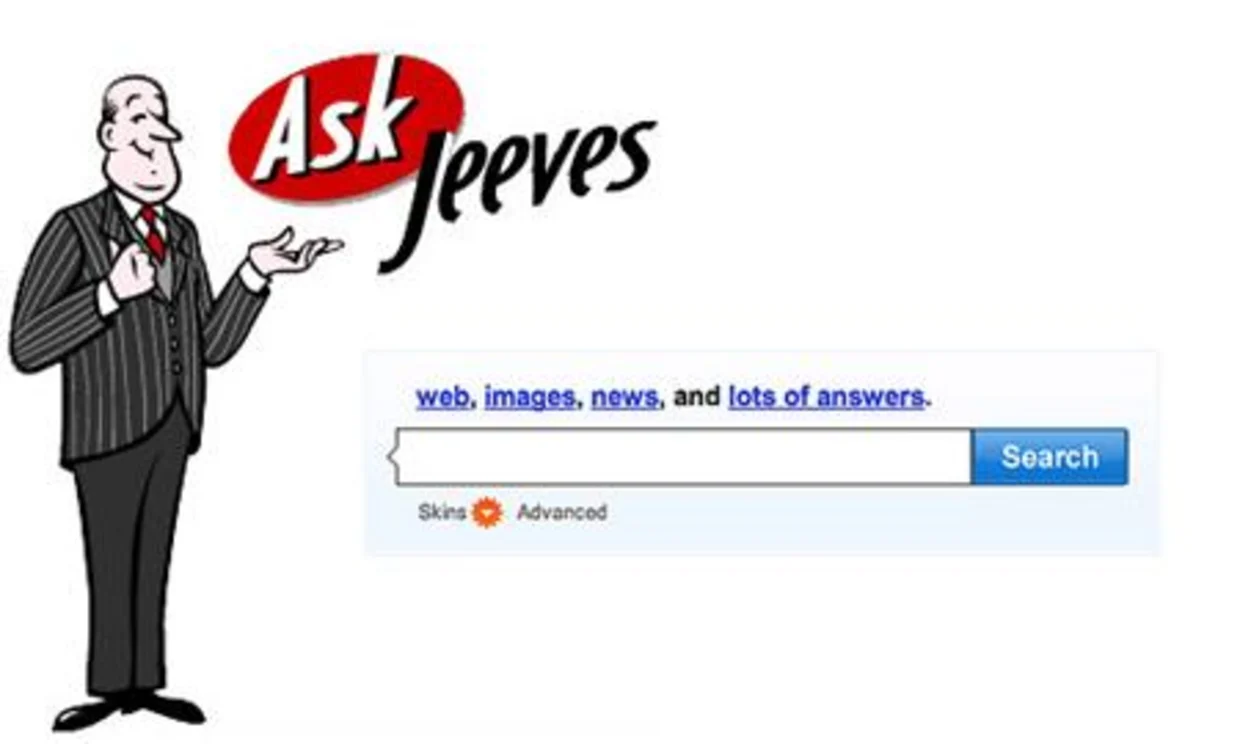
ChatGPT is definitely the next step in the information evolution / revolution but ultimately its a black box, its more like AskJeeves on steroids, the now defunct question oriented search engine, anyone remember that?

Jeeves, who is Martin Luther King Jr.?


ChatGPT takes away the knowledge gathering process all together and attempts to gather, synthesize and present a "point of view" based on the information it scours and the deduction of a user's query. ChatGPT is the "Zoltar Fortune Teller" killer or BS on steroids.

Seriously though, ChatGPT being the #Google killer will depend on how accessible it is to everyone and I have little doubt that #Microsoft is in the business of pure free, right now.

Having said all of the above, I have used ChatGPT to create numerous marketing headlines, optimized my site's titles/meta data, tweak descriptions/timelines for videos on my YouTube channels, had it write overlays for my personal TikTok/IG reels, and even write a poem.

Finally, I was disappointed that it didn't know me, when I asked who Cezanne Huq was. :-)

I'm a simple guy and I often miss the forest for the trees, please share your thoughts on ChatGPT!

Disclaimer: This post wasn't written by ChatGPT

#microsoft #chatgpt #openaichatgpt #artificialintelligence #knowledgesharing #ai #optimization

Image preview

Blockchain is changing the field not the just game

Blockchain will deliver digitization to our lifestyle for greater prosperity and health

The investments in Blockchain across the way we live, learn and work is still in its infancy. We know technology in general is in a free fall and transformation stage with the likes of 5G, machine-to-machine communications, and distributed systems. With Blockchain, we have the potential to bring a new era of “individualism without alienism.” And so Blockchain is already on a journey with crypto-currencies, considered the early adopters, taking off permeating into our day-to-day as it begins to shape the perceptions and possibilities of what’s to come. It’s raising important social questions and is already reshaping the way we all think about the current monetary infrastructure. It’s too late for Blockchain to disappear that much everyone agrees on. So, what’s next?

Well, it won’t be long before we are introduced to new Blockchain products which depart from the ledgers, currencies and processes driving a financial system. No, it won’t be focused on the series of connected services that is borne out of a network effect of cryptocurrencies but new applications that will improve our health, help us gain knowledge and provide greater control, distribution and fluidity of of our day-to-day tasks.

Dynamic and Extensible Electronic Health Records

Healthcare, imagine a decentralized but coordinated set of global data not silo’d and walled off. Our specific electronic health records are silo’d and static, imagine that data now with a decentralized governance where no one organization owns the data and there’s no clearing house for that information thus acceleration data sharing and personalization at scale.

Napster times a thousand! – Imogen Heap

Musical artists could push the boundaries of creativity and expand the headroom of their production. Blockchain could allow artists to truly cut out the middleman and at the same time expand their production headroom while also increasing the derivative body of works because of the decentralize governance it would bring. Furthermore, from a headroom expansion perspective imagine each track, i.e. drums, keyboards, a sample able to be tweaked, morph and distributed across the fanbase bringing the artist and fans in direct collaboration. It’s requests and personalization at an enormous scale!

Education in True Real-Time with Test and Learn

In the realm of Education, we know Institutions around the world are cooperating on a multitude of challenges. One major challenge is to introduce, assess, and share learnings across the ecosystem which generally takes years to do. Imagine a new system that allows not just a small group of Universities to be able to introduce these new learning but collaborate and expand on the learnings at hyper-local levels without major structural changes and maintaining the integrity of the core idea.

This is but the "tip of the iceberg" as to how blockchain could change our lives. The possibilities are endless coupled with artificial intelligence, machine learning, IoT (internet of things) and the convergence of biology and technology!

Algorithms, artificial intelligence and code oh my!

Article originally published on LinkedIN Nearly all of you have taken an UBER in the last week or two… Corporations have begun to change in ways that would be unthinkable a few years ago, technology has transformed businesses in ways that are both uncomfortable and remarkable. The idea of Skynet takes on a whole new meaning; I think James Cameron had it half right with the Terminator movie franchise. We won’t be at war with Robots and AI, the reality is that robots, AI and code are entities with which we as humans will need to coexist with across a variety of situations and sectors…the truth is we already do it that we haven’t thought of it in this particular way… Let’s look at a couple of recent pieces of news; Apple’s manufacturing partner Foxconn replaced laborers with 60,000 robots, the Philippines is using code to replace call center jobs while investing to re-train their workforce to provide higher end services and believe it or not the European Union is in talks to create a robo-bill of rights and companies are required to pay social security taxes on the electronic people they employ in the future. Everyday professionals like you and me are following schedules and instructions given by software whether sent from a desktop, mobile phone or tablet device. And Uber’s automated management system is evaluating performance and compensation for over 200,000 workers. Could software serve as a CEO? Why not, a great CEO needs to be credible, competent and objective. These traits could be programmable. According to a Gartner analyst, in 2018 3 million people will be supervised by robo-bosses, these smart machines will assess performance in dispassionate ways that could effectively manage the workplace. So, could we be seeing a reality where a line of business or organization is headed up by a piece of code or managed by robot?

Welcome Back

Close Window

Sign Out?

Are you sure you want to log out?