Category: Brand Marketing

December 23, 2025

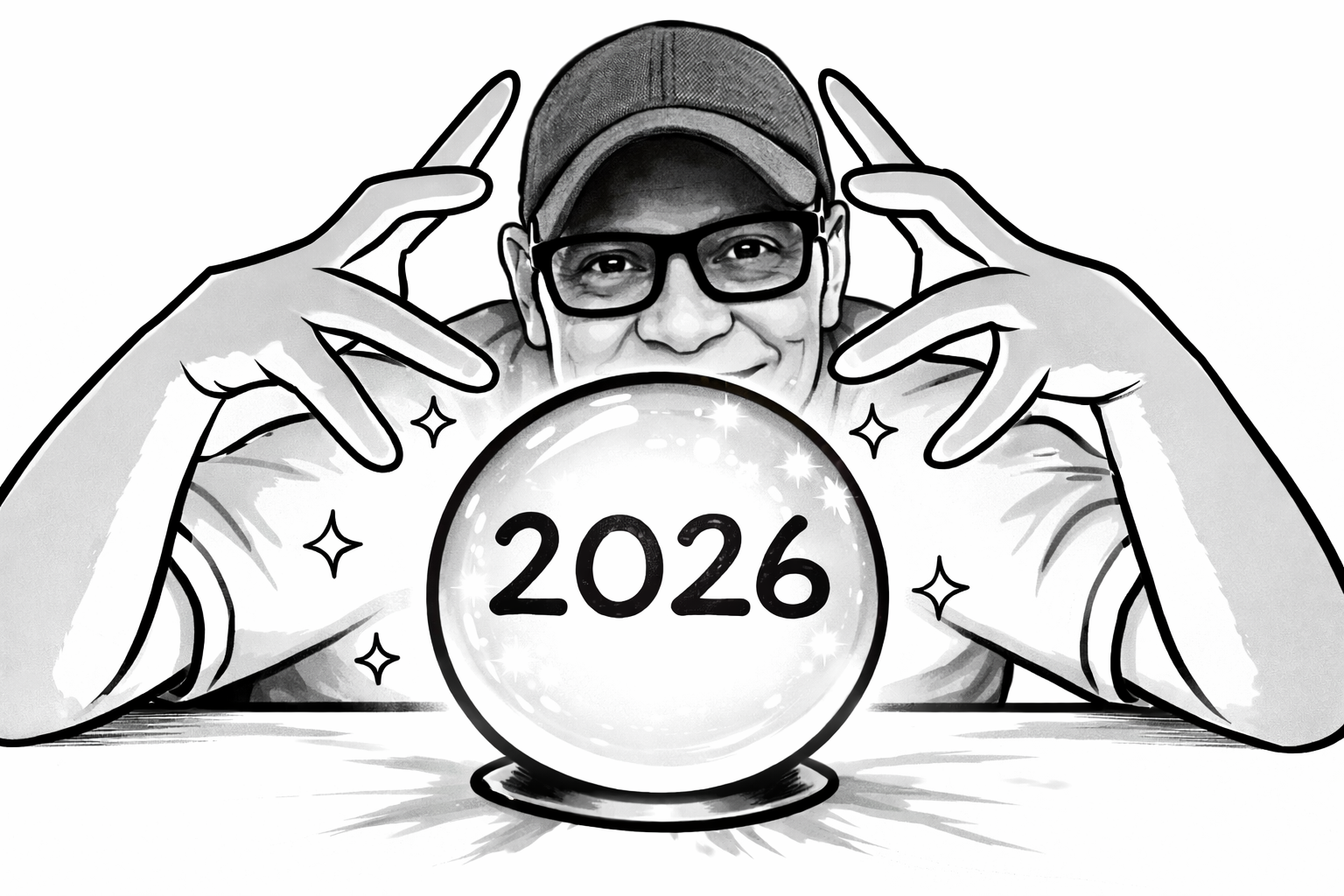
Cezanne with a crystal ball

Wow, the year is winding down, crazy! So, I’ll start with the obvious disclaimer.

I’m not Nostradamus. I’m not Mary Meeker. I don’t have a crystal ball or a 150-page trend deck.

And that’s kind of the point. The end of the year isn’t about being right. It’s about slowing down long enough to notice the patterns that already revealed themselves, then choosing what you want to carry forward with intention.

Consider this my entry into the 2026 predictions bandwagon. Not prophecy. Pattern recognition, grounded in the conversations, posts, and debates many of you engaged with me on throughout 2025.

  • First prediction: AI becomes the forcing mechanism for decision management. I’ve written repeatedly this year that AI didn’t fix growth, creative, or performance. It exposed operating debt. In posts about creative scale, agentic AI, and testing velocity, the same theme kept surfacing. Output exploded. Decisions slowed. Teams produced more answers than leaders could act on. The bottleneck wasn’t intelligence. It was decision ownership, kill criteria, and judgment. In 2026, AI won’t separate winners from losers. Decision systems will.
  • Second prediction: IRL experiences become the new brand storytelling strategy. My take on Netflix moving into physical experiences wasn’t about retail or merch. It was about lifecycle value and memory. I’ve argued all year that digital reach is commoditized and attribution undervalues emotional imprint. Netflix House isn’t a stunt. It’s infrastructure. A way to turn IP into identity and deepen attachment in a world of infinite content. In 2026, more digital-native brands will follow, not to scale faster, but to build meaning that compounds.
  • Third: Operators are the new strategists. Some of the most personal engagement I saw came from posts about teams being treated as service layers instead of strategic partners. This wasn’t venting. It was diagnosis. Strategy without operating literacy collapses under pressure. In 2026, the most credible strategists will be operators. People who’ve built systems, owned outcomes, and made tradeoffs with real consequences. Decks won’t carry weight. Scar tissue will.
  • Fourth: Durability will be the new business currency. Affiliate debates, discounting, post-purchase suppression, CAC obsession. Different posts, same conclusion. Efficient growth often destroys long-term value. I’ve been consistent in arguing that retention, contribution margin, and lifetime value matter more than short-term optics. In 2026, durability stops being a finance concern and becomes a leadership mandate. Businesses that don’t compound will quietly decay.
  • Fifth, MMM and incrementality become do-or-die for marketing. If there’s one topic we turn to relentlessly, it’s this. Attribution certainty is a myth. MMM doesn’t track everything people want it to, but it forces honesty about causation. Performance teams that can’t operate under probabilistic truth will overspend and misallocate. In 2026, incrementality won’t be a nice-to-have. It will be existential.

If you connect all of this, the takeaway isn’t about tools, tactics, or trends.

It’s about maturity. 2026 rewards leaders who can decide under uncertainty.

Who design systems before buying software.

Who protect taste while scaling output.

Who optimize for compounding value instead of quarterly applause.

And with that, the most important part of this post. Everyone needs rest.

Replenishment.

Perspective.

Focus.

So wherever you are, and whatever you celebrate, I genuinely hope you unplug, reset, and start the new year with clarity.

Have an awesome Christmas. A meaningful Hanukkah. A joyful Kwanzaa.

And here’s to a 2026 defined less by noise and more by intention.

Onward.
Read More

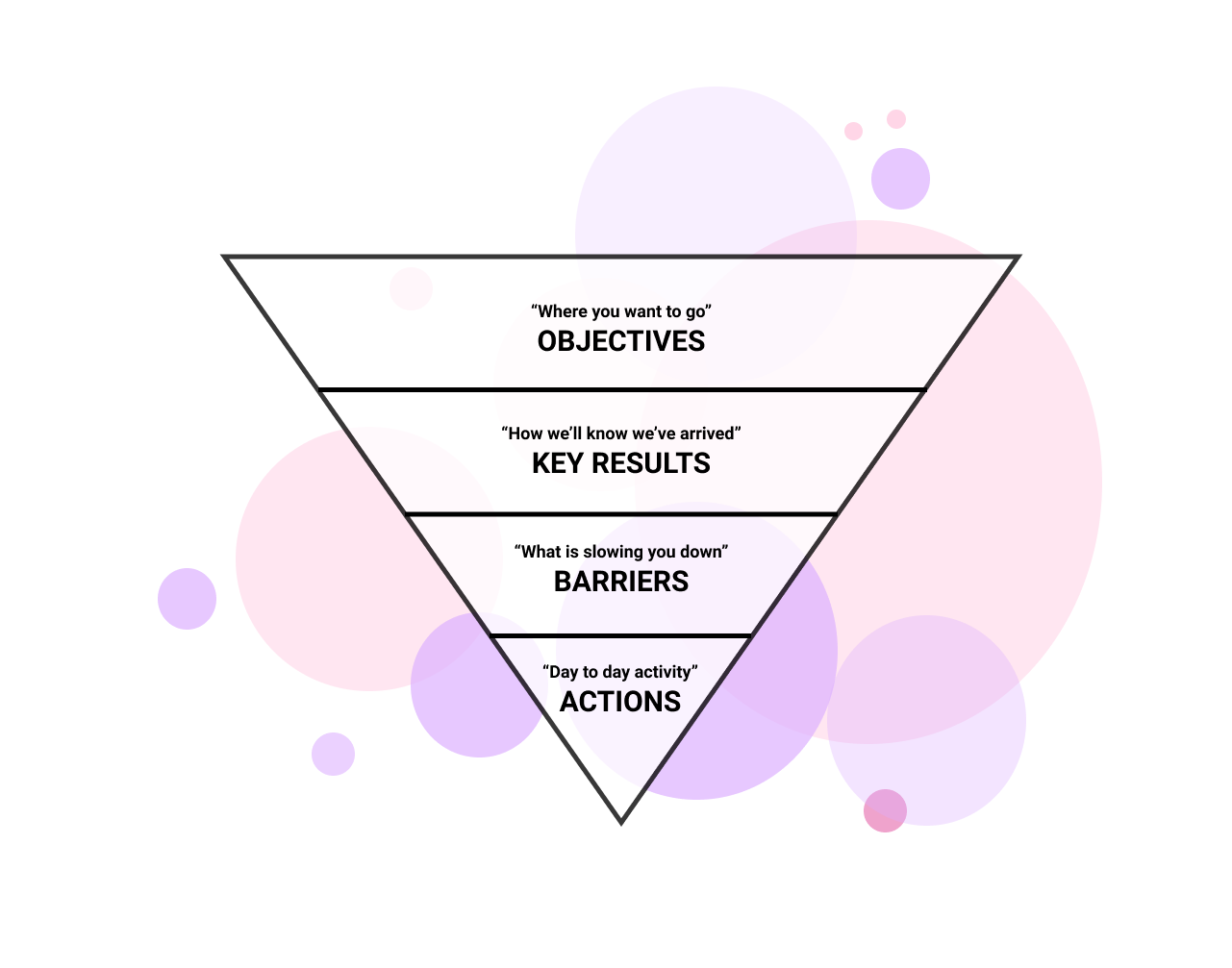
Balancing OKRs with the Basics: Keeping Growth and Brand Marketing on Track

Its been awhile since I've posted folks, sorry! While on a new journey and as I look back you know, I had this realization. It’s easy to get wrapped up in the shiny, new stuff like OKRs (Objectives and Key Results), but sometimes, we might end up spending so much time on them that we forget the basics—like keeping the trains running on time, or making sure the team has what they need to grow the business and build the brand.

Why OKRs Are Good, But…

  • Focus and Direction: OKRs are like that map on a road trip except for businesses. They help you know where you’re headed and make sure everyone’s car is pointed in the right direction. Without them, you might just end up driving in circles.
  • Accountability: They make it easy to see who’s doing what. Everyone knows their part, and you can quickly spot if something’s off track.

The Flip Side—When You’re Stuck in the OKR Weeds

  • Too Much Process, Not Enough Doing: If you spend all your time planning and tracking, there’s a chance you’re not doing enough actual work. It’s like planning the perfect garden but never getting around to planting the seeds.
  • Forgetting the Basics: Core business processes—like making sure the Growth and Brand Marketing teams are firing on all cylinders—might take a backseat. You still need to keep an eye on the day-to-day, like keeping operations smooth, ensuring customer service is top-notch, and steering the marketing ship in the right direction.

Steering the Growth and Brand Marketing Teams

  • Growth Management: Growth teams need a good bit of attention to keep the momentum going. It’s not just about setting ambitious though achievable goals—it’s about making sure they’ve got the tools, resources, and support to hit those targets.
  • Brand Marketing: Brand marketing is all about storytelling and building trust. While OKRs might tell you what needs to be done, it’s the brand folks who figure out how to say it in a way that resonates. They need to be closely guided and supported to ensure that the brand’s message stays consistent and strong.

Getting the Balance Right

  • Integrate OKRs with Business Processes: OKRs should work hand-in-hand with the day-to-day management. They’re not there to replace the basics but to enhance them. When done right, they should be pushing the business forward without pulling you away from essential tasks.
  • Keep It Simple: Don’t overcomplicate things. Focus on a few key objectives that really matter, and make sure the team isn’t drowning in process. Sometimes less is more.

Wrapping Up

OKRs are a great tool, no doubt. But like any tool, they’re only useful if you use them right. It’s important to keep things in balance—make sure the business processes, like steering the Growth and Brand Marketing teams, are getting the attention they need. After all, you can have the best goals in the world, but if the basics aren’t in place, those goals won’t mean much in the end.

Is there such a thing as Brand Response Marketing?

Whatever happened to #brand response #marketing? Or the idea that brand marketing actually does drive down funnel productivity, cost efficiencies and conversions? How about the taboo idea that performance marketing can actually create aided recall and awareness? The digitization of all things whether fully or minimally, I would say nowadays, everything is a brand experience, and everything is about performance.

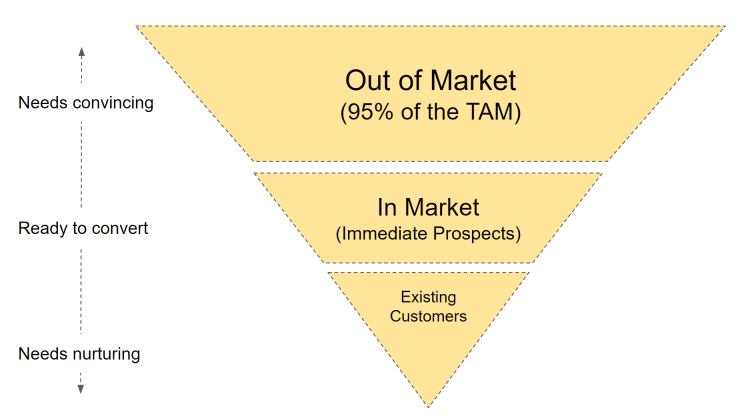
The reality is the funnel hasn't really changed right? At the very top, you've got the consumers that are "out of market" they just don't know they need you yet for various reasons, this is where 95% of your TAM resides and where brand marketing focuses on.

What about the folks who are ready to buy? Here performance marketing is the active tactic, it's easy to measure, aligned with sales goals and key business metrics.

Then you have your customers, the fickle to the loyal. These are the folks who are nurtured, hopefully appreciated and intertwined with our product development efforts.

Most of the time, these three tactics are not integrated, mostly siloed or indelibly operating somewhat independently. Is it idealistic to think that a business can balance and quarterback the three segments? I think so and this is where brand performance marketing comes into play for me.

So what is brand performance marketing?

Simply, it's the idea of integrating brand marketing with performance marketing. I see it as a holistic method to move consumer segments from, being "out of market" to being "in market" and finally bonding with the brand as existing customers. The classic approach has always seen brand, direct response and lifecycle marketing as three distinctly different functional capabilities. However, these old constructs can be susceptible to competitive pressures, are detrimental to achieving a cohesive experience for the consumer segments and of course sustaining the success gained when bad times come about. Disparate focus on the three segments creates a type of tunnel vision, particularly for large brands and a competitive edge for early and stage businesses during a economic downturn. There are ways to overcome this of course through better integration, processes, governance and frameworks. However, this only serves to further separate the business from the consumer.

How can we address these segments? Start with deconstructing your buyer's journey, nothing elaborate or scientific rather basic, just start at the very top. We have to build an architecture that works to convince consumers to want your product when they've been using/considering alternatives, then enabling them to find your product to eventually be converted into a customer. It doesn't end there, your competitors are persistently "conquesting" your prospects and customers. This means you have to continue to nurture them and adapt your product to address changing expectations.

All three segments (funnel screenshot) care about these four things

  1. Price - If I had a nickel for every brand that sees "price" as a number barrier, I'd be a gazillionaire. Level setting on price is so crucial, its the hardest thing to figure out. Pricing something too low presents a perception of low quality / cheapness and of course pricing something too high could harm your growth trajectory. A pricing strategy should be a consumer first process, know who they are and build from there, test and learn.
  2. Value - Does your product deliver the benefits and reasons to dole out the cost to buy your product? I always tell my family, somewhat jokingly, no-one ever pays MSRP for antivirus software. Have you? If you did, I want to know about it because that's when you value the cost of the product your purchasing. Its no longer a transaction, there's a clear need from the consumer point of view and they are fully bought into your brand's vision. Apple, Sony, Theragun (yes a DTC!) and there are many more out there.
  3. Trust - Are you a legitimate brand and is the product reliable to the degree that this person is willing to take leap, next step or continue to buy into your product's promise? This is so crucial, legitimacy is not going to come from your business, we have to earn this through surprise and delighting prospects and happy customers. I worked for a company that saw things differently, in fact quite the opposite and they are no longer around. This company persistently focused on sentiment management versus addressing the underlying issue which was a product that underperformed and always shorted them.
  4. Superiority - Are the features and functionality of the product above the rest? This is true for "affordable" products as well, think, Kia or Hyundai, right? Automotive brands that persistently remind us not only of the affordability of their cars but the high level of quality and workmanship that went into them. This helps the consumer rationalize the trade off and becomes invested in the brand.

Brand performance marketing can bring the three segments together. Philosophically, I don't believe there's should be a distinction between how each of the segment views a brand, interacts with the funnel designed to convert them and active use of the product.

I'd love to hear from my network, is brand performance marketing a thing? Should fuhgeddaboudit? Let me know and thanks for reading.

Welcome Back

Close Window

Sign Out?

Are you sure you want to log out?