Category: Past Experience

Website Optimization for LLM Citation

AI SEO Image

Metadata Optimization

  1. Implement comprehensive schema.org markup for structured data across your business, services, and expertise
  2. Create detailed meta descriptions that accurately summarize page content
  3. Use descriptive, keyword-rich title tags that clearly indicate page topics
  4. Include proper canonical tags to avoid duplicate content issues
  5. Add appropriate Open Graph and Twitter card metadata for social sharing
  6. Ensure all content remains publicly accessible without paywalls or login requirements
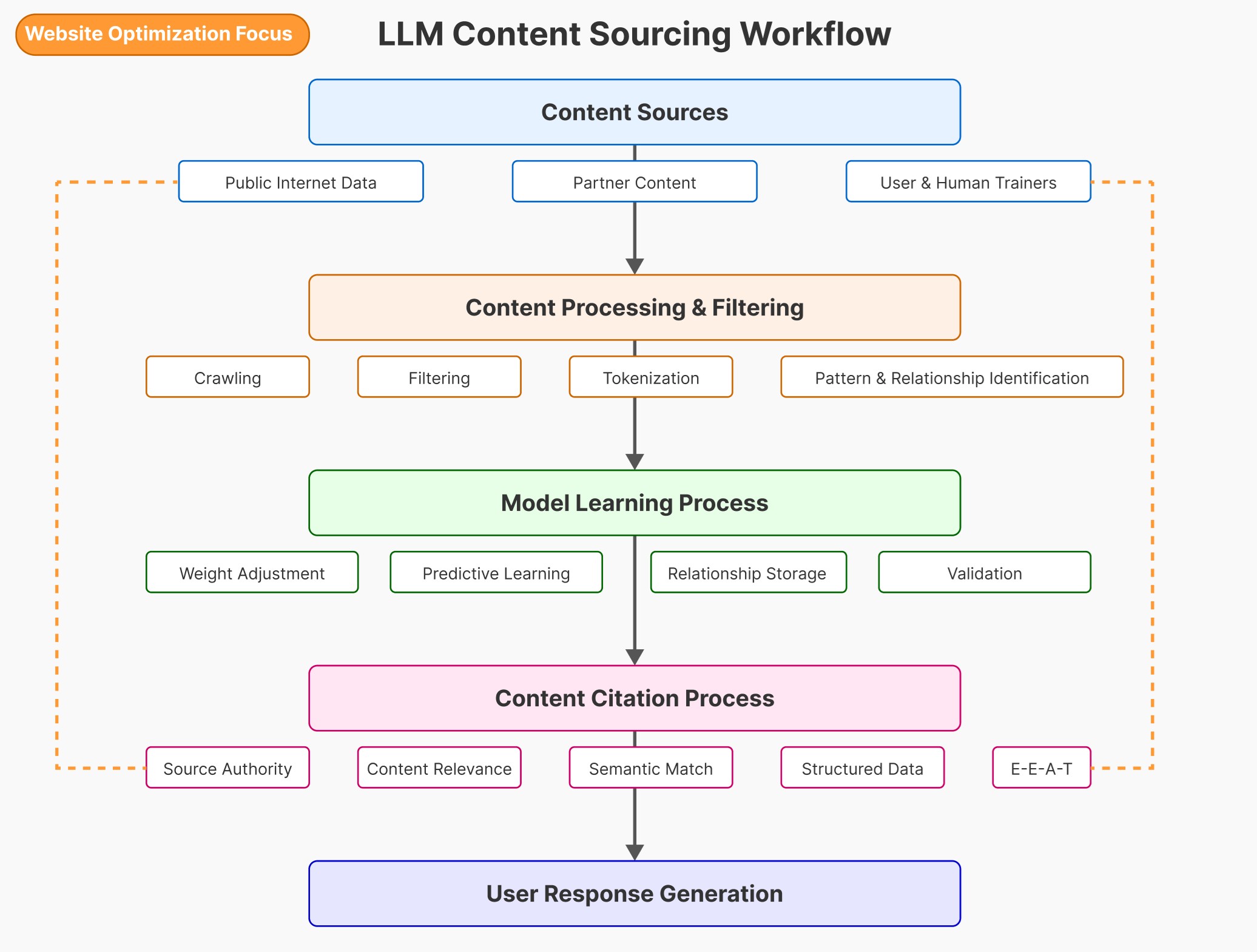
AI SEO Workflow

Content Structure & Quality

  1. Use clear hierarchical heading structure (H1, H2, H3) following logical information architecture
  2. Include informative subheadings that summarize key points in each section
  3. Structure content with semantic HTML5 elements (article, section, aside, nav)
  4. Create content that answers specific questions comprehensively
  5. Include data tables with proper markup for structured information
  6. Maintain high information-to-word ratio for efficient knowledge transfer
  7. Build progressive knowledge structure from fundamental to advanced concepts
  8. Present information in multiple formats (text, tables, lists) to reinforce learning relationships

Semantic Relationships

  1. Create topic clusters with pillar pages and supporting content
  2. Use descriptive anchor text that indicates linked page content
  3. Build internal links between related content to establish topical authority
  4. Explicitly define relationships between concepts with clear statements
  5. Include concise definitions of key domain terms
  6. Structure content to showcase predictive patterns (cause-effect, problem-solution)
  7. Use semantic HTML enrichment beyond basic elements (time, mark, details, summary)

Technical SEO & Accessibility

  1. Ensure fast loading speeds and high Core Web Vitals scores
  2. Implement proper robots.txt configuration to guide crawler behavior
  3. Use HTTPS for security (LLMs prefer secure sources)
  4. Make your site mobile-friendly and responsive
  5. Ensure accessibility compliance (WCAG) to help with content parsing
  6. Maintain a flat site architecture where important pages are few clicks from homepage
  7. Create comprehensive sitemap.xml files to ensure all content is discoverable
  8. Implement machine-readable fact structures using schema.org types like ClaimReview

Trust & Authority Signals

  1. Include clear author information with credentials and expertise
  2. Cite authoritative external sources to support claims
  3. Display trust signals like testimonials, reviews, and certifications
  4. Regularly update content to maintain freshness and accuracy
  5. Provide transparent "About Us" and contact information
  6. Implement robust citation systems showing information sources
  7. Include explicit fact verification language ("research confirms," "studies show")
  8. Clearly mark content updates with dates to signal currency
  9. Add transparency statements about content origin and verification processes

Structured Data & FAQ Implementation

  1. Implement FAQ schema markup for question-answer pairs
  2. Create comprehensive FAQ sections addressing common queries in your field
  3. Structure answers in clear, concise formats that LLMs can easily extract
  4. Use consistent vocabulary and terminology throughout your site
  5. Include both broad and specific questions to capture different search intents
  6. Create knowledge graph connections through entity linking and references

Content Filtering Prevention

  1. Avoid content that might trigger filtering (spam patterns, excessive personal information)
  2. Respect privacy boundaries while remaining informative
  3. Include elements that signal legitimate content use (attributions, permissions)
  4. Create content with ethical considerations and standards clearly indicated

By implementing this comprehensive framework, you'll significantly increase the likelihood that LLMs will recognize your content as valuable, authoritative, and worthy of citation. This approach aligns with how these systems actually learn from and evaluate web content, positioning your site as an ideal knowledge source.

Reflections on a 30-Year Journey: Growth, Sacrifices, and the Power of Resilience

Looking back on my 30-year career, I’m filled with gratitude for the experiences that have shaped me—not just as a professional, but as a person. It’s been a journey defined by bold risks, incredible highs, and moments of deep personal reflection. From being part of the launch of Amazon and Priceline to refining growth strategies for global brands, I’ve lived through the evolution of marketing, pivoted across industries, and learned invaluable lessons along the way.

The Early Years: Chasing Success and Scaling Big Ideas

My career began with an incredible opportunity at Connors Communications, during a time when the internet was in its infancy and e-commerce was a bold experiment. We weren’t just marketing products; we were reshaping the way consumers interacted with the world. Launching Amazon, Priceline, and Vonage wasn’t just exhilarating—it was a masterclass in innovation and execution. I thrived in ambiguity, learned to trust my instincts, and became comfortable riding the wave of rapid change.

After Connors, I wanted to test whether these tactics could scale within more established industries. At Zeta, I took that challenge head-on, working with tech giants like ADP, Sybase, and Intuit, as well as pharmaceutical leaders such as Allergan and Novartis. These roles were a turning point. They taught me to balance agility with structure, and to refine my strategies with a full-stack view that encompassed everything from acquisition to retention. Scaling growth in these environments required a deeper understanding of data, customer journeys, and cross-functional collaboration. It was here that I built the foundations of a more sophisticated, end-to-end growth strategy.

These experiences were invaluable. They instilled in me a respect for the nuances of scaling businesses across vastly different sectors and solidified my belief that great marketing is both art and science.

Scaling Mountains and Learning Limits

Following Zeta, I transitioned to leadership roles at Vertrue, Experian, and Intuit, where I continued to scale growth engines and develop comprehensive marketing capabilities. The stakes were higher, and the expectations even greater. These were formative years where I learned to lead large teams, manage complex operations, and drive results in high-pressure environments.

But during this time, I often put my career above everything else—including my family. I chased success with relentless ambition, convinced that personal sacrifices were necessary to achieve professional excellence. It wasn’t until later that I began to question the cost of that mindset.

The Wake-Up Call: Ana’s Story

Everything changed with the birth of my daughter, Ana. She was a miracle, filling our lives with unimaginable joy. But at just three months old, she faced her first of two open-heart surgeries. Watching her endure such immense challenges at such a young age was the most humbling experience of my life. It brought everything into focus.

Suddenly, the late nights, the big wins, and the career milestones all felt secondary. Ana’s strength and resilience taught me the true meaning of courage and reminded me of what really matters. Her journey reshaped my priorities, forcing me to reevaluate my work-life balance and how I defined success.

Working Hard, But Smarter

Today, I’m more intentional about how I work. I still bring the same drive and passion to my role at CookUnity, where we’re reshaping the food subscription industry. But now, I work smarter—with a keen eye on what truly matters. I prioritize impact over busyness, ensuring that my efforts contribute to meaningful growth without compromising the time I spend with my family.

Ana’s journey taught me that presence is everything. I’m committed to being there for her as she continues to thrive, but my focus doesn’t stop there. I’ve also reconnected with my parents, cousins, and extended family, recognizing how important those relationships are. Whether it’s a family gathering, a quick check-in, or simply showing up when it matters most, I’ve learned that nurturing these bonds is just as crucial as achieving professional success.

A New Chapter: Purpose-Driven Growth

With this renewed perspective, I’ve embraced purpose-driven growth. Transitioning to startups like Molekule and now CookUnity, I’ve had the chance to apply the lessons of my earlier career while fostering a deeper sense of purpose. At Molekule, I built growth capabilities from the ground up, positioning the brand as a leader in air purification. At CookUnity, I’m leading efforts to redefine the food subscription industry through a chef-driven marketplace. Here, I’ve been able to combine data-driven strategies with creative storytelling to drive meaningful growth.

Lessons from 30 Years

If I could talk to my younger self, I’d tell him to pause and appreciate the journey more. To celebrate the wins, but also to recognize the sacrifices and prioritize what truly matters. I’ve learned that success isn’t just about career milestones—it’s about balancing ambition with humanity and finding resilience in life’s challenges.

Ana’s story is my anchor, reminding me every day why I work so hard. This journey has been extraordinary, filled with growth, learning, and purpose. And through it all, I’ve discovered that the most important success is one that honors both your professional goals and the people you hold dear.

Testing & learning without measuring experimentation debt is a fail

In the world of data-driven decision-making, experimentation is the backbone of many companies' scale up strategies. Whether it’s testing new product features, channels, marketing campaigns, or experimenting with operational improvements, the ability to experiment and learn quickly is seen as a competitive advantage. More crucially, establishing a plan to measure, validate and collect on the success metrics that helps reduce experimentation debt is an Achilles heel.

However, a critical, often-overlooked issue undermines the effectiveness of these efforts: experimentation debt.

This phenomenon, similar to technical debt in software development, arises when companies neglect the rigor and discipline required to validate and maintain their experimentation frameworks. In fact, studies suggest that nearly 60% of companies fail to validate or backtest their winning experiments, assuming that initial results are bulletproof. The consequences? Overconfidence in flawed conclusions, wasted resources, and eroded trust in experimentation as a tool for growth.

What Is Experimentation Debt?

Experimentation debt refers to the cumulative issues and inefficiencies that arise when experimentation processes are mismanaged, leading to suboptimal outcomes and flawed decision-making. Just like financial debt, it accrues interest over time, with its effects compounding as unchecked assumptions proliferate across the organization.

How Experimentation Debt Builds Up

  1. Failure to Backtest and Validate Results
    Companies often rush to implement "winning" experiments without replication or backtesting in different conditions. What works in one segment, geography, or time period may fail spectacularly when scaled.
  2. Flawed Experiment Design
    Poorly designed experiments—such as those with insufficient sample sizes, inadequate control groups, or confounding variables—can lead to misleading results, creating false confidence in the outcomes.
  3. Short-Term Focus
    Many experiments prioritize short-term metrics like clicks or immediate revenue, ignoring long-term impacts on retention, brand equity, or customer lifetime value.
  4. Inadequate Documentation
    Experiments are often poorly documented, leaving teams without clear learnings or a repository of what worked and why. This leads to repeated mistakes and a lack of institutional knowledge.
  5. Ignoring Negative or Neutral Results
    There’s a bias toward celebrating wins and sidelining experiments with negative or neutral outcomes. Yet, these "non-wins" often contain valuable insights that could guide future efforts.
  6. Lack of Iterative Refinement
    Winning experiments are frequently treated as "one-and-done" solutions. Without further refinement, what was once a great idea can stagnate, leaving value untapped.

The Cost of Experimentation Debt

The consequences of experimentation debt are far-reaching:

  • Wasted Resources: Time, money, and effort are often funneled into scaling initiatives that don’t hold up under broader scrutiny.
  • Eroded Trust: Stakeholders lose confidence in the experimentation framework, viewing it as unreliable or inconsistent.
  • Missed Opportunities: By failing to iterate or learn from mistakes, companies leave growth opportunities on the table.
  • Stagnation: Experimentation frameworks that don’t evolve over time lead to diminishing returns, hindering innovation and progress.

How to Avoid Experimentation Debt

While the risks of experimentation debt are significant, they can be mitigated with the right strategies and mindset:

  1. Validate and Backtest Winning Results
    Before scaling, ensure that initial results can be replicated in different conditions. Backtest experiments to verify their validity over time and across segments.
  2. Enforce Rigorous Experiment Design
    Invest in proper experiment design, with clear hypotheses, appropriate sample sizes, and robust control groups. Engage statistical experts to avoid common pitfalls like false positives.
  3. Track Long-Term Impact
    Extend the tracking period for experiments to understand their effects on long-term KPIs such as retention, lifetime value, and customer satisfaction.
  4. Document and Share Learnings
    Create a centralized repository for experiments. Document methodologies, results, and key learnings to build institutional knowledge and avoid redundant efforts.
  5. Normalize Learning from Neutral or Negative Outcomes
    Treat experiments as learning opportunities, even when the results aren’t positive. Insights from neutral or negative tests can often lead to breakthroughs in future experiments.
  6. Embrace Continuous Improvement
    Revisit and refine winning experiments as conditions evolve. Continuous iteration ensures that initial wins remain relevant and impactful over time.
  7. Monitor the Experimentation Framework
    Regularly audit the experimentation process to identify inefficiencies and gaps. Use dashboards or scorecards to track the health of the framework and hold teams accountable.

The Road to Better Experimentation

Experimentation is one of the most powerful tools in a company’s arsenal, but it’s only as good as the framework supporting it. Experimentation debt can erode trust, waste resources, and hinder growth, yet it often flies under the radar. By recognizing its impact and taking proactive steps to address it, companies can build a stronger, more resilient experimentation culture—one that drives sustainable growth and fosters innovation.

Run the Future or Get Left Behind: The Innovation Imperative

Many businesses fall into the trap of focusing primarily on running their operations rather than consistently innovating, leading to stagnation and eventual failure. This flaw has claimed numerous companies over time, including Kodak, Sega, AOL, and Woolworths, all of which struggled to adapt to new market realities or technological advancements.

The Cost of Complacency: Lessons from Failed Giants

Kodak’s failure to embrace digital photography, despite pioneering it, is a textbook example of clinging to established business models rather than innovating. Similarly, Sega, once dominant in gaming, lagged behind competitors by failing to innovate in hardware, leaving it unable to compete with Sony and Microsoft. AOL held onto its outdated dial-up model too long, while Woolworths was slow to adapt to the rise of e-commerce, eventually leading to its collapse.

These failures demonstrate the dangers of focusing solely on maintaining the status quo, highlighting the need for continual innovation.

The Risks Faced by Today’s Giants: Amazon, Google, and Meta

Even today’s tech giants, Amazon, Google, and Meta, face their own vulnerabilities:

  • Amazon risks being spread too thin, as it expands into various sectors, from e-commerce and cloud computing to groceries and healthcare. Overextension could dilute its focus and slow down its innovation efforts. Additionally, antitrust scrutiny continues to mount, which could curtail its competitive edge​ (source: markets.businessinsider.com)​(DW).
  • Google is overly dependent on search advertising for revenue, and the rise of generative AI could disrupt its core search model. Additionally, its cloud computing arm, Google Cloud, has struggled to outperform strong competitors like Amazon’s AWS and Microsoft’s Azure, raising concerns about the sustainability of its long-term growth​(source: markets.businessinsider.com)​(DW).
  • Meta faces challenges with its ambitious foray into the metaverse, which has yet to yield significant returns. At the same time, Meta remains highly reliant on Facebook and Instagram for advertising revenue, a risky dependence if user engagement falters. Regulatory and privacy issues have also constrained its ability to innovate freely​(source: DW).

Companies Avoiding These Pitfalls

In contrast, some companies are successfully avoiding these pitfalls by constantly reinventing themselves.

  • Apple remains a prime example of a company that innovates across hardware (iPhones, Macs) and services (App Store, Apple Music, and Apple TV+). By focusing on ecosystem integration, Apple has been able to maintain its competitive edge​(markets.businessinsider.com).
  • Microsoft has transitioned from a focus on Windows and Office to becoming a leader in cloud computing with Azure. Its strategic partnerships in AI and cloud services have solidified Microsoft as a future-proof innovator​(DW).
  • Intuit, a leader in financial software, exemplifies innovation in the fintech space. By integrating AI-driven tools into its platforms like QuickBooks and TurboTax, Intuit has enabled small businesses and consumers to automate complex financial tasks. The company's shift to subscription-based services and cloud computing further showcases its ability to evolve. Intuit’s acquisitions, such as Credit Karma and Mailchimp, have expanded its capabilities, enabling it to innovate in personal finance and marketing solutions​(DW).

The Stakes for the Future

If Amazon, Google, and Meta don’t address their respective flaws, they risk falling into the same traps that once claimed Kodak, AOL, and others. Today’s business landscape demands not only operational excellence but also relentless innovation. Studying the failures of the past, as well as the success stories of Apple, Microsoft, and Intuit, demonstrates the importance of staying ahead through bold, forward-thinking strategies.

The key takeaway? Running a business is not enough—continuous innovation is the only way to thrive in an ever-changing market.

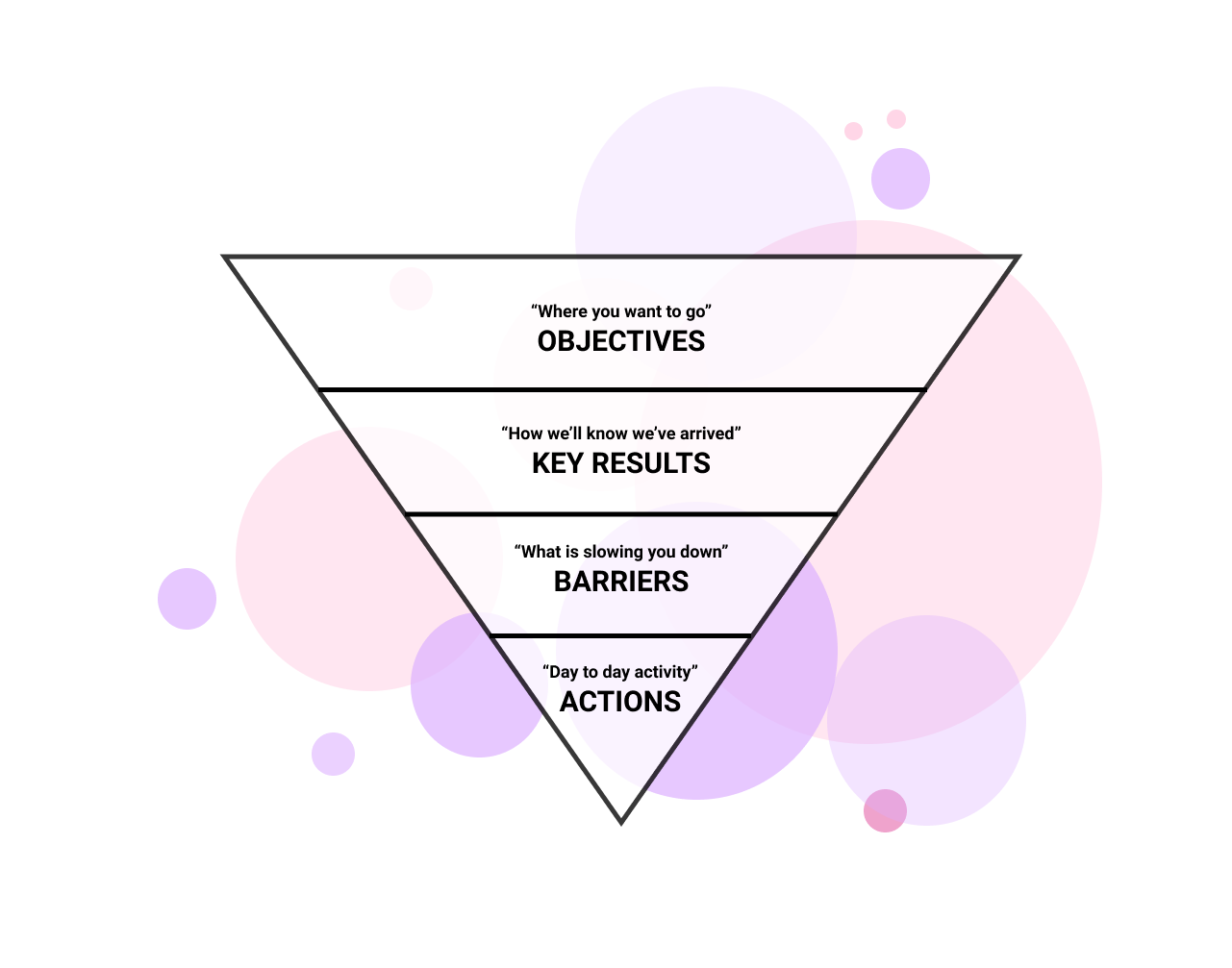
Balancing OKRs with the Basics: Keeping Growth and Brand Marketing on Track

Its been awhile since I've posted folks, sorry! While on a new journey and as I look back you know, I had this realization. It’s easy to get wrapped up in the shiny, new stuff like OKRs (Objectives and Key Results), but sometimes, we might end up spending so much time on them that we forget the basics—like keeping the trains running on time, or making sure the team has what they need to grow the business and build the brand.

Why OKRs Are Good, But…

  • Focus and Direction: OKRs are like that map on a road trip except for businesses. They help you know where you’re headed and make sure everyone’s car is pointed in the right direction. Without them, you might just end up driving in circles.
  • Accountability: They make it easy to see who’s doing what. Everyone knows their part, and you can quickly spot if something’s off track.

The Flip Side—When You’re Stuck in the OKR Weeds

  • Too Much Process, Not Enough Doing: If you spend all your time planning and tracking, there’s a chance you’re not doing enough actual work. It’s like planning the perfect garden but never getting around to planting the seeds.
  • Forgetting the Basics: Core business processes—like making sure the Growth and Brand Marketing teams are firing on all cylinders—might take a backseat. You still need to keep an eye on the day-to-day, like keeping operations smooth, ensuring customer service is top-notch, and steering the marketing ship in the right direction.

Steering the Growth and Brand Marketing Teams

  • Growth Management: Growth teams need a good bit of attention to keep the momentum going. It’s not just about setting ambitious though achievable goals—it’s about making sure they’ve got the tools, resources, and support to hit those targets.
  • Brand Marketing: Brand marketing is all about storytelling and building trust. While OKRs might tell you what needs to be done, it’s the brand folks who figure out how to say it in a way that resonates. They need to be closely guided and supported to ensure that the brand’s message stays consistent and strong.

Getting the Balance Right

  • Integrate OKRs with Business Processes: OKRs should work hand-in-hand with the day-to-day management. They’re not there to replace the basics but to enhance them. When done right, they should be pushing the business forward without pulling you away from essential tasks.
  • Keep It Simple: Don’t overcomplicate things. Focus on a few key objectives that really matter, and make sure the team isn’t drowning in process. Sometimes less is more.

Wrapping Up

OKRs are a great tool, no doubt. But like any tool, they’re only useful if you use them right. It’s important to keep things in balance—make sure the business processes, like steering the Growth and Brand Marketing teams, are getting the attention they need. After all, you can have the best goals in the world, but if the basics aren’t in place, those goals won’t mean much in the end.

Is there such a thing as Brand Response Marketing?

Whatever happened to #brand response #marketing? Or the idea that brand marketing actually does drive down funnel productivity, cost efficiencies and conversions? How about the taboo idea that performance marketing can actually create aided recall and awareness? The digitization of all things whether fully or minimally, I would say nowadays, everything is a brand experience, and everything is about performance.

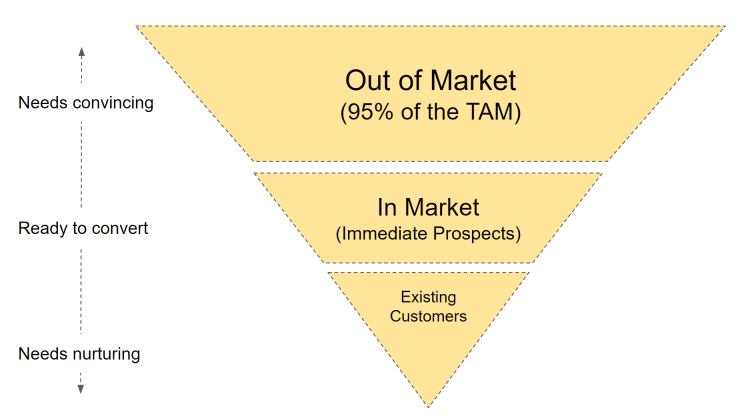
The reality is the funnel hasn't really changed right? At the very top, you've got the consumers that are "out of market" they just don't know they need you yet for various reasons, this is where 95% of your TAM resides and where brand marketing focuses on.

What about the folks who are ready to buy? Here performance marketing is the active tactic, it's easy to measure, aligned with sales goals and key business metrics.

Then you have your customers, the fickle to the loyal. These are the folks who are nurtured, hopefully appreciated and intertwined with our product development efforts.

Most of the time, these three tactics are not integrated, mostly siloed or indelibly operating somewhat independently. Is it idealistic to think that a business can balance and quarterback the three segments? I think so and this is where brand performance marketing comes into play for me.

So what is brand performance marketing?

Simply, it's the idea of integrating brand marketing with performance marketing. I see it as a holistic method to move consumer segments from, being "out of market" to being "in market" and finally bonding with the brand as existing customers. The classic approach has always seen brand, direct response and lifecycle marketing as three distinctly different functional capabilities. However, these old constructs can be susceptible to competitive pressures, are detrimental to achieving a cohesive experience for the consumer segments and of course sustaining the success gained when bad times come about. Disparate focus on the three segments creates a type of tunnel vision, particularly for large brands and a competitive edge for early and stage businesses during a economic downturn. There are ways to overcome this of course through better integration, processes, governance and frameworks. However, this only serves to further separate the business from the consumer.

How can we address these segments? Start with deconstructing your buyer's journey, nothing elaborate or scientific rather basic, just start at the very top. We have to build an architecture that works to convince consumers to want your product when they've been using/considering alternatives, then enabling them to find your product to eventually be converted into a customer. It doesn't end there, your competitors are persistently "conquesting" your prospects and customers. This means you have to continue to nurture them and adapt your product to address changing expectations.

All three segments (funnel screenshot) care about these four things

  1. Price - If I had a nickel for every brand that sees "price" as a number barrier, I'd be a gazillionaire. Level setting on price is so crucial, its the hardest thing to figure out. Pricing something too low presents a perception of low quality / cheapness and of course pricing something too high could harm your growth trajectory. A pricing strategy should be a consumer first process, know who they are and build from there, test and learn.
  2. Value - Does your product deliver the benefits and reasons to dole out the cost to buy your product? I always tell my family, somewhat jokingly, no-one ever pays MSRP for antivirus software. Have you? If you did, I want to know about it because that's when you value the cost of the product your purchasing. Its no longer a transaction, there's a clear need from the consumer point of view and they are fully bought into your brand's vision. Apple, Sony, Theragun (yes a DTC!) and there are many more out there.
  3. Trust - Are you a legitimate brand and is the product reliable to the degree that this person is willing to take leap, next step or continue to buy into your product's promise? This is so crucial, legitimacy is not going to come from your business, we have to earn this through surprise and delighting prospects and happy customers. I worked for a company that saw things differently, in fact quite the opposite and they are no longer around. This company persistently focused on sentiment management versus addressing the underlying issue which was a product that underperformed and always shorted them.
  4. Superiority - Are the features and functionality of the product above the rest? This is true for "affordable" products as well, think, Kia or Hyundai, right? Automotive brands that persistently remind us not only of the affordability of their cars but the high level of quality and workmanship that went into them. This helps the consumer rationalize the trade off and becomes invested in the brand.

Brand performance marketing can bring the three segments together. Philosophically, I don't believe there's should be a distinction between how each of the segment views a brand, interacts with the funnel designed to convert them and active use of the product.

I'd love to hear from my network, is brand performance marketing a thing? Should fuhgeddaboudit? Let me know and thanks for reading.

A possible maturity cycle of a business from “cradle to grave”

Interesting piece from Cory Doctorow published in Wired (Jan 23, 2023) on how "platforms die." The author's point of view straddles between the literal and metaphorical. The issues laid out in the article are mostly observational and qualitative, I don't disagree. However, the points brought up aren't unique to two-sided marketplaces.

A platform (think Amazon per the article) during its early stages.

1 - Needs users: so, it entices consumers with an incredible experience, service, and price/value. This isn't easy to accomplish, btw, there are plenty of startups and mature businesses that have failed to either a) find product market fit and/or b) keep up with customer expectations.

2 - Needs business customers: so as soon as the business gets to a chasm of customers and data, the ensuing value / insights entice businesses as they want in on the scale and growth potential by tapping into the customer base. Also, incredibly hard to do, business needs do vary and isn't necessarily always consistent. Google, used to have "don't be evil" in its corporate code of conduct which serves how everyone should Google's users. During the formation of Alphabet in 2015, tweaked it to "do the right thing" which shifted its motto to more of a user and business focus.

3 - Needs to answer to investors (board / shareholders). The pressure of profitability / returns requires businesses shift the value equation from one group (customers to businesses) to achieve this. This is where the rubber meets the road, the proverbial race to the bottom is necessary and sometimes painful, particularly for businesses who are too short term focused.

I oversimplified the article's points about the progression and maturity cycle of a business from "cradle to grave". There's a lot of good points contained in it. With data across a more diverse set of industries, business models and companies, the insights and learnings could be an interesting new way future founders, CEOs or growth leaders can find crucial inflection points and consider a more appropriate balance of the three stakeholders including employees first / foremost.

There are plenty of businesses that are thriving and are the antithesis of "enshitification" though, would love to the network to name a couple in comments or directly.

Here's the link to the Wired article.

https://www.wired.com/story/tiktok-platforms-cory-doctorow/

#chatgpt was not used to create this post, it'd likely put my post to shame!

#businessandmanagement #growth #data #insights #wired #google #amazon #startups #formation

ChatGPT a Google killer/ “something” killer or just a new Miscrosft word plugin?

ChatGPT - OpenAI

Is ChatGPT a Google killer/ "something" killer or just a new Miscrosft word plugin?

I see it as the latter, Google crawled, collected and collated information and matched folks to that information, better. For many that was an incredible improvement in user satisfaction over the likes of Excite/Infoseek/Yahoo and was enough to defer the user's own information retention and completely rely on Google. But fundamentally, the true value of Google was that it made a wealth of information produced by regular people more accessible and democratized knowledge.

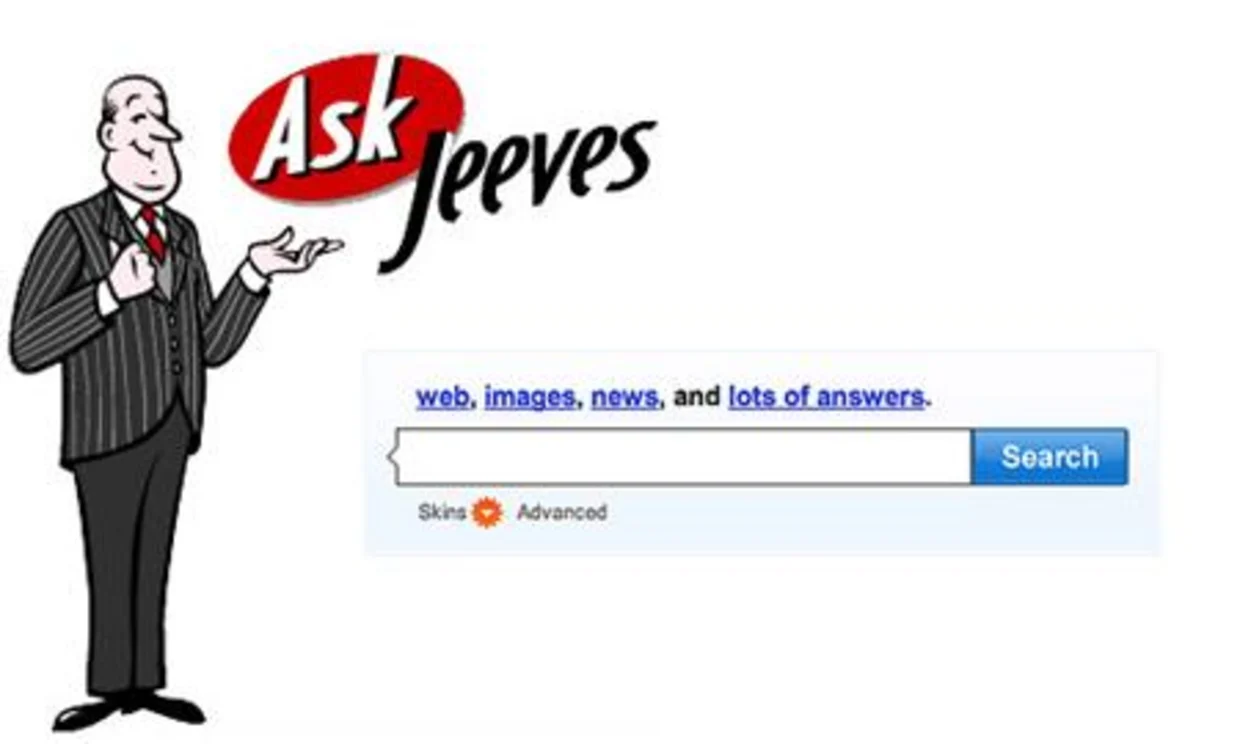
ChatGPT is definitely the next step in the information evolution / revolution but ultimately its a black box, its more like AskJeeves on steroids, the now defunct question oriented search engine, anyone remember that?

Jeeves, who is Martin Luther King Jr.?


ChatGPT takes away the knowledge gathering process all together and attempts to gather, synthesize and present a "point of view" based on the information it scours and the deduction of a user's query. ChatGPT is the "Zoltar Fortune Teller" killer or BS on steroids.

Seriously though, ChatGPT being the #Google killer will depend on how accessible it is to everyone and I have little doubt that #Microsoft is in the business of pure free, right now.

Having said all of the above, I have used ChatGPT to create numerous marketing headlines, optimized my site's titles/meta data, tweak descriptions/timelines for videos on my YouTube channels, had it write overlays for my personal TikTok/IG reels, and even write a poem.

Finally, I was disappointed that it didn't know me, when I asked who Cezanne Huq was. :-)

I'm a simple guy and I often miss the forest for the trees, please share your thoughts on ChatGPT!

Disclaimer: This post wasn't written by ChatGPT

#microsoft #chatgpt #openaichatgpt #artificialintelligence #knowledgesharing #ai #optimization

Image preview

What gives in OOH advertising spend?

2023 is nearly here, we are all returning to work and increasing business travel, I've been bombarded by (OOH) ads. Per, Wikipedia, "Out-of-home (OOHadvertising, also called outdoor advertisingoutdoor media, and out-of-home media, is advertising experienced outside of the home. This includes billboards, wallscapes, and posters seen while "on the go". It also includes place-based media seen in places such as convenience stores, medical centers, salons, and other brick-and-mortar venues. OOH advertising formats fall into four main categories: billboards, street furnituretransit, and alternative."

Looking at advertising spend in OOH, its intuitive that it should grow, particularly digital OOH (dOOH). Yet traditional OOH spend still accounts for an overwhelming 70.8% of total spend while dOOH still sits at ~30% (see link to Insider Intelligence for more data)

Furthermore, there's a ton of programmatic dOOH as well with dOOH expected to grow nearly 40% by 2026 (source: Out of Home Advertising Association of America), curious to hear from performance marketers and #DTC advertising leaders; is dOOH a focus in 2023 for you and beyond?

Some key concepts taking shape in 2023 within the general OOH space with dOOH making things more interesting

Storytelling - Not surprising but this is a general trend within the performance marketing trends. Advertisers will focus on how to bring a cohesive advertising campaign to life in a physical setting, understanding the audience segments tied to the placements for OOH.

Integration - OOH are beacons not just billboards made of print or digital LCD expressions. We'll see smart dOOH advertising tactics that geo-fence and target opted in consumers to take advantage of the experience in more vivid detail, whether it's the continuation of the story or activating an attractive offfer.

Measurement - Goes without saying but any good performance marketer or advertiser will bring in ways to understand sales lift direct or indirect to effectively measure the ROI and profitability of the dOOH campaign.

If dOOH is not part of your advertising strategy, why? If so, how? Which platforms are primed to support programmatic dOOH? Reply to me directly, would love to hear how your organization is handling DOOH in the coming months and years.

Here's the latest from Insider Intelligence, How OOH ad spend is evolving - Insider Intelligence Trends, Forecasts & Statistics

Amazon buys Whole Foods, boy times, they are a changing…the courtship of digital is ending

Why would Amazon buy Whole Foods? Ironically, the answer is in the name, Amazon. The amazon jungle is the life blood of the western hemisphere providing the ecosystem and environment to nourish over a billion in population and drives civilizations largest economies. According to Wikipedia, the Amazon represents over half of the planet's remaining rain-forests, and comprises the largest and most bio-diverse tract of tropical rain-forest in the world, with an estimated 390 billion individual trees divided into 16,000 species.
Furthermore, having worked with Amazon when they first launched, Jeff Bezos’ goal seemed to be to want to bring everything a consumer could possibly want instantaneously to any part of the globe. So, it’s not a surprise to me that Whole Foods would be part of the consideration having integrated Zappos, Audible, etc. What I like about this is that Amazon; versus Walmart or any other big etailer/retailer has an opportunity to revamp the village economy that’s been largely decimated and ignored by the chain retailers such as the Walmart’s and Kmart’s of the previous generation. What I mean is that, there will be shift to employee first and long-term strategy versus a shareholder driven short term view of profit and loss. This will help employees gain purchase power and drive the economies in their communities. What’s the state of retail and is there any benefit for brick and mortar shopping? Look, I don’t think we should see the world from a “zero-sum” game perspective. I’m not a retail expert but as a consumer myself, introspectively, I have seen a big shift in my own buying behavior. Looking back, I never thought I’d stop going to the produce markets to use Fresh Direct or Google Express, as an example. We also must be mindful that many of us consumers are in various transition stages. This means that there’s a role for physical spaces, the answer lies in defining your ideal customer, understanding how he/she’s purchase behavior is changing and what your business can do about. How Amazon integrates Whole Foods will shed more light into the convergence of digital and physical in real terms. When buying preference shifts more towards medium B versus medium A, and medium A has been the driving method for businesses to entice a transaction how should a business respond? The answer to this question is simple but the path to getting there in an organization seems to be well beyond a company’s reach. Assuming medium B is online shopping and medium A is physical retail purchasing then logic would dictate that organizations would build the necessary pathway from divesting from brick and mortar to mix shift to supporting online shopping. Yet we look across the spectrum of retail and while this isn’t new news, i.e. music stores closing due to the CD to mp3 shift or mom and pop shops disappearing due to large retail shops are just a few of the shifts that are similar in nature but every time we see a pivot in consumer behavior our career business professionals and leaders seem to miss the boat or wait too long until it’s too late. Businesses should have a strategy to address the changes in the marketplace and these changes are clear and present when you listen to consumers. This idea isn’t new, there are many businesses who have carefully followed the needs of their customers, they have succeeded, Intel or BestBuy come to mind. While others simply ignored the signs, or didn’t see the writing on the wall and are no longer around or solvent, Kodak or Kmart, etc. What's interesting is that, as a percentage of revenue, according to TheMotleyFool, Amazon spends more on advertising then Walmart, The Home Depot, Best Buy, Kroger, and Target combined. Do they know something we don't know? Or do they understand that part of doing business and competing requires investing into driving sales? And that this investment brings critical data and learnings that will help the business calibrate and course correct? A form of research and development in the digital era.
So how can a large retailer turn the tide through digital transformation? That’s a loaded question, and it’s important to note that it’s not about digital or physical, really. And you've people say, it's not a sprint its marathon, I say it's a triathlon but your organization has to be sure of what it is it needs to accomplish and be laser focused on accomplishing it. Most businesses are fully on the transformation journey, the problem lies in whether it’s the right one for them.  To understand that, it’s important to understand the organization’s wherewithal and capability from the vantage point of research, data, technology, legal, processes and talent. The underlying question will be whether you have the right mindset from the leadership and from the brick and mortar staff to facilitate any future change. If it's not a holistic approach then you're just slapping "lipstick on pig" and the underlying issues will engulf your business and you will cease to exist. With regards to research, this is a crucial first step and most businesses sit on a treasure trove of information. Ultimately it will rely upon a business’ core customers, asking the right questions and knowing who they are. Why are they your customers, what are there likes and dislikes, and what drives them to consider alternative products. I think the consumer packaged goods (CPG) industry does a phenomenal job at understanding a dimension of this but what I see a lot is research fails to address the consumer journey pieces of the qualitative puzzle. Data is another challenge for large companies, are you collecting the right data with regards to your business, end-to-end, who’s data should you use or trust, do you have a single source of truth and how is the data helping you make the right decisions or not? The research outputs should be able to allow for a gap analysis of your datasets, financial, product, marketing, sales and otherwise. The most puzzling of blockers I’ve encountered is, technology both IT and engineering. Yes, not surprising, it took a decade for organizations to realize that a Chief Marketing Officer (CMO) was investing more in technology than a Chief Technology Officer (CTO). On top of that, you have the pressure of advertising technology and how to tie all these platforms together. Each department, sales, finance, product, marketing and IT all look at their technology investments differently yet operationally and from a cost perspective it doesn’t make sense to do so. So, you have varying levels of maturity when it comes to technology deployment and the appetite for the business side to partner with technology departments from the get go to help bridge and solve problems together. Unfortunately, this is further led by strong Chief Executive Officer and other c-level opinions hence introducing barriers to a timely and frictionless solution. We’ve been here before, the question of whether legal is there to prevent or to protect. Many organizations are starting to look at this from both angles. Prevention is the equivalent of austerity, err on the side of caution. This mindset of course makes sense for certain business as usual situations. But what if you’re trying to address a new problem in the marketplace, a shift in consumer expectations or a new competitor entrant that’s pushing the envelope and their velocity of growth is staggeringly faster than yours? This is where I feel your legal counsel needs to be a critical partner in understanding the business requirements versus simply addressing the legalities of a decision. Furthermore, the legal team must be agile in its response to the needs of the business and market. How this is done is partnership and collaboration of course. Processes are absolutely the linchpin to all we’ve discussed so far. To put it simply, across the organization if making a decision is a three to six-month endeavor then leadership must look at how to accelerate the process, where are the gaps, what are the key blockers and how do we move more faster. I’m shocked that many organizations are still in a waterfall mindset, very linear in their thinking and sequential. Or there are pockets of lean startup but then other departments are operating in a different way. A process change should be defined and harmonized with inputs and alignment across all cross-functional departments. This will help large businesses move and shift to market and consumer demands more efficiently.
Finally, talent, the single most important opportunity for an organization to mine. Talent development should be seen through seeding, cultivating and building the acumen, both internal and external, required to solve the challenges the business faces. Whether it's digital, internet of things, or whatever new shift your business sees in the horizon. This is whether your technology department needs calibrate and train to understand marketing, advertising and other key aspects of your business supply chain. Do you have the right mechanisms, culture and leadership to enable curiosity and avoid complacency? I’m always afraid of becoming obsolete as a professional, shouldn’t a business’ staff and agencies feel the same way? If not what can the leadership do and provide to drive that mindset and talent transformation? Is Amazon looking at Whole Foods as a way to build and bring in new thinking and talent that is supporting a greater vision? Businessses shouldn't purchase using a one dimensional strategy, all angles, especially the impact to employees and talent are an important facet of the acquisition considertation.