
Category: Streaming

December 23, 2025

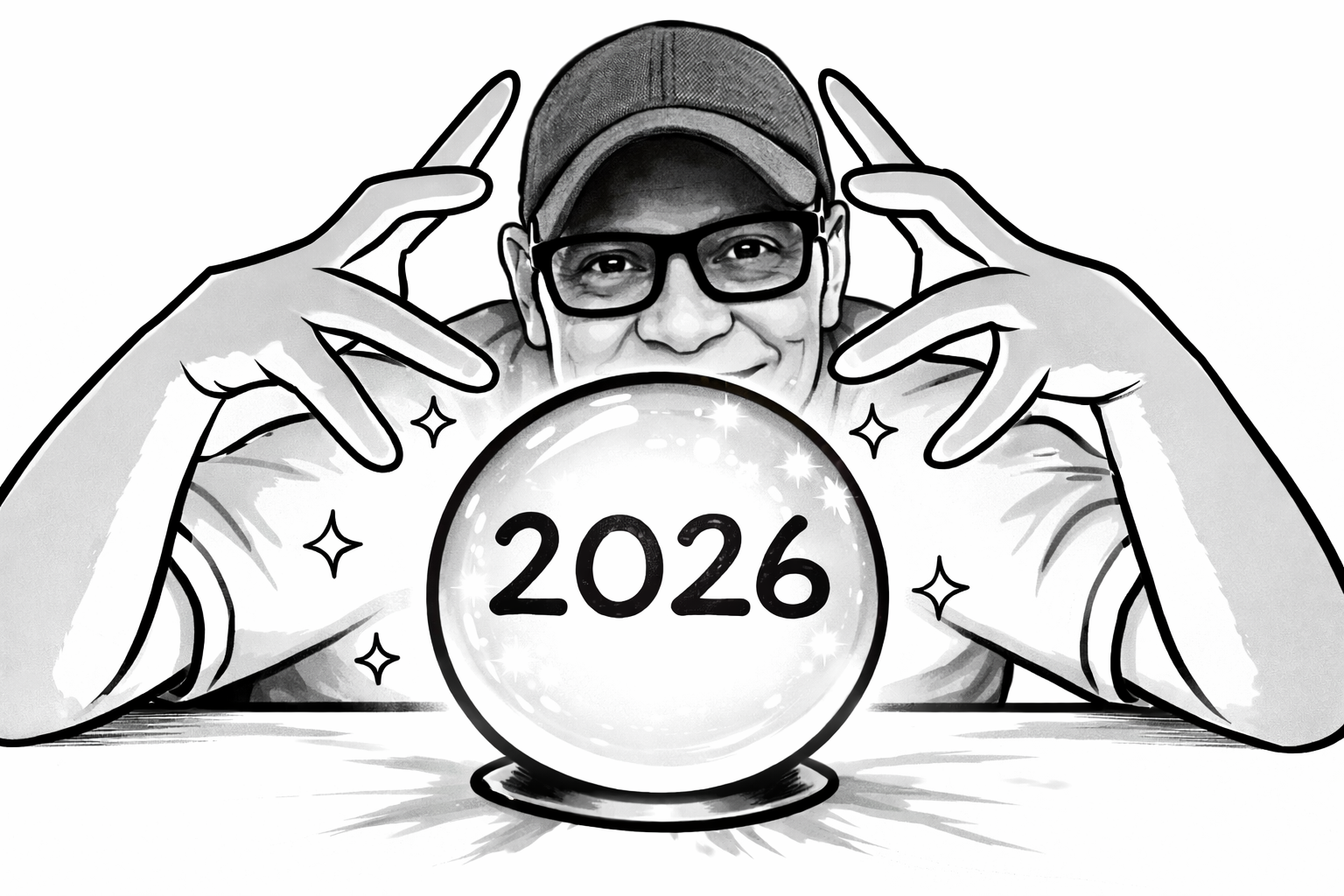
Cezanne with a crystal ball

Wow, the year is winding down, crazy! So, I’ll start with the obvious disclaimer.

I’m not Nostradamus. I’m not Mary Meeker. I don’t have a crystal ball or a 150-page trend deck.

And that’s kind of the point. The end of the year isn’t about being right. It’s about slowing down long enough to notice the patterns that already revealed themselves, then choosing what you want to carry forward with intention.

Consider this my entry into the 2026 predictions bandwagon. Not prophecy. Pattern recognition, grounded in the conversations, posts, and debates many of you engaged with me on throughout 2025.

  • First prediction: AI becomes the forcing mechanism for decision management. I’ve written repeatedly this year that AI didn’t fix growth, creative, or performance. It exposed operating debt. In posts about creative scale, agentic AI, and testing velocity, the same theme kept surfacing. Output exploded. Decisions slowed. Teams produced more answers than leaders could act on. The bottleneck wasn’t intelligence. It was decision ownership, kill criteria, and judgment. In 2026, AI won’t separate winners from losers. Decision systems will.
  • Second prediction: IRL experiences become the new brand storytelling strategy. My take on Netflix moving into physical experiences wasn’t about retail or merch. It was about lifecycle value and memory. I’ve argued all year that digital reach is commoditized and attribution undervalues emotional imprint. Netflix House isn’t a stunt. It’s infrastructure. A way to turn IP into identity and deepen attachment in a world of infinite content. In 2026, more digital-native brands will follow, not to scale faster, but to build meaning that compounds.
  • Third: Operators are the new strategists. Some of the most personal engagement I saw came from posts about teams being treated as service layers instead of strategic partners. This wasn’t venting. It was diagnosis. Strategy without operating literacy collapses under pressure. In 2026, the most credible strategists will be operators. People who’ve built systems, owned outcomes, and made tradeoffs with real consequences. Decks won’t carry weight. Scar tissue will.
  • Fourth: Durability will be the new business currency. Affiliate debates, discounting, post-purchase suppression, CAC obsession. Different posts, same conclusion. Efficient growth often destroys long-term value. I’ve been consistent in arguing that retention, contribution margin, and lifetime value matter more than short-term optics. In 2026, durability stops being a finance concern and becomes a leadership mandate. Businesses that don’t compound will quietly decay.
  • Fifth, MMM and incrementality become do-or-die for marketing. If there’s one topic we turn to relentlessly, it’s this. Attribution certainty is a myth. MMM doesn’t track everything people want it to, but it forces honesty about causation. Performance teams that can’t operate under probabilistic truth will overspend and misallocate. In 2026, incrementality won’t be a nice-to-have. It will be existential.

If you connect all of this, the takeaway isn’t about tools, tactics, or trends.

It’s about maturity. 2026 rewards leaders who can decide under uncertainty.

Who design systems before buying software.

Who protect taste while scaling output.

Who optimize for compounding value instead of quarterly applause.

And with that, the most important part of this post. Everyone needs rest.

Replenishment.

Perspective.

Focus.

So wherever you are, and whatever you celebrate, I genuinely hope you unplug, reset, and start the new year with clarity.

Have an awesome Christmas. A meaningful Hanukkah. A joyful Kwanzaa.

And here’s to a 2026 defined less by noise and more by intention.

Onward.
Read More

OTT Plot Twist No One Saw Coming: Consolidation at the Top, Price Drops at the Bottom

Fubo logo

Members Only Podcast

Please log in or subscribe to listen.

The streaming landscape has spent the last five years marching toward one inevitable destination, consolidation. The Netflix acquisition of Warner Bros is exactly the kind of seismic event everyone expected. The biggest platforms keep getting bigger, rights keep clustering, and consumers keep getting pushed toward fewer choices at higher prices.

But the wild card in this story is coming from a surprising player: Fubo, the scrappy, sports-centric vMVPD that just made the rarest move in modern streaming history. While the giants tighten their grip and prepare the market for price hikes, Fubo is lowering its prices.

And that tension, consolidation at the top, deflation from one of the smallest players, and consumers caught in the middle, is the real tectonic shift worth paying attention to.

Netflix + Warner Bros: The Gravity Well Gets Stronger

Every major streaming consolidation has followed a familiar pattern. Content libraries merge, duplicative orgs get cut, bundles expand, and subscription prices adjust upward under the logic of added value.

Netflix absorbing Warner Bros pulls a massive amount of premium IP into one gravitational center. On its face, this is great for libraries and long-term platform defensibility. But it also creates a structural expectation that your subscription is about to get more expensive.

Higher production costs, deeper portfolios, and increased bargaining power all point in the same direction. This move rewires the competitive field around super-aggregators. Netflix is building a position where it becomes the cable company of the next decade: must have, must carry, and priced accordingly.

In other words, consolidation is the throttle. The price is the release valve.

Fubo: The Contrarian Move in a Market Built on Increases

While Netflix shifts into empire-building mode, Fubo is sprinting in the opposite direction, slashing monthly prices by up to 14.8 percent across major plans starting January 2026 .

Let’s pause there because no one in streaming lowers prices anymore.

Platforms introduce ad tiers, charge extra for 4K, unbundle features that used to be free, or raise the base plan and call it content reinvestment. Lowering prices is almost unheard of.

But Fubo isn’t acting irrationally. It’s acting with urgency.

With NBCUniversal channels blacked out due to a dispute over carriage and bundling fees, Fubo demonstrated two things:

1. Structural pressure on content costs is breaking the vMVPD model.

Fubo accused NBCU of using legacy cable bundling tactics that force small distributors to pay for expensive channels they don’t want simply to access the channels they do need .

This is the oldest fight in pay TV history and streaming hasn’t solved it.

2. Fubo needed to do something bold to keep subscribers from fleeing.

Losing NBC, Telemundo, CNBC, Bravo, and multiple RSNs is catastrophic for a sports-driven platform. Instead of pretending nothing was wrong, they passed value back to subscribers, something consumers have been asking the industry to do for years.

And just as important, the lower price point puts pressure on NBCU during negotiations. When the smaller player undercuts the marketplace, it flips the leverage table.

The Reality Behind the Curtain: Fubo Is Fighting for Its Life

If we zoom out, this isn’t just a pricing story. It’s a survivability story.

According to investor analyses, Fubo’s revenue dropped for a second straight quarter, ARPU declined, and the company’s cash burn continues to deepen. Its long-term outlook is increasingly tied to its merger with Hulu + Live TV, where its influence could be limited inside a far larger bundle ecosystem .

This is the classic innovator’s dilemma. Fubo has built genuinely differentiated ad products, including programmatic pause ads with Magnite’s ClearLine that drive 33 percent better engagement than standard video ads, a rare bright spot for the company .

But the business model reality is unforgiving. Content costs rise. Ad ARPU falls. Competition consolidates.

Price cuts are the right move for subscribers, but they also signal that Fubo knows the next phase of the market will be shaped entirely by the giants.

The New Streaming Equation: Power Accumulates, Prices Escalate, and Outliers React

Netflix’s acquisition accelerates the inevitable. The OTT future looks a lot like the cable ecosystem we thought we were escaping.

Fewer distributors. Larger bundles. Narrower differentiation.
More negotiations happening behind closed doors.
Consumers paying for decisions made in rooms they’ll never see.

Meanwhile, Fubo is essentially running an experiment on the industry. They’re asking a provocative question.

What if the market is so price-saturated that differentiation must come through reduction instead of expansion?

This matters. It is the first meaningful price contraction from a major streaming player in years. If it works, others may follow. If it doesn’t, consolidation will accelerate even faster.

My Take

Consolidation always comes with hidden taxes. It simplifies the ecosystem while simultaneously raising the floor on what premium access costs. The Netflix and Warner Bros deal is the clearest sign yet that we’re entering the next era of streaming, one where power pools at the top and competitive pressure pushes everyone else to experiment or evaporate.

Fubo lowering prices isn’t a footnote. It’s the counter-narrative.
A real-time market correction wrapped in a defensive maneuver.
And potentially the opening for a new consumer segment that wants sports, news, and live TV without yearly inflation.

The OTT market is rebalancing.
And for the first time in a long time, the story isn’t just about how high prices can go.
It’s also about who is willing to push them back down.

Sources

Pew Research Center. Streaming usage by adults and demographic penetration.
Deloitte. Number of services per household and average monthly spend.
USA Today. Market share, cable retention and analysis of the Netflix and WBD merger.
Comments by Representative Darrell Issa regarding antitrust concerns.
Statements by Bank of America analyst Jessica Reif Ehrlich on the industry impact of Warner Bros. Discovery.

Welcome Back

Close Window

Sign Out?

Are you sure you want to log out?